JAVAKHK DURING THE ANCIENT PERIOD AND IN THE MIDDLE AGES
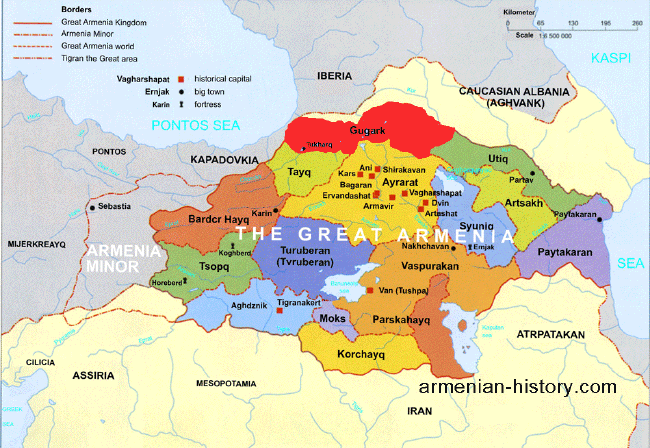
Gugark (Գուգարք) – was the thirteenth of the fifteen provinces of Metz Hayk (Armenia Maior) Kingdom of Historical Armenia. It occupied the northern part of the Armenian Highland and bordered on Utik in the east, Tayk in the west, Ayrarat in the south, and Iberia (Georgia) in the north. Gugark, that represented one of the four vitaxates (bdeshkh, բդեշխություն) of the Armenian Kingdom, enjoyed certain independence, its administrative center being the town of Tsurtav. Its nine principal districts were Dzoropor, Koghbopor, Tzobopor, Tashir, Treghk, Kangark, Kgharjk, Verin (upper) Javakhk (Ջավախք) and Artahan (Ardahan, Արդահան).
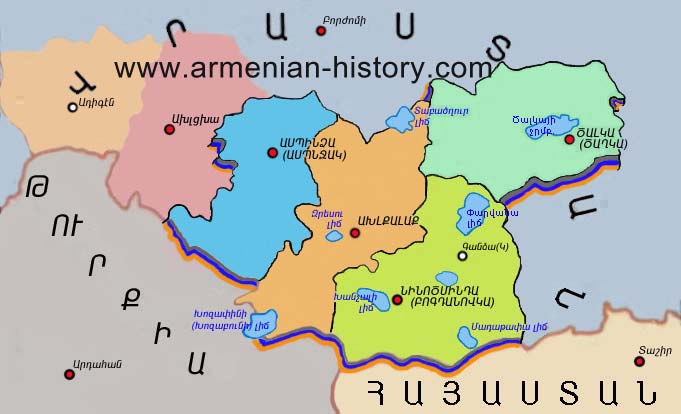
As attested by the Urartian (kingdom of Van) inscriptions of the late 9th century B.C., the name of “Javakhk” is an altered version of the name of “Zabakha” a state located in the northern part of the Armenian Highland. In the course of time, this Armenian toponym underwent the following phonetic transformations: Zabakha-Jabakha-Javakhk1.

The available sources treating the period of the Orontid (Yervanduni) Kingdom (6th to 2nd centuries B.C.) contain almost no records with direct reference to Javakhk. Mention can be made of only two notable references found in the History of the Armenians by Moses Khorenatsi (Մովսես Խորենացի) and Kartlis Tskhovreba. The great Armenian Historian writes that Vagharshak I bequeathed “…half of Chavakh…” to Gushar, descended from the sons of Sharay, and appointed him bdeshkh (vitaxa, բդեշխ) of the province so that he would defend the Armenian land against the North Caucasian Highlanders.

Greek historian Srabo, who bears witness to the recapture of the aforementioned territories from the Georgians, writes that in the 2nd century B.C., Armenian King Artashes (Artaxiad) I (189 to 160 B.C.) returned Gugark, from the Iberians and made it part of his country together with other lands.
The period of the Araxiad (Artashesyan) (189 B.C. to 1 A.D) and Arshakid (66 to 428 A.D.) Dynasties is very poor in any mention of Javakhk. Information about the district can be obtained only in records relatind to the whole province of Gugark. The latter kept its position as the northern defense province of Metz Hayk until the fall of the Arshakids in 428 A.D. It was not separated from the territory of the Armenian kingdom even in the first half of the 1st century A.D (1 to 52), when the Armenian throne was also occupied by the Georgians among other foreigners.
It is Notable in the early 4th century, when Armenia (301 A.D.) and Georgia (320 to 330s A.D.) were being converted to Christianity, Gugark, along with Javakhk, retained its importance as one of the strongest vitaxates of the Armenian kingdom. Its governoer, the vitaxa, who was called “the other vitaa,” enjoyed a special position and particular influence in the Armenian Royal Court. He was one of the 16 noblemen who were chosen by Trdat III the Great to escort St. Gregory, the future first Armenian Catholicos, to Caesarea, where he was to be ordained. The vitaxa had his vassals.
After the partition of Armenia in 387. the Arshakids’ influence over Gugark and Javakhk considerably weakened. After collapse of the Armenian Arshakid Kingdom in 428, these territories were annexed to the Georgian state, which was a subject of the Sassanid Kingdom of Persia (Iran). Although Georgia represented a simple marzpanutyun, it was still considered a vitaxate.
After the fall of the Arshakid Dynasty, the Armenian Apostolic Church retained its influence over Georgia, despite the fact that the latter was attempting to acquire certain independence.
The District of Javakhk is again mentioned in the mid-7th century in connection with the Arab invasions. Contemporary historian Hovhan Mamikonian writes in “The History of Taron” that Arab commander “…Abdrahim led his army though Hayk, Basen, Virk, Javakhk and Vanand, where he collected taxes and returned to Arabia.”
Javakhk suffered the Arab domination for nearly a century, until the early part of the 9th century.
The circumstances of Javakhk’s Liberation were as follows: after Nerseh Kamsarakan’s murder (785A.D.), Prince Ashot Bagratid, who had committed himself to the restitution of the Armenian territories from the Arabs, purchased Arsharunik and Shirak from the prince’s descendants and thus approached the borders of Javakhk. In the early 9th century, while escaping the pursuit of Arab commander Khalil, who had invaded Georgia, the troops of Ashot Kyurapaghat reached Lake Parvana. The enemy army, that soon arrived there, suffered a total defeat by Ashot’s troops. This means that after the victory won at the battle of Parvana, Javakhk presumably became part of the territories of the Armenian Bagratids
Between the 70s and 80s of the 10th century, most of the province of Gugark constituted part of Lori or Kyurikian (Gugark, Dzoraget) Armenian Kingdom, while Verin Javakhk and, particularly, Gogshen i.e. its southern part, remained under the Armenian Bagratid’s influence for some time.
fortress_in_AkhalkalakIn the early 11th century, the Georgian Bagratids commenced founding defensive installations in Javakhk in order to strengthen their positions there. Bagrat III built and fortified a settlement which was called Nor Kaghak (New City), the name being equivalent to the Georgian word ‘akhalkalak’ (‘akhali’ is the Georgian equivalent for ‘new’, and ‘kalaki’ is that for ‘city’).
In 1064 Armenia and Georgia were subjected to the Seljuk Incursions. Sultan Alp-Aslan occupied Akhalkalak amongst other Transcaucasian cities.
Sharing the fate of the other districts, Javakhk suffered the domination of different rulers throughout the 12th century. In August 1175, the troops of Yeldkuz, the sultan-atabek of Gandzak, raided Javakhk and Treghk. Georgi III (1156 to 1184) escaped confrontation and did not repel the advancing Selkjuk army. Having destroyed Ani and Shirak, Yeldkuz “… similarly devastated Akhalkaghak and Javakhet and returned to Dvin, where he and many of his high ranking people died.” As testified by the historian of Queen Thamara (1184 to 1213), it was only in the late 12th century that the territory extending from Javakhk to Sper was subjected to Georgian dominion thanks to the victory the brothers Zakare and Ivane Zakarian had won against the Seljuks. The territories which had released from Seljuks, Georgian court gave to the Armenian Zakarians, who established their own principality
In the mid-’20s of the 13th century, Javakhk was raided by Jalal ad-Din, a Central Asian rular, whose invasions where followed by those of the Mongols in the ’30s. However, the Zakarians retained their autonomy in several districts, including Javakhk. In 1245, by new administrative partition, Javakhk was left to the Tori people under the control of the Mongols. In 1266, taking advantage of the conflict between the Georgian kings and the Mongols, Sargis Jaghetsy, the master of the fort of Tmuk, established the large prinicipality of Samtskhe, which covered the territory from Tashir to Erzrum, including Javakhk. The prince of the region bore the title of Atabek, his principality being called Saatabago, i. e. ‘Subject to Atabek.’ In Armenian sources, it is known as Ishkhanats Yerkir (Land of Princes).
Many researchers who consider the Meskh tribe of Samtskhe an Armeno-Kartvelian, or purely Armenian ethnic group, veiw the foundation of the principality as “a manifestation of the Meskhetians’ willfulness.” i.e. a formation of a state on the basis of naional identity This principality, set up in the north and northwest of Armenia, mainly consisted of Armenians. Until the early 14th century, it paid a certain amount of taxes to the Mongols. From the 14th until 15th centuries, the principality struggled against Kartli, Timur, and his successors, i.e. the Timurians, as well as the Turkoman Koyunlu tribes. It maintained its independence until 1535.. The political center of Armenian Samtskhe-Javakhk principality was moved from Tmpgapert to Akhaltskha, in Nerkin Javakhk (often quoted as Samtskhe, diverting from the word “Somekh”, that is country of the ‘Somekhs’, which means Armenian in the Georgian language!).
The Samtskhe-Javakhk had to face many Persian or Ottoman invasions, but managed to keep its independance. It’s one of these episodes that is related in the famous work of Hovhannes Tumanian, “The Capture of Tmpgapert”.
In 1535 Kings Bagrat III of Imeret and Luarsab I of Kartli, with the assistance of the ruler of Guria, defeated the troops of the atabek of Samtshke near Murjakhet Village of Javakhk and occupied Akhalkalak and Akhaltskha. In this way these cities and the adjacent territories temporarily shifted into the control of Imeret.
In 1545 the Ottoman Turks conquered the region and appointed Kaykhosro, probably a descendant of one of the loacl princely families, as Governor of the subjected territories. Two years later, in 1547 assisted by Turkey’s archenemy, the Persian Safavids, he revolted against the Ottomans and gained independence. In 1549 the large Turkish army succeeded in suppressing the rebellion after a bloody struggle that lasted one and a half months. In 1555 Turkey and Persia signed an armistice according to which Javakhk passed to Persia, and Samtskhe to the Ottoman Empire. In 1578 the Turko-Persian war was resumed, and the Turks again invaded Samtskhe and Javakhk.
In 1639, by the armistice of Kasr-e-Shirin signed between the Ottoman Empire and Persia, the Turks forcibly put entire Western Armenia, Akhaltskha, and Akhalkalak under their control. As early as the 17th century. Akhaltskha and Akhalkalak had been part of the newly-established vilayet of Cheldr (later Akhalstkha). The territory of Historical Javakhk was partitioned into several self-governing districts having the status of liva-janjaks. This marked the beginning of a long and dreadful period of Turkish domination in the region.
Throughout the 17-th to 18th centuries, as a result of emigration, mass slaughters, forced conversion to Islam, and the penetration of Turkish speaking ethnic elements, the number of Muslims consideralby increased both in the entire province of Akhaltskha and the districts of Javakhk (they were known by the collective geographical name of Meskhetian).
The “Big Daftar of Gurjistan” (The Big Register of Georgia), is in fact an internal fiscal document of the Ottoman administration, where are mentioned all the cities and towns of the “Georgian provinces” incorporated in the empire, spread from Adjaria to Artvin, from Ardahan to Javakhk. … (The word Armenia being banned in Ottoman Turkey). In this register are mentioned not only the towns, but equally the name of the ‘Res’ of the towns, the number of homes, the amount of the sums to collect, and the religion of the towns, that is their ethnic membership.
The study of this register shows, that before the big slaughters perpetrated by the Turks in 1827-28, the population in Javakhk was in a very wide proportion still Armenian, faithful to the Armenian Apostolic church, and was subordinated to the Arshbishop of Garin (Karin) (Erzeroum), himself under the authority of the Katolikos of Etchmiadzine. The document shows that the Mtshkhetian Turks are mostly installed in the town of Akhaltskha and its surroundings. That there were some Kurdish nomadic tribes too, in the valley of the Kour river, and some Greek orthodox communities essentially on the shores of the Kour and West of Akhaltskha, just like the presence of an important Jewish community in Akhaltskha,…. and finally that there were some Georgian families around Borjom and represented an infirm minority in Akhaltskha city! This turkish document is an undeniable proof that there was no Georgian presence in Verin Javakhk, and only some rare communities in Nerkin Javakhk …2
Then came the Russo-Turkish war of 1827- 28, when occurred the rebellion of the Armenian populations, facilitating the liberation of Armenia by the troops of the Russian Tzar. At this date, virtually the whole of the Erkir is liberated, the Russians capturing Garin (Erzeroum) and attaining the Euphratus.
REFERENCES
1 Ashot Melkonyan, “Javakhk in the 19th Century and the 1st quarter of the 20th century”, Yerevan 2007
2 djavakhk.com