About Mohammed and Rise of the Caliphate
Since the earliest ages, numerous and varied tribes had been scattered over the vast area of the Arabian peninsula, breeding their own camels and wandering from place to place. Only a small number of the Arab tribesmen had settled permanently on the western edge of the peninsula and engaged in agriculture and trade.

From the fourth century A.D., the city of Mecca had been a center of commerce. Foodstuffs and manufactured goods were imported there from the Byzantine and Persian domains, while precious stones, gold, odoriferous oils, tropical fruits and frankincense, all Arabian products, were exported, particularly from Yemen. Arabian cities and villages which had suffered much from the irruption of Persian and Abyssinian hordes also felt the destructive effects of the wars between Persia and Byzantium in the early centuries of the Christian Era.
In the seventh century the opportunity came for the wealthy Arab chieftains to correct this situation by uniting their forces. The element that gave the victim cohesion was the religion of Islam which had just been founded by Mohammed. Born in Mecca about 570, Mohammed’s life was undistinguished until he reached forty. He then, as the result of an alleged vision, launched his cult, which he called the True Religion, epitomized in one sentence, “There is no God but God, and Mohammed is his Prophet.” Despite some vicissitudes, his following steadily increased. Eventually he headed an army and conquered southwestern Arabia, including Mecca, which he entered in triumph in 630, and made it thereafter the holy city of Islam. He sent messages to the monarchs of Byzantium and Persia, demanding their recognition of his religion and suzerainty.
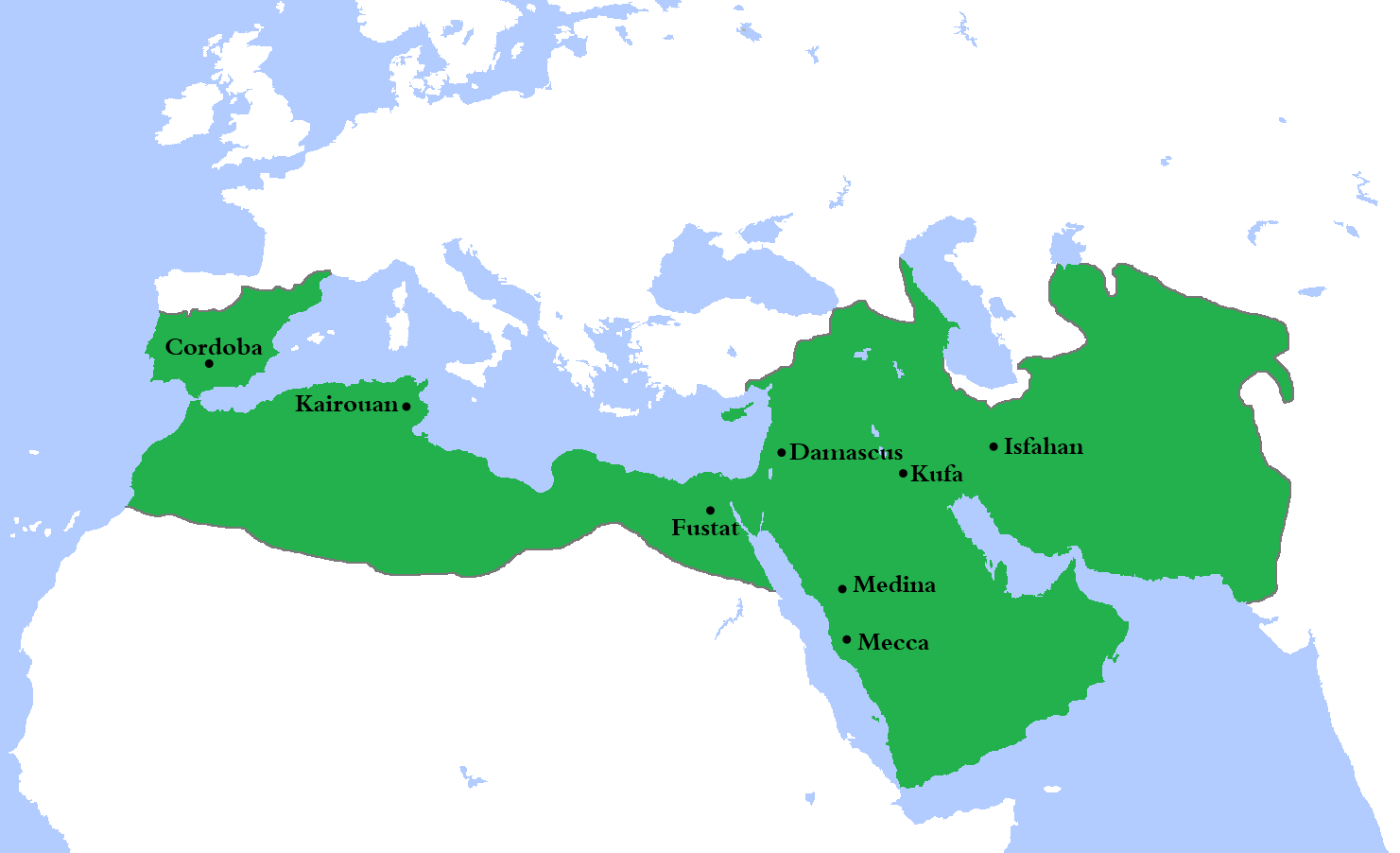
Mohammed died in 632 and was succeeded by Abubekr, with the title Khalifa, i.e., “Successor or Vicar of the Prophet.” He soon declared a “Holy War,” wild horsemen being charged not only to spread the true religion, but to conquer and loot rich nations and cities for the aggrandizement of Islam. Within ten years the Arabs became masters of Syria, Palestine, Phoenicia, Mesopotamia and Egypt. Then they surged eastward across Afghanistan, Turkestan and Baluchistan to the very borders of India. Even the mighty Persian Empire succumbed to their fury. In three wars the armies of Yazdegert III were dispersed, Ctesiphon was sacked (in 637) and the books of the Royal Library were thrown into the Tigris. To the west the Arabs subdued all North Africa — Tripoli, Tunisia, Algeria, Morocco and Barbary — and even crossed the Mediterranean to take over Spain in 713. By the middle of the eighth century, they had conquered an empire as large as that of Rome had once been, stretching from India to the Atlantic Ocean. The great Khalifa might have swept his gaze over it and boasted, like Augustus Caesar, that he ruled the universe.
First Arab invasion
Towards 639, under the leadership of Abd‑er‑Rahman, 18,000 Arabs penetrated the district of Taron and the region of the Lake of Van and put the country to fire and sword. Now for the first time on the battlefield the Armenians met these warriors — poor, ill-called, ill-armed, but recklessly brave and inflamed with an intense fanaticism until then unknown among ancient peoples. Persians and Romans had something to gain by tactful treatment of the Armenians, alternately their subjects and their allies. But these children of the desert knew no political expediency, nothing to curb their severity in dealing with “infidels.”
Bishop Sebeos, an eye-witness and the only historian to record the story of the Arab conquest, writes with bitter lamentation (in his History of Heraclius) of the sad fate of his country. On January 6th, 642, the Arabs stormed and took the city of Douin, slaughtered 12,000 of its inhabitants and carried 35,000 into slavery.
Horrors of the conquest
“Who can tell,” says the Bishop, “the horrors of the invasion of the Ishmaelite, who set both the land and the sea ablaze? . . . The blessed Daniel foresaw and foretold like misfortunes. . . . In the following year (643), the Ishmaelite army crossed to Atrpatakan and was divided into three corps. One moved towards Ararat; another into the territory of Sephakan Gound, the third into the land of Alans. Those who invaded the domain of the Sephakan Gound spread over it, destroying, plundering and taking prisoners. Thence they marched together to Erevan, where they attacked the fortress, but were unable to capture it.”
Constans II, then Emperor in Constantinople, sent occasional reinforcements to Armenia, but they were inadequate. The commander of the city of Douin, Sembat, confronted by the unpleasant fact that he could no longer hold out against the Ishmaelite horde, submitted to the Khalifa Omar, consenting to pay him tribute. Sembat was soon replaced by the Mohammedan Othman (644).
“The Arabian army which was in Ararat,” continues Sebeos, “penetrated into the territories of Taiq, Georgia and Albania, seizing captives and booty. Thence it marched to Nakhjavan . . . but could not reduce the city. However, it took the fort of Khram, slaughtered the garrison and carried the women and children into captivity.”
Emperor compels Armenian loyalty
The first Arab governor of Tiflis was installed in 646. The Byzantine government dared not permit the Arabs to establish themselves as a threat on the plateau of Erzerum. But Constans II, incensed against the Armenians, resolved to recapture their country by force and compel them to accept the Greek brand of Christianity, fatuously hoping thus to bind them more tightly to the Empire. He did not succeed in his doctrinal objective, but the new Armenian prefect, Hamazasp, who regarded the taxes imposed by the Moslems as too heavy, yielded to the Emperor. Khalifa Othman, in retaliation, ordered the massacre of 1,775 Armenian hostages then in his hands, and was about to march against the Armenian rebels when he was assassinated by his own soldiers in 656.
His second successor, Moawiyah, Khalifa of Baghdad (661‑680), resumed Othman’s projects, devastated Armenia and retook it from the Emperor, who called upon the unfortunate Armenian people to yield him obedience again.
Armenian retort to Emperor
“How many times,” retorted the Armenians, “while submitting to the government of the Greeks, we have received only trifling aid from it, even during our worst calamities! On the contrary, our submission has often been rewarded only with insults! To take the oath of loyalty to you means to expose ourselves destruction and death. Leave us, therefore, under the domination of our present masters, who accord us their protection.”
This answer naturally did not please the Basileus. He dispatched an army which ravaged Armenia, carried away what little wealth the Arab conquerors had overlooked and took away 8,000 Armenian families to be sold as slaves far from their homeland.
Armenia ravaged by Greeks and Arabs
The Arabs suspecting that the Armenians were restive under their rule, once more overran and laid waste the Ararat province, razed many cities, spread death and desolation, and demolishing the island fortress of the Lake of Sevan, condemned its defenders to slavery. Justinian II, on the other hand, relentlessly continued his endeavors to force the Armenians to accept the Orthodox creed, and in pursuance of this missionary work, ordered his troops to ravage Upper Armenia, Iberia and Albania, which had been compelled to yield to the power of the Khalifas. Thus the Armenians were persecuted by the Moslems because of their Christianity and by the Byzantine Greeks because of mere differences in creed.
Byzantine intolerance
“The Byzantine court at that time, says Jacques de Morgan, “exhibited the spectacle of a most ferocious religious intolerance; a fierce hatred stirred the Greeks against those peoples who did not have the same beliefs as they did. . . . These passions and the futile wrangling resulting therefrom weakened the Empire; but the Emperors, like the people, had been blinded by the subtleties of casuistry, of sophistical reasoning, while menacing armies pressed hard upon all the frontiers.”
But the Greek domination in Armenia did not continue long. The Basileus, after five years of odious exactions, called his legions home, and Abd‑el‑Melek, the Omayyad Khalifa, again overran the country, occupied the city of Douin, ousted the Greek prefect and appointed as Governor one Abd‑Allah, a cruel master who sent the most prominent Armenians in captivity to Damascus. Among them were the Katholikos Sahak and Prince Sembat. The latter, having succeeded in escaping, was appointed to the leadership of Armenia by Leontius, the new Byzantine Emperor in 695.
Reign of Terror
In 702 the Emir Mohammed bin Merwan, the Governor of Mesopotamia, Assyria had been driven away by the Greek legions. But soon after the withdrawal of the latter, the Emir regained his authority and tightened his grip by terrorizing the inhabitants. In Nakhjevan, Armenia, he locked up many prominent persons in the church, and setting fire to the edifice, burned them alive. Meanwhile, Byzantine statesmen were debating questions of dogma with the Armenian clergy! Synodic meetings were being held to decide whether or not it would be proper to mix water with wine in the celebration of the mass, or to add to the trisagion the words, “who has been crucified.”
Theology was not, of course, the only preoccupation of Armenians. The higher clergy, with the Katholikos at their head, also meddled in politics. They sought to appease their Moslem masters by demonstrating their ritual divergence from the Greeks.
The struggle between the Greeks and the Arabs had increased Mohammedan power, and therefore their contempt for all other peoples who did not adopt their faith. Bishop Sebeos has left to us the Armenian translation of a letter which “the King of the Ishmaelites” sent to “the Emperor of the Greeks.” The Moslem monarch wrote:—
Contemptuous Letter to the Emperor
| “If you wish to live in peace, renounce your vain religion. . . . Abjure this Jesus and turn to the great God whom I serve, the God of our Father Abraham. Disband the multitude of your troops and dismiss them to their countries, and I will make you a great chief in those lands. I will send Osticans (military governors) to your city. I will search for all treasures and divide them into four parts; three for me, one you. Also, I will give you soldiers, as many as you may want, and levy on you such tribute as you can pay. Otherwise, how could that Jesus, whom you call Christ, who was unable to save himself from the Jews, deliver you from my hands?” |
A bitter insult, indeed, to the ancient Empire, where no longer did any sense of national honor seem to stir the souls of the people. Bishop Sebeos further reveals the Emperor’s fear that there was little he could do about the situation. He says that the Emperor entered into the House of God, prostrated himself with his face to the ground and prayed abjectly aid and for confusion and destruction to the Moslem enemies. He doffed his purple and his crown, put on sackcloth, sat on ashes and ordered the proclamation of a fast in Constantinople.
The Arabs had first penetrated into southern Armenia in 639. Their earlier efforts were not attended with great success, but they soon overran most of the country, and the Armenians were compelled to recognize the authority of the Khalifa in 652. Thirty years later the Greek Emperor Justinian II made war on the Moslems, but his enterprise was short-lived, and Armenia was again abandoned to the Khalifas.
Christianity uprooted in Transcaucasia
After conquering Armenia proper, the Arabs held Georgia and occupied Tiflis. The Armenian provinces of Taiq, Gougarq, and the basin of the Phasis River were under Byzantine rule, as were the northern part of Asia Minor, Lazistan and the littoral of Euxine-Pontus (Black Sea). The capital of Georgia became thenceforth the government seat of the northern provinces of the Khalifas, and the people of these regions, unable to resist, were for the most part “converted” to Islamism. Among them were Armenian and Georgian princes, clinging to their domains. Thus Christianity almost disappeared in Transcaucasia, excepting in the mountains and inaccessible places. Churches and monasteries were demolished, mosques and minarets erected in all the cities and towns.
However, some Armenians and Caucasians, taking refuge in natural citadels and on mountains in the vicinity of the Rion River, clung to their Christian faith and hoped for a counter-offensive. They made frequent sorties upon the Arabs, with occasional successes, but their descendants had to wait long before they could reconquer their land. In the mountainous regions extending from the north side of the Arax River towards Ispir, Kars and Artwin, many castles of Armenian seigniors were perched like eagles’ nests on well-nigh inaccessible summits, offering shelter to the rural population of the neighborhood in times of trouble. These fastnesses could be reached only over mere goat-trails, and could have held out for months, even for years, against entire armies. So, while Moslem chants and prayers resounded in the plains and valleys, church bells high above, often hidden in the clouds, could be heard ringing calls to the faithful.
Arabs stimulate Commerce
From the economic viewpoint, the Arabian conquests, though they profoundly upset the general situation in the East, gave commerce a new impetus. At first, gold currency was minted almost entirely by Roman Emperors; Oriental princes issued coins only in small amounts. The Arabs put into circulation a large quantity of dinars, and so forced Byzantium to raise the weight and standard of the coin. Furthermore, the vast extent of their empire enabled the Moslems to spread their commercial relations throughout the Eastern world. Maritime routes were opened between the Persian Gulf, the Red Sea and the coasts of India, Africa, Malaya and China. The Greeks, too, became to a certain extent tributaries of their rivals. Continental highways still functioned through Iran, Armenia and Mesopotamia over well-worn roads which were known to the Phoenicians of old, and which Moslem Semites followed to reach Tibet, central China and India.
Moslems overreach themselves
After the conquest of Anterior Asia, the Arabs did some colonizing in these regions, but in Persia, Transcaucasia, Armenia and Asia Minor, the ancient races continued to occupy the soil, the Arabs reserving to themselves the collection of taxes and the government. The very extent of the Arab empire, however, compelled the Moslems to divide and weaken their forces. They had invaded all the Mediterranean coasts of Africa and Spain, and seemed to be on the point of conquering Europe when, in 732, they were checked by Charles Martel in the great battle at Poitiers, in France, in what has been called not of the seven most decisive battles in history. The weakening of the garrisons of Armenia by reason of these far-off expeditions permitted the Armenian princes to attempt, from the middle of the ninth century, a reaction which was crowned by success in 885. On the other hand, the fear inspired by the Moslem invasion of the south of France was to bring about, two centuries later, the grandiose idea of the Crusades.
The withdrawal of Arab troops from the Caucasus and Armenia encouraged the mountain folk to come down from their eyries to their ancestral domains. The Armenians and Caucasians later on crossed the frontiers of the Arab empire, stirring revolt and founding little kingdoms in many places. Byzantine Emperors gave countenance to these movements and aided them, in the hope of bringing all these peoples under their own rule. In Constantinople the statesmen refused to believe that Moslem power could last; they did not perceive the vast difference between the political and military organization of the Arabs, based upon religious fanaticism, and that of the various barbarian peoples against whom the Roman world had been struggling for centuries.
Civil War
It should be noted that even among these devastating Arabs there were occasional upright leaders who disbelieved in oppression. One of these, the Ostican Merwan, adopted in 744 a policy of moderation in Armenia, and upon his elevation to the Caliphate, he nominated Ashot, a Bagratid, as governor of the country. This excited the jealousy of the rival family, the Mamikonians, who, under the pretense of opposing foreign domination, began a civil strife which presently became a senseless rebellion against the Khalifa. In the heat of it, the Armenians even imprisoned Ashot, their fellow countryman. The revolt was literally drowned in blood. Sembat, son of Ashot, was killed and other chiefs dispersed.
Revolt of Moushegh (Mushil)
Three tyrannical Arab governors, Suleiman (766), Bekir (769) and Hassan (778), delivered thousands of Armenians over to the cruelty of the soldiers. These oppressions resulted in another uprising. Moushegh, the Mamikonian, at the head of 5,000 men, attacked the troops of Hassan, who were then devastating the district of Taron. The Armenians won a brilliant victory, but greatly outnumbered, they failed in their final objective. Moushegh fell on the battlefield, and his son Ashot drove the Arabs out of several provinces and fortified the city of Ani, a natural stronghold in the district of Shirak, on the cliffs above the Akhurian River (the Arpa-tchai).
Harun al‑Rashid (786‑809)
The great Harun al‑Rashid, fifth of the Abbasid Khalifas, was more humane than his predecessors who ruled in Baghdad. While maintaining his Arab governors in Armenia, he enjoined his lieutenants, Yezid II and Khuzima, to treat the Armenians with less rigor. Notwithstanding this order, the Christians were mercilessly subjected to the fanaticism and cupidity of these masters. In the district of Bagrevand, the deputy of Yezid caused one of his slaves to be strangled and the body thrown into a ravine near Etchmiadzin. Then, charging the monks of that place with the crime, he plundered the sanctuaries and put forty-two priests to death. Fortunately for Armenia, some of the ostikans (governors) sent later from Baghdad were more humane. Special mention should be made in this connection of Hol (818‑835), appointed by the Khalifa Al‑Mamoun. But among the Arabs themselves bitter competitions often prevailed, with sinister reactions upon the subject peoples. One Sevada, a Moslem chief, concocted a plot against Hol, and the Armenians foolishly took sides with the rival. The movement was soon crushed and the Armenians suffered in consequence.
Another reign of terror
Later on, however, Bagarat the Armenian, whom the Khalifa Motassim had appointed as governor of the Ararat provinces, effectively aided the Arab authorities in the suppression of the revolt of Babek, a Persian leader. Despite Bagarat’s loyalty, Khalifa Motawakkil replaced him with a Moslem governor, Abou-Seth (Abou-Saïd), and then by the latter’s son, Youssouf, whose extortions goaded the Armenians into another uprising; this in turn affording another pretext to those in power in Baghdad to inaugurate a new reign of terror in the unhappy country. Churches, villages and cities were burned, nobles were exterminated, the people reduced to slavery and entire communities put to death for refusing conversion to the Moslem religion.
Bagarat was sent as a prisoner to Baghdad, and a little later his successor, Sembat Bagratid, was likewise seized, taken to the Arab capital and tortured. But all this bloody persecution, continuing under several governors, among whom Bogha, of Turkish origin, surpassed the others by his atrocities, did not break the Armenian spirit. At this juncture the Byzantine Empire complicated the Arabs’ problem by invading Mesopotamia and Syria. Encouraged by this, the Armenians once more arose in revolt under Ashot, son of Sembat. Finding himself thus confronted by two doughty enemies, the Khalifa Motawakkil decided to get rid of one of them in the easiest way, and gave the Armenians their autonomy in 859, appointing Ashot as the governor of his own country and bestowing into him the title of “Prince of Princes” of Armenia.
Ashot Bagratuni, Prince of Princes
Ashot was worthy of the title. He revived the country, reorganized the army and entrusted its high command to his brother Abbas, who was soon put to the test. Jahab, the Arabian, a son of the rebellious Savada, invaded Armenia at the head of 80,000 troops. The Armenian army under Abbas, though much inferior in numbers, dealt a crushing blow to this enemy on the banks of the Arax River. The scene of conflict has been spoken of as the Field of the Forties, because 40,000 men there destroyed a force of double their number. This menace having been eliminated, Ashot now devoted all his energy to the welfare of his people. He built new towns, encouraged architecture, and constructed highways to facilitate commercial intercourse. Meanwhile, the concurrent change of policy towards Armenia in Baghdad manifested itself even more openly. Threatened by revival of Byzantine power, the Khalifa Mutamid (870‑892), sought still further appeasement by sending to Ashot the insignia of sovereignty. The Emperor Basil I (867‑886), who, though born in Macedonia was Armenian by ancestry, likewise agreed to recognize Armenian autonomy, and in 885 conveyed similar honors to Ashot, who, in the following year hastened to Constantinople to greet the new Emperor, Leo VI. Nevertheless, the Empire continued to cherish a longing for the assimilation of the country. Ashot was troubled by the recalcitrance of certain powerful feudatories, but on the whole his reign was one of peace and prosperity, due as much to the counterbalancing antagonism of the two great neighboring powers as to the patriotism and virility of the Armenian people and their loyalty to their religion.