Divisions of Armenia
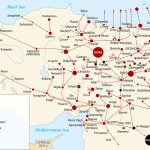
By the treaty of 387, the western part of Armenia, along the line of Karin (Erzerum), Niphrkert-Mdzbin (Nissibin), had been turned over to the Byzantine Empire and administratively divided into northern and southern sections. The northern part, with the city of Karin as its center, was known as Inner Armenia, and had been annexed to the Empire after the death of Arshak III the Arsacid, in 391. The southern part comprised the five satrapies, or autonomous feudal states.
Armenia Minor (Pokr Haik) was already under Byzantine domination before the division of Armenia, and consisted of two parts — First Armenia, with Sebastia (Sivas) as its center, and Second Armenia, with Melitine (Malatia) as the capital. The internal status of Western Armenia had remained almost unchanged, with its native social order and laws prevailing. But it submitted to some change under the Emperor Zeno (474‑491), when Armenian princes had joined the forces revolting against him. Zeno suppressed the hereditary feudal prerogatives of the Armenian princely houses in the southern provinces. The nomination of the head of the house became the Emperor’s vested right. Other radical changes were decreed by Justinian in the sixth century.
Emperor Justinian reorganizes Western Armenia

During the Persian-Byzantine wars in the first quarter of the sixth century, the divided feudal units of western Armenia had been unable effectively to defend the eastern borders of the Empire. Western Armenia was therefore subjected to military reorganization in 528 by Justinian, whose name is most familiar to the modern world as a legislator and codifier of the law. First, Second and Inner Armenia and Pontus were all combined to form a general military zone. The Armenian satrapal regiments were made parts of the Imperial divisions. Through this rearrangement, the military functions of both Greek governors and Armenian nakharars were abolished.
After the conclusion of the peace treaty with Persia in 532, Justinian set to work on the administrative, judicial and legislative reorganization of Western Armenia, with intent to make that region finally a province of the Empire. Accordingly, all its territorial areas and the ancient Armenia Minor formed one grand unit, composed of four administrative regions, under the names of First, Second, Third and Fourth Armenia.
Legislative edicts promulgated by Justinian in 536 ended some ancient laws and customs in Western Armenia. By the same edict, women were entitled to inherit dominion rights. The main object of this legislation was to parcel out the inherited estates of the Armenian princes. The same laws aimed also at putting an end to hereditary rights within private domains; in other words, to unite and absorb Western Armenia into the Byzantine hegemony.
Insurrections in Western Armenia
The restriction of the authority of the nakharars, and even more definitely an increase in taxes, stirred popular discontent and uprisings. In the Karin district at that time there lived the last remaining issue of the House of Arshakuni, among whom Hovhan and his son Artavan were prominent. They had as neighbors the Bagratunis of Sper and the Mamikonians of Taiq. These all combined their forces to foment insurrections (537‑539). The movement started in the northern portion of Western Armenia, as the immediate result of the assassination of Prince Hamazasp of Sper by a Byzantine proconsul. The rebels massacred the Imperial troops and swept all Byzantines out of Western Armenia; but in turn a Greek army in great force was rushed to the scene and checked the revolt. Many Armenian nakharars were executed or exiled to distant parts. The Emperor’s severity dealt such a blow to the military efficacy of the Armenians that their leaders never again regained their martial power in those parts of their homeland. That which Sassanid Persia had failed to accomplish in eastern Armenia through centuries of struggles, Byzantium succeeded in bringing about in Western Armenia at one stroke.
Persian Oppression in Armenia
In the second half of the sixth century, the Persian Government resumed its oppressive policy in Armenia. It imposed heavier taxes, demanding payment in cash, treated the nakharars with suspicion and restricted their economic and political exemptions. Complaints against these provocations were intensified by the tyranny of the Persian Marzban Souren. His attitude towards the clergy and the nobility was insolent, and he provoked the indignation of the masses by attempting to erect a Mazdean temple in Douin.
Armenian Rebellion
The Byzantine government took advantage of the ill-feeling brewing against the Persians in the Caucasus. In 570 the Armenian chiefs concluded a secret agreement with Byzantium, under which the latter guaranteed the liberation of Eastern Armenia and recognition of it as an independent state. The discontented Armenian princes having made some remarks against the Marzban, Manuel Mamikonian was killed in retaliation. His brother, Vardan Mamikonian, rose in rebellion in 571 and captured the city of Douin. Souren the Marzban was slain in turn, and Persian officials and soldiers fled. For two years the rebels continued their resistance against the Persian armies, but the failure of the Byzantines to send promised aid at last compelled them to lay down their arms. Hovhan II Capeghian, the Katholikos and Vardan the general repaired to Constantinople in the hope of obtaining imperial assistance in recovering their homeland, and circumstances sustained their hopes. Persia, whose eastern frontiers were again menaced by Hunnish hordes, would suffer greater embarrassment from an accelerated Armenian rebellion. Acting upon such a theory, Byzantium declared war against Persia in 572.
Second Partition of Armenia
But the imperial edict did not prosper; several successive defeats forced the Emperor to ask for peace in 579. A treaty was signed, but its terms did not satisfy Ormuzd IV, successor of Khosrov I (Chosroes). He renewed hostilities, and now the Byzantines were more fortunate, for they had a new and able Emperor, Maurice (Morik) of Armenian origin. He pushed forward, even into Persia itself, and brought the war to a successful conclusion by supporting the claim of Khosrov II against his rivals and restoring him to the throne in 591. In return for his aid, Maurice received from the new King the major part of Armenia, extending from the western shore of the Lake of Sevan and the valley of the Azat River to the Arax, thence by a straight line across the Lake of Van to Nissibin.
Maurice for crushing Armenia
But the Armenians paid a price for Byzantine aid. Bishop Sebeos relates that the Emperor Maurice sent to Chosroes II the following letter:
"We have among us an unruly nation which foments disorder. See, let me collect the Armenian chiefs from my side and concentrate them in Thrace, and you collect the Armenian chiefs of your side and order them to be sent to the East to fight your enemies. If they kill, your enemies shall have been destroyed; but if the enemies kill, they will have destroyed our mutual foes. Then we may live in peace, because if they remain in their country, we shall enjoy no rest."
Khosrov agreed to this proposal, and the Armenian soldiers were all transferred to foreign lands; those of the Byzantine area to distant parts of the Empire, and those of the Persian section to the East. This policy of the two dominating powers created bitter resentment in Armenia and brought about seditions under Sahak Mamikonian and Sembat Bagratuni.
Maurice assassinated
The strict military discipline imposed by Maurice provoked the Imperial army to mutiny. The revolt of the popular factions in Constantinople followed in 602, culminating in the assassination of Maurice by the usurper Phocas. The Persian leaders, who had been seeking a pretext to denounce the treaty of 591, now assembled their army as if to defend the rights of the heirs of Maurice, but in reality to recapture the territories ceded to Byzantium. The Imperial internal crisis gave them an opportunity for successes in the field. In 616 they occupied Syria and Egypt, and even encamped before Constantinople. But fortune eventually favored the Christian Empire. Heraclius unseated the usurper Phocas in 610, seized the throne, developed into an able general and took the field against the mighty foe in the East. His first attempt in 622 to get a foothold in Armenia was unsuccessful; but in his second campaign, in 624‑626, he swept the Persian army before him across the Armenian highlands to the Tigris, where he won a decisive victory. Two years later, he advanced to the environs of Ctesiphon, recovered the True Cross from the Persians and brought it back to Constantinople.
Khosrov assassinated
The Persian reverses brought about grave disorders in their capital, which reached a climax in the assassination of Khosrov II. His son Kavad concluded a new treaty with the Byzantine, or as it was beginning to be called, the Greek Empire, by which the greater part of Armenia again passed into Western hands. The administration of the Persian area of Eastern Armenia was now handed over to an Armenian Marzban, Varaztirotz Bagratuni, while that of the Byzantine section was entrusted to an Armenian governor, Mezhezh (Mjej or Mezezius) Gnouni.
Feudaries under the Marzbans
Marzbanic Armenia was a typical feudal country. By comparison with the Arshakuni period, its economic status was more advanced. However, Peasantry and Aristocracy were still the two basic classes of the nation. After the fall of the Arshakuni kingdom, the monarch of Sassanid Persia, the common suzerain of the Armenian feudatories, determined ranks among the Armenian nakharars, as judged by their situation, landed holdings and military force. The most powerful ones among them under the Arshakuni kings — the Sewnis, Bagratunis, Ardzrunis, mamikonians and Kamsarakans — retained their respective positions during the Marzbanic period. About the end of the sixth century, the Saharuni and Reshtuni houses appear to have risen high in power. The situation was different in Western Armenia, where Armenian satrapal houses came to an end in 535 A.D.
New Law of Land Ownership
The law of land ownership was definitely changed under the Marzbans. During the Arshakuni regime, the satrapal lands were considered indivisible, each of them forming a unit, under the rule and jurisdiction of the chief of the house or clan. In the Marzbanic period, there came a change; the Sepouhs, the junior members of the satrapal line, received authority to take possession of their share, and to be known as new landlords. The share of the Sepouhs was called sepouhakan or sebhakan. Armenia in the Marzbanic era was covered with a network of feudal estates. The clergy were feudaries, too, and they also increased in number under the Marzbans. There were four episcopates or dioceses in the fourth century, rising to fifteen in the first half of the fifth century. Through purchase, donation and otherwise, they acquired extensive landed properties.
Rural class
The peasants, the second basic element of the population, became subject to double exploitation under the Marzbans — by the old, native land-owners on the one hand, and by the Persian and Byzantine powers on the other. Upon the division of a property or a change in ownership by sale or donation or otherwise, the people living on the land were likewise handed over to its new lord. The peasants had to give to the land-owner one portion of their products, and to the Church one-tenth portion, known as bdugh (fruit).
The peasant belonged to the Anazat (unfree) class. Offenses committed by Azats and Anazats were not subject to the same degree of penalty. The blood-wite, the fine levied for the murder of an Azat, was higher than that for an Anazat. An Anazat offender was sentenced by the court to corporal punishment and condemned to hard labour; as for the Azas, they were usually sentenced to pay various amounts of cash. The peasants were heavily taxed also by the Persian and Byzantine governments. The former had imposed a land tax (Hass in Armenian) and personal tribute (Sak), also custom-house duties (Baj) on merchants. All objects subject to taxation were registered in the book called “Divan.” For the classification of the taxes, a census of men was taken and surveys made of every productive item. Tax-gatherers added to the burden of the people by arbitrary exactions.
Peasants suffer
The condition of the rural population grew worse during the second half of the sixth century, when the land taxes became payable in cash. As a result, the peasants often fell into the hands of usurers. Men between 20 and 50 were subject to payment of a poll tax and land products were taxed at various rates — one-third, one-quarter, one-fifth and one-sixth, according to the quantity of the yield, the method of irrigation and the kind of product. Serf labour was to some extent still in force in Armenia until the last quarter of the nineteenth century; that is, common people were drafted for labor on public works — for the construction of roads, bridges, canals and dams, and for the excavation of mine shafts.
Growth of Trade
The economic life of the country showed a gradual improvement during the Marzbanic period, parallel to the growth of cities and the bettering of relations among the crafts and trades. As to civil life, its improvement was enhanced by the economic developments in Hither Asia and Byzantium. One of the international commercial transit routes from Oriental countries crossed through Douin on its way to the West, to the ports of the Black and Mediterranean Seas. On that route were the ancient mercantile cities of Armenia — Artashat, Erouandashat and Theodosiopolis-Karin (Erzerum). Over it Armenian, Jewish, Arab and Syrian merchants exchanged raw silk, spices, drugs, precious stones and other goods. Many of the business men moved their residences into such centers. The long periods of peace between Persia and Byzantium during the fifth century contributed much to the expansion of trade connections between East and West. In Douin the traders of India, Persia and Georgia transacted business and exchanged wares and commodities with the merchants of Byzantium. “Douin is an excellent place,” remarks Procopius, Greek historian of the sixth century. “It has a healthy climate and abundance of good water. Its distance from Theodosiopolis is eight days journey. In that region there are plains suitable for riding. Populous villages are situated not far apart, and numerous merchants conduct their business in them. For from India and the near-by Iberia, and from all the nations of Persia, and some of those under Roman sway they bring in goods and carry on their dealings with each other there.”
Besides being a transit medium, Armenia was also a center of production. It exported horses, mules, wine, dyes, grain, oil, metals, rugs, textiles, etc. The system of cash payment of personal tribute aided in the encouragement of trade. It compelled the peasant to bring a part of his products into the market, in order to obtain currency. At the same time usury flourished. A document surviving from those days tells us that: “Money is lent for profit, interest being demanded thereon. Shamelessly, poor people’s flesh is devoured and their blood drunk. Cash is given in certain amounts, but demanded in double. They (the usurers) reap without sowing the seed; they collect output and hoard their iniquitous earnings.”
Artisans numerous
Among the inhabitants of a city, the artisans outnumbered all other classes. Their products, together with those of the peasants, constituted the major part of the goods offered for sale in the inner market. Many handicrafts, such as pottery, tanning, wood and iron working, wine-making, weaving and the goldsmith’s art, were in an advanced stage of development. It was the custom for an artisan to keep the methods of his craft secret, revealing them only to his heirs. Socially, merchants and artisans had a higher status than the peasants.
Feudalism chief weakness
The Kings of Armenia could never quite crush feudalism, which was the chief political weakness of the Nation. Nevertheless, the King was recognized by the nobles as their supreme head; they were his vassals, even when Armenia in turn was entirely in vassalage to one empire or another. At the time when the ruling monarch was powerful enough, his will was the supreme law, and the life of the grandee was in his hands. An insurgent lord might be punished by death, or by the loss of all or a part of his lands. In wartime the vassal nobles must assemble their forces at the call of the king, to be put at the disposal of the commander-in‑chief.
Few large cities existed in Armenia, but many castles and forts were surrounded by villages. In the mountain areas, because of the severity of their climate, the peasants’ dwellings were half buried in the earth. They were warm enough during the winter, and were stocked with provisions for the family and domestic animals. Until the invention of the Armenian alphabet, the masses lived in ignorance, their only fragments of intellectual culture being found in temple chants or minstrel songs.
Armenian Mores
The morals, manners and customs of the Armenians for many centuries were similar to those of the Medes. The family head had full authority over his children, their wives and his grandchildren. The father gave his daughter to a suitor in marriage for a gift commensurate with the possessions of the latter. Among the common people domestic life seems to have been smooth and harmonious. The wife’s fate depended upon her husband’s will; she might, if such was his whim, be summarily repudiated. Polygamy was the rule among the nobility. The organization and administration of justice were irrational, all being at the mercy of the King and the nakharars. Criminals were thrown into underground dungeons, and punishment often included bodily torture, in accordance with Persian practice. Political convicts were frequently deprived of their eyesight by branding or laceration, a procedure prevalent in the Byzantine Empire. Such inhuman customs were more or less abated or suppressed after the conversion of the nation to Christianity; then trials were held and sentences pronounced by the high clergy in accordance with canonical laws.