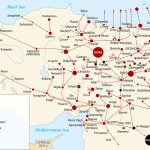
Cilician Armenia: The Armenian Kingdom of Cilicia (11th-14th Centuries)
Roupen I Organizes a Revolt
Many of the Armenian nobles who accompanied Gagik II to Constantinople also followed their sovereign to his new domain, forming a small court around him, primarily composed of members of the Bagratid family. Among them was Roupen, who, according to some chroniclers, was of direct royal lineage. He held considerable authority over the Armenians in the Tzamandos (Zamanti) district and, shortly after King Gagik’s assassination, organized a band of Armenian warriors to lead a revolt against the Byzantine Empire, raising the flag of rebellion in 1080.
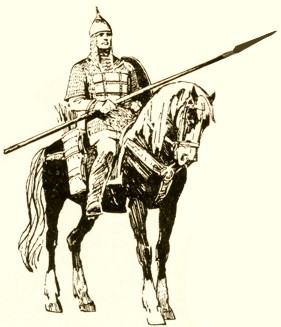
For centuries, the persistent oppression and violence inflicted by the Greeks fueled animosity among the Armenians. Differences in language, traditions, customs, and especially religious beliefs deepened the divide between the two peoples. However, the fall of the Kingdom of Ani created two distinct factions: one that resigned itself to submission to Greek rule, and another, still animated by national spirit, that yearned for vengeance and the restoration of national independence. The Byzantine Empire, weakened by internal factionalism and religious conflicts, and beset by foreign threats, was unable to effectively suppress the provincial uprisings against tyrannical nobles and corrupt officials. In this climate, Roupen’s revolt began unnoticed, as the Asiatic provinces of the Empire lacked security.

With the Kingdom of Ani having already fallen to the Seljuk Turks, Roupen set his sights on Cilicia, where many Armenian chiefs and their people had emigrated from their homeland.
Cilicia: A New Refuge for Armenians

Cilicia, conquered by the Arabs in the 7th century, was partially reclaimed by the Byzantine Empire in 964, when Emperor Nicephorus II Phocas recaptured Anazarba, Adana, Tarsus, and Mopsuestia (Missis). In 966, Byzantine forces extended their conquests southward to Tripoli in Lebanon, Aleppo, and Damascus. These military expeditions, followed by another led by Emperor John Zimiskes in 973, were essentially crusades aimed at liberating the Holy Land from Turkish control and recovering the prosperous provinces of Syria. However, Cilicia, which had suffered greatly under Arab rule, required significant reconstruction to serve as a strong bastion for the protection of Constantinople.
Byzantine emperors took advantage of the voluntary migration of Armenian nobles fleeing their occupied homeland, settling them along the borders of the Euphrates and Taurus Mountains. These Christian settlers were seen as an asset, strengthening the Empire’s frontier defenses.
Oshin in Cilicia
Among the Armenian nobles who took refuge in Cilicia was Oshin, a nakharar (nobleman) and former lord of a fortress near Gandzak (Elizabethpol) in Caucasian Albania. Arriving in Cilicia in 1075, Oshin joined his kinsman Abulgharib Ardzruni, who governed Tarsus and Mopsuestia in the name of Emperor Alexius I Comnenus. Oshin was granted the hereditary fief of Lampron (Nimroun Qala), a strategic district along the Tarsus River at the Cilician Gates, a narrow pass through the Taurus Mountains crucial for the security of Cappadocia.
Geography of Cilicia
The natural frontiers of Cilicia were clearly defined by the surrounding geography. To the west lay the rugged mountains of Isauria and Cilicia Trachea, forming a vast triangle with its northern base resting on the plains of Lycaonia and its eastern border along the Gulf of Pompeiopolis. The apex of this triangle was the promontory of Anemur, a strategically important point both commercially and militarily.
The valleys of the Seyhan (Sarus) and Ceyhan (Pyramus) rivers connected Cilicia to Coelesyria via the Syrian Gates, breaks in the Amanus range. Along the southeastern coast was the city of Issus, famous as the site where Alexander the Great defeated Darius of Persia in 333 B.C. The northern side of the Gulf of Alexandretta featured the port of Ayas, which became an important commercial hub during the Middle Ages. The region’s numerous harbors, including Megarsus, Alaya, and Side, offered safe shelter to ships and facilitated trade between Cilicia, Syria, and the Mediterranean.
Byzantine Policy
Byzantine policy emphasized guarding the mountain passes that provided access to Cilicia, which is why the emperors encouraged the creation of small Armenian principalities in the region. The Armenian lords who migrated to Cilicia were known as Ishkhans (princes), a title similar to that of barons later adopted by the Crusaders. Many of these lords settled in the Taurus and Amanus Mountains as well as in the plains.
Roupen’s Stand and the Foundation of the Armenian Kingdom of Cilicia
In the city of Cyzistra, near Caesarea, where Gagik II was assassinated, Roupen established himself and began his revolt. Moving westward, he took refuge in the mountainous regions of northern Cilicia and captured the fortress of Partzerpert (High Castle), located on a tributary of the upper Pyramus River. This fortress would become the cradle of the Cilician Armenian kingdom.
Death of Roupen
Without holding any official title, Roupen declared independence and began establishing a de facto kingdom. Shortly afterward, according to the historian Hetoum, Roupen “died in the peace of the Lord, after living a pious life,” and was buried in the Monastery of Castalon. He was succeeded by his son, Constantin.
This fertile province of Cilicia, once so rich through its agriculture and commerce, had, as a result of the Arab invasions, been reduced almost to the condition of a desert. The survivors of Greek, Syrian and Jewish nationalities were concentrated in small groups in the ruins of the cities. Agriculture was carried on only in the shadow of the city walls and strongholds, where there was comparative safety.
Constantin and the Expansion of Armenian Power in Cilicia
Upon Roupen’s death, his son Constantin assumed leadership of the nascent Armenian principality in Cilicia. Constantin displayed remarkable leadership and political acumen, successfully navigating the region’s complex political landscape while expanding Armenian influence. His actions laid the groundwork for the eventual establishment of the Armenian Kingdom of Cilicia.
Constantin capitalized on the region’s fragmented state, as Byzantines, Turks, and Crusaders all vied for control of Cilicia. The Byzantines, focused on defending their empire from the encroaching Seljuk Turks, lacked the resources to impose direct control over Cilicia. The Crusaders, having established states such as the Kingdom of Jerusalem, were more focused on consolidating power in Syria and Palestine. This created a power vacuum that Constantin skillfully exploited, gaining control over fortresses and towns throughout the Taurus Mountains and the Cilician plains.
Alliance with the Crusaders

Constantin and his successors recognized the strategic importance of alliances with the Crusader states. The Crusaders needed reliable allies in the region to ensure the security of their supply lines and access to the sea. Constantin fostered close ties with the Crusader princes, offering Armenian military support in return for recognition of his independence.
These alliances also facilitated trade between Cilicia and the Crusader states, benefiting both parties economically. Armenian merchants played a crucial role in facilitating trade between the Eastern Mediterranean, the Crusader states, and Europe. Ayas, a key Cilician port, became a bustling hub of commerce, attracting merchants from Venice, Genoa, and other European trading powers.
Establishing Authority
Constantin fortified Armenian power in Cilicia by consolidating control over key fortresses, expanding his territory, and establishing a system of governance that balanced Armenian traditions with the political realities of the region. He ruled as a prince, exercising authority over both Armenian nobles and local populations. His leadership was marked by fairness and justice, earning him the loyalty of his subjects.
Constantin’s success in securing Cilicia from external threats and internal dissension allowed him to strengthen his family’s hold over the region. His descendants, known as the Roupenid dynasty, continued his work, steadily expanding their authority over Cilicia.

The Rise of Thoros I
Constantin’s successor, Thoros I, proved to be a strong and capable leader, building on his father’s achievements. Thoros I further expanded the Armenian presence in Cilicia, fortifying additional strongholds and maintaining close ties with the Crusaders. Under his rule, the Armenian principality grew in strength and influence, and Thoros demonstrated a keen understanding of diplomacy.
One of Thoros I’s most notable accomplishments was his successful defense against Byzantine attempts to reassert control over Cilicia. As the Byzantines sought to reestablish their dominance, Thoros skillfully navigated between the various regional powers, ensuring that the Armenian stronghold in Cilicia remained secure.
Repulses Turkish Invasion
Assisted by the Franks of Antioch, Thoros had conquered the major part of Cilicia, driving out the small Greek garrisons, when Turkish hordes penetrated into the heart of Cilicia and took Anazarba. Byzantines had been almost entirely dislodged from their former strongholds in the lower part of the country, and the Turks therefore believed that they could easily crush Armenian resistance. They coveted the possession of the Sultanate of Iconium and the southern shore of Asia Minor. Thoros repulsed and drove them back to the territory of Cogh Vassil, another Armenian chieftain, who reigned at Marash. There too the invaders were defeated and once more forced to flee. Two years later, after ravaging the lands around Melitine (Malatia), they besieged the fortress of Harcan (Hajen), where they were again beaten by the Armenians. Their chief was captured and brought to Kessoun, the headquarters of the district, near Marash. Nevertheless, the Turkish marauders continued their depredations, especially in rural areas. The country suffered a major attack by the Seljuk Sultan of Iconium, Malik Shah (1107-1116). Thoros, however, after sustaining a severe reverse in the first engagement, won a decisive victory in the second, though it was a costly encounter. The Sultan retreated towards Kharput, looting and devastating everything in his way. The only stronghold that he failed to subjugate was the fortress of Dzovk, known to Strabo as Cybistra.
Baron Leon I expands his domain
Thoros died in 1129, and was succeeded by his brother, Leon I (1129-1137), who reigned eight years and expanded his rule over the plains, and even to the Mediterranean shores. Without the possession of seaports, contact with Europe could be effected only through the Frankish coastal cities in the southeast. But relations between two former allies did not always remain as courteous as before. Thoros seems to have been slow in paying Baldwin the sum of 60,000 gold besants, his daughter’s dowry; the Armenians complained of the exactions of the Crusaders, while the Franks accused their allies of calling upon infidels for help whenever they had the least pretense of discontent. A major cause of dissension between the Armenians and the Latins of Antioch was the ownership of the strongholds of the southern Amanus, and of the neighboring coasts of the Gulf of Alexandretta.
Treachery of Antioch
The fort of Sarouantikar, on the lower Jihoun River, dominated by Leon, was also a subject of dispute. Raymond de Poitiers, Prince of Antioch, demanded that place in the 1136, claiming that it was a part of Crusaders’ territory. Raymond refrained from taking arms against the Armenian Baron, but chose a more despicable course; he lured Leon into a trap and held him prisoner. After two months of confinement, Leon obtained his liberty by consenting to harsh terms. Not only did he surrender the fort of Sarouantikar, south of Marash, but also Mamestia and Adana; in addition he paid 60,000 gold pieces and gave his son as hostage. He also pledged himself to assist Raymond against the Emperor John II Comnenus.
Baron Leon did not wait long to break the contract which had been extorted from him through treachery. He recaptured all the territories surrendered to Raymond and launched an attack against the Prince of Antioch and his ally, Foulques d’Anjou, King of Jerusalem. This hostility would have been fatal to both Armenians and Franks-both of whom were always menaced by the Turks-but Josselin II, Count of Edessa, who was related by marriage to Leon, obtained an honorable agreement for both sides in 1137. An alliance was formed by them against the Emperor, who was then pressing his claims against Antioch as well as Cilicia.
Stepane at Marash
Menwhile, the war against the Turks was in progress. “In 584 (1135),” says a historian, Michael the Syrian, “Baron Stepane, brother of Baron Thoros, having arrived under the walls of Marash, caused his troops to enter the city during the night. They were received in the houses of those inhabitants who were Christians. This suprise had been contrived by a priest of this city whit whom Baron Stepane was in Compact. At dawn his soldiers captured the place and slew the Turks who were within. Flushed with their victory, they instulted the guardians of the citadel and molested their hands. So they set the city afire, and taking away the Christians with them, advanced into the interior of the country.”
Aboulfaraj (Mar-haebreus, a Syrian bishop of great erudition) decribes the same events adding: “The turks, exercising humanity, showed a pacific disposition towards the Christians who had remained; and to the Armenian fugitives who had returned, they restored their houses, vineyards and fields. But an Armenian priest whom they (The Turks) suspected of being in connivance with his compatriots was flayed alive. After three days they cut off his tongue, hands and feet and threw him into the flames. The Armenians, incensed at this cruelty, put a number of Turks to the same torture.”
Greeks incite Turks
The hostility of the Turks towards the Armenians had in the meantime been nurtured by gold supplied by the court of Byzantium, which maintained, as ever, its designs on Cilicia and the principality of Antioch. Despite the alliance concluded between the Armenians and the Princes of Antioch, the Greeks invaded Cilicia, defying the Crusaders and Leon, and occupied all the plain of Adana and the Gulf of Alexandretta. The Baron took refuge in the Taurus Mountains, but at last found the situation hopeless, and surrendered himself to the conqueror. He was dragged away to Constantinople, where he died in imprisonment in 1141. His son Roupen, after being blinded was assassinated by the Greeks.
Thoros II (1145-1169)
All Cilician remained under Byzantine rule for eight years. The Latin principalities of Antioch and Edessa, often harassed by the Turks, were unable to assist their allies. One of Leon’s sons, Thoros, a prinsoner in Constantinople, had gained the favors of the Palace through his personal charm. He fled from the capital in disguise, on board a Venetian vessel, reached Cyprus and thence went to Antioch. There, Prince Raymond and Patriarch Athanas VIII, supplied him with means by which to accomplish his adventurous design, namely, the shaking off of the Byzantine yoke. In company with a small escort he left Antioch and penetrated into the Amanus mountains, where some thousands of Armenian volunteers joined him. After several successful engagements with the Imperial troops, he recovered the ancient domain of his father.
Romantic escape of Thoros
The chronicles of Vahram of Edessa thus describe the triumph of young Baron:-
“Those who were attached to the Emperor’s palace claim that Thoros prologed his sojourn until tha day when a Greek princess who was in love with him gave him treasures which he took away with him. Reaching the mountainous part of Cilicia, he met an Armenian priest, whom he secretly made himself known as the son of Leon. The priest welcomed him with joy. The Armenians who remained in the country and those who lived in the mountains, subjected to the oppression of the Greeks, had been most fervently wishing for the return of their old masters. Now being apprised by the priest of the return of their beloved prince, they readily united in greetin Thoros as their Baron.”
While the Emperor John was subduing Cilicia and approaching Antioch, the Turks ravaged the adjacent Latin territories. The Byzantines had allied themselves with the Turks, so as to overthrow the power of the Frankish interlopers and destroy the Armenian baronies. But that unholy alliance was broken when the Moslems invaded the district of Kessoun, within the domain of the Empire.
Byzantine-Turkish alliance violated
This rupture is described by Matthew of Edessa as follows:-
“In 585 (1136), Sultan Mohammed, son of Amir Ghazi, son of Danishmend, came with a great army to the country of Marash, near Kessoun, and set fire to the villages and monasteries. . . He deferred attacking the city, busying himself with diverting the water of the river, laying waste the gardens, making incursion here and there, and collecting his booty and putting it into security. However, the citizens of Marash, in constant fear of an assault, fell into such an excess of discouragement that one night they abandoned the outer ramparts; but their chiefs and the priests succeeded in reviving their spirits. . . God did not command the infidels to invest and assault the place, and on Friday, which is the day of the passion of our Lord, Kessoun was delivered. The enemy burned the Garmirvank (the Red Monastry), the chapel and the cells of the monks, smashed the wooden and stone crosses and carried away those of iron and bronze, demolished the altars and scattered their fragments. He took away the doors with their admirable scrollwork design, as well as other objects, and transferred them all to his country, to show to his concubines and the populace . . . Mohammed retreated upon learning that the Emperor of the Romans (John Comnenus) was speeding to the rescue of besieged Kessoun, and of our Count Baldwin, who had implored him on his knees for help. The Emperor, devastating the Moslem lands, was already approaching Antioch. After having deprived our Prince Leon of his sovereignty, he seized his cities, and fortresses, and taking him prisoner, carried him off to the country of the Greeks, beyond the sea, on the frontiers of Asia.”
Thoros II reconquers his barony
Whatever the conditions in which Thoros entered Cilicia, he found it occupied by many Greek garrisons. One after another, he conquered Amada (Tumlu-Kalessi), Anazarba, Adana, Sis, Aryudzapert and Partzerpert. The city of Edessa, however, was taken on December 23rd, 1144, by lmad-ed-din Zenghi. Thoros, unable to rexeive any aid from the princes of Antioch, was compelled to resist alone the Greek army of 12000 men, commanded by Adnronicus Comnenus, a cousin of the Emperor Manuel I, but inflicted a signal defeat upon that general in 1152. To average this humiliation, the Emperor resorted to stratagem, instigating an attack by Massoud I, the Seljuk Sultan, upon the Armenian Baron. The Seljuks, seated in the very center of Asia Minor, constituted a peril for the capital of the Greek Empire; but Manuel’s chief concern at the moment was the punishment of the Armenian Baron for the affront inflicted on him. Massound invaded Cilicia, but Thoros parried this new danger by recognizing the Moslem Sultan as his lord paramount.
Turks beaten
In 1156 upon some flimsy pretext Massoud again sent his troops against the Armenians. The invaders were repulsed by the Crusaders and the army of Thoros. Surprised in the defiles between the Amanus Mountain and the sea, the Turks suffered a bloody reverse. The remnants of their army retreated northeastward, devastating the districts of Marash and Kharput. But they were not slow in reorganizing and returning to the offensive, laying siege to the Castle of Till Hamdoun, in the vicinity of Sis. They were dispersed, however, when the Armenians took advantage of a pestilence raging in the foe’s army and dealt him a telling blow. Masoudº died and his son, Azzed‑din Kilij Arslan II, concluded in 1158 a peace with Thoros, who continued to rule Cilicia and Isauria.
Templars invade Cyprus
In 1156 the Crusader ships disembarked upon the Cyprianº coast an army composed of Latins and Armenians which, after crushing a feeble opposition, spread rapidly in all directions, plundering and kidnapping the rich, to be held for ransom. These acts of violence, though unjustifiable, were a natural retaliation for the intolerant and perfidious actions of the Greeks, often with Moslem aid, against the non-Orthodox Christians of the East.
Emperor Manuel of course could not tolerate the seizure of Cyprus. He sought revenge in 1158 by invading Cilicia at the head of an army of 50,000. He captured Anazarba, Till Hamdoun, Tarsus and Lamos, while Baron Thoros, unable to defend his country, retired to the castle of Dajikikar in the Taurus Mountains. Renaud and Baldwin of Jerusalem (husband of the Emperor’s niece) interceded for Thoros, and regained for him the major part of his domain, on condition that he recognize the Greek Emperor’s suzerain right. Thoros was then honored with the title “Palatin of Pansebastos.”
Stepané murdered Thoros Massacres Greeks
Peace, however, was not yet well established. Disregarding all official pledges, Stepané, the Baron’s brother, at the head of Armenian bands, laid waste the Imperial territories in the district of Marash. Andronicus, the Greek governor of Tarsus, resorting to stratagem, invited Stepané to a feast and killed him in the most cruel manner. Thoros, thereupon, ordered a massacre, to which a great number of Greeks within his borders fell victims. War between the Emperor and his vassal Prince would have broken out again had not Amaury I, King of Jerusalem, intervened.
Mleh Usurper
Disheartened by the country’s misfortunes, Thoros abdicated before his death in 1169 in favor of his son Roupen, a minor, under the guardianship of Baille Thomas. But Thoros’s brother Mleh, once member of the order of the Knights Templars, and now supported by Nour‑ed‑Din, the Turkish atabek (prince) of Aleppo, invaded the Armenian barony. Mleh at first agreed to a settlement offered by the guard of Roupen, by which he was to receive an equal share of the territory. But soon after this, the usurper repudiated his pledge and seized the entire territory. The Baille secretly carried Roupen to the castle of Romgla and put him under the care of the Katholikos Nerses (Shnorhali, “the Gracious”). But despite this precaution, the young prince was found dead not long afterward.
Mleh, who is accused by some chroniclers of apostasy and tyranny, had aligned himself with Moslem rulers, such as Salih-Ismail of Aleppo and Kilij-Arslan II of Iconium, defying both Greek and Latin states. Because of his military prowess, Mleh was finally recognized by Emperor Manuel in 1173 as the independent Baron of Cilician Armenia. But he had made a host of enemies by his cruelties in his country, resulting in his assassination by his own soldiers in the city of Sis in 1175.
Treacherous warfare
This period of Levantine history was characterized by a constant and bitter clash of conflicting interests. The Greeks cunningly embroiled the Crusader princes with each other and inflamed Moslem hostility against non-Greek Christians. They pretended friendships with formidable enemies, then suddenly changing their tactics, took up arms against their allies of yesterday. As for the Moslems, their treatment of Christians was not only contemptuous but merciless when they had the opportunity. The famous Saladin (Salah-ed‑Din), Sultan of Egypt and Syria, issued a decree in Egypt forbidding “infidels” (Christians) to ride horses or mules and commanded themº always to wear a belt in public, so that they may be distinguished from true believers. The Byzantines, despite the indignities to which they were subjected by the Mohammedans, sometimes heaped upon Turkish princes such honors that these only tended to increase Moslem contempt for all Christians.
Gaudy display of Emperor
An account by Aboulfaraj of the welcome accorded to Kilij-Arslan, who spent three months in Constantinople seeking aid against his domestic adversaries, says that “twice a day food was served him on gold and silver plates which were left to him as gifts. On one occasion the Emperor, after dining with his guest, offered him all the battle service decoration as well as other gifts, not counting those presented to each of the thousand Turks who composed his escort.” According to other chroniclers, feasts were given in honor of the Seljuk Sultan in an atmosphere of amazing splendor.
“On a magnificently decorated platform stood a throne of massive gold, set with diamonds, jacinths and other precious stones, encircled by pearls of brilliant whiteness. Profusely distributed lights struck dazzling rays out of all these jewels. On the throne was seated the Emperor, dressed in a mantle of purple, upon which artistically combined diamonds and pearls formed admirable designs. Over his chest suspended to a golden chain hung a pink stone of the size of an apple. On either side were ranged the members of the Senate, in the order of their respective State functions. Kilij-Arslan, when escorted in, was astonished by such magnificence, but at length took a modest seat. During his stay at the court of Manuel, he lived in one of the palaces in the southern part of Constantinople. All the pleasures of the imperial city — equestrian combats, dramatic entertainment, spectacles of the circus, Greek fire — were offered him.”
Thus the Byzantine Emperor treated the Seljuk chief who, entrenched in Iconium, was threatening all eastern Christendom, who, in 1148, had taken the city of Marash and violating his pledged words, slaughtered the knights, the Frankish bishop and priests and the major part of the populace. Instead of demonstrating to Kilij-Arslan the might of his legions, the Emperor chose to display only his wealth — which merely excited the visitor’s greed and stirred him to action against the Crusaders and even the Greeks. Finally, the Emperor’s worst error was that of supplying him with funds with which to turn against the Franks, but which were used against Byzantium itself.
Baron Roupen II (1175‑1187)
Roupen II, son of Stépané andº nephew of Thoros II and of Mleh, was elected by the seigneurs of Cilician Armenia to occupy the throne of the principality. The mighty Saladin, lord of Egypt and a part of Syria, was then preparing a campaign against the Crusaders. The Armenians meanwhile were threatened by Kilij-Arslan II; in fact, all the Christian principalities had to come then to grips with the Moslems. The new Baron of Cilicia feeling unequal to the struggle was constrained to buy peace in 1180; but scarcely had he withdrawn his forces from the frontiers, when the Prince of Antioch and Hetoum, the pro-Greek master of Lampron, instigated by Manuel, began hostilities against him. Roupen sent his brother Leon to surround Hetoum’s mountain lair. Bohemund III, rushing to the aid of Hetoum, treacherously made Roupen prisoner, and the latter obtained his release only upon payment of 30,000 dinars as ransom and the cession to the Prince of Antioch of the cities of Adana and Mamestia.
Roupen, however, who had married Isabelle, daughter of Humphrey III, seigneur of Karak and Thoron, remained always friendly to the Crusaders in spirit. He was a just and good prince, and created many pious foundations within his domains. Shortly before his death, he abdicated in favor of his brother Leon, and retired to the monastery of Drazark.
Third Crusade moves to East
Events of the gravest import were taking place in the East at this time. Saladin captured Jerusalem on October 2nd, 1187. Edessa and Acre had already fallen to the Moslems; Tripoli and Antioch soon followed. Unless the Western powers could come to their aid, the Crusaders and Cilician Armenia were doomed to early disappearance. The Pope exerted all his energy to bring about a new expedition. Accordingly, Frederick I, “Barbarossa,” the German monarch — known as head of the “Holy Roman Empire,” — and the Kings of France and England were moved to action. Frederick was given the leadership of the Third Crusade in 1189. Reaching Asia by way of Macedonia, the great army made a halt in Cilician Armenia, with Antioch and Jerusalem as its next objectives.
Leon saw in these formidable operations a unique opportunity to extend his authority and to obtain for himself a royal crown. He dreamed of playing the part of territorial and political intermediary between the Byzantine Empire and the Latin principalities of the East. He, therefore, eagerly supplied the Third Crusaders with provisions, guides, pack animals and all manner of aid, besides pledging the cooperation of his army.
The Emperor Frederick was thus won over to Leon’s cause, and promised him a crown, but a fatal accident delayed the consummation of this act. Barbarossa met his death in the icy waters of the Galycadnus River (Gheuk-sou), either in crossing it or while bathing. Leon then turned his eyes towards Frederick’s successor, Henry VI, the new head of the Crusade. He also made an appeal in 1195 on the same subject, to Pope Celestine III who, as a spiritual sovereign, wielded more extensive and permanent authority.
Crusade saves Armenia from incursions
The arrival of this Crusade ushered in a new era for the Armenians. Greek legions as well as Turkish hordes ceased their incursions in Leon’s domain. The necessities of a new situation were being considered by all the neighboring elements. The creation of a Kingdom of Cyprus was one of the striking signs of changing conditions. In the spring of 1191, Richard I (Lion-Hearted), King of England, who had left Sicily at the head of his crusading fleet, was forced by tempestuous weather to lay by in Cyprus, then ruled by Isaac Comnenus, a kinsman of the Greek Imperial dynasty, but who had declared himself independent of Byzantium. Being told that an English vessel had been shipwrecked upon his shores, Isaac hastened to the port of Limassol, hoping to lay his hands upon Berengaria of Navarre, the fiancée of King Richard, and Jeanne de Sicile, his sister-in‑law, whose vessel had grounded, but getting clear again, had rejoined the English fleet.
Richard I in Cyprus
Incensed at this affront, the doughty Richard disembarked at Limassol, took possession of the entire island, and seized Isaac, with his family, and his treasure. The downfall of this despot was joyously hailed by the Latins because of his acts of espionage and treason in behalf of Saladin. Blithely installing Guy de Lusignan as the first King of Cyprus, Richard then proceeded towards the Holy Land.
Byzantines antagonizing Christians
The meddling of Western nations in the affairs of the East during the first two Crusades had greatly ruffled the Greeks. They believed that any Moslem occupation of their territory would only be temporary; but they dreaded the outcome of the Crusades, especially the Third one, led by an emperor and two kings. Had they joined the Western forces, the Christian kingdoms of Syria and Cilicia would have survived, and Constantinople would probably never have fallen into the hands of a common enemy. But the fanaticism of the Greek Emperor greatly contributed to the fall of the Empire and the retrogression of world civilization.
Leon plays Greeks against Crusaders
Baron Leon displayed an astute diplomatic talent by balancing Greeks against Latins, though his ambition enough a crown induced him to lean towards the Latin side. On the other hand, Sultan Saladin had almost crushed the Western powers in the Levant, while the Greek Empire still enjoyed an imposing prestige, and, as a great ally or protector, could gratify Leon’s ambition if it chose. This, however, never came about. The Armenian Church delegates who visited Constantinople in 1179 for the settlement of disputes between the sects, failed in their negotiations. The specified conditions on which Byzantine goodwill towards the Armenian nation might be obtained were these; (a) To recognize two natures in Jesus Christ; (b) To honor the fourth Council of Chalcedon; (c) To solemnize the birth of Christ on December 25th; (d) To celebrate mass with leavened bread and water mixed with wine; (e) To eliminate the formula, “Holy God . . . that hast been crucified;” (f) The election of a new Katholikos must always be submitted to the Emperor for his sanction.
Papacy favors Armenian kingdom
The demands of the Byzantine clergy, seconded by the Emperor, compelled the Armenian Baron to turn towards Rome, to make common cause with the Western powers and to follow their fortunes in the Near East. In Rome, the creation of a native kingdom in Asia in harmony with the Latin spirit and culture was welcomed; it would provide the Crusades with a solid base, assuring the development of Christian states in Syria and Palestine, which might in due time dominate all Anterior Asia.
Western Europe generally believed that the Byzantine Empire would not last long. It was expected or hoped that it would be replaced by a Latin state, capable of preventing the Turks from entering Europe via the Bosporus. The conquest of Spain and Sicily by the Moors and their drive to the very heart of France in the eighth century had been a serious warning to Western Christians. Leon’s ambition therefore found a favorable echo in the Papal palace as well as in secular courts. It was necessary, however, for that to be moderate in its demands for changes in the Armenian Church, for the people were strongly attached to its ancient rites and customs. The clergy clung to its prerogatives, and the nobles looked askance not only at the abandonment of religious isolation, but also at the creation of a royal authority to replace the seignorial allegiance which they were capable of selling to the highest bidder whenever opportunity offered.
Leon had received while with his maternal uncle, Pagouran, an education that was more Greek than Armenian, for the lords of Baberon and Lampron had remained loyal to the Byzantine Emperors. It is significant that Leon signed his name in Greek ΛΕΟ, followed (in Armenian) by his royal title, “Tacavor Hayotz,” “King of the Armenians”. It was indeed through his Byzantine contact that his great political plans were developed. Aspiring to a higher and wider range of authority, he yearned to wear the purple and to treat on equal terms with emperors, sultans, khalifas and European sovereigns.
Leon labors to obtain the Crown
The negotiations dragged on for a long period. Leon appealed directly to the German Emperor, Henry VI. He also submitted his designs to other Crusader chiefs, winning the good will and support of all. Communications between Rome and himself became more frequent. The Pope received the Baron’s ambassadors and sent his legates to Cilicia to discuss matters both political and religious. Already, half a century earlier, the subject of a closer relationship between the Armenian and Roman Catholic churches had been broached by Pope Eugenius III. Pope Lucius III sent a letter to the Armenian Katholikos, Grigor IV, Degha, in 1185, the translation of which by Nerses, Archbishop of Lambron, has been preserved.
Negotiations between Pope and Katholikos
“In the year 634 of the Armenian calendar,” says the Archbishop, “came Gregory, Bishop of Philippopolis, sent by the Roman Pope Lucius to our Katholikos Gregory. He brought the answer to the letter of our master (the Katholikos) and the book containing the customs and rites of the church, in Latin script.” Four years later, in 1189, a letter which Pope Clement III sent to Baron Leon, urging him to participate in the deliverance of the Holy Land, began, “Clement, bishop, servant of the servants of God, to our well-beloved son, the illustrious mountain prince, apostolic greeting and benediction.”
Greeks still in opposition
This correspondence with the Papacy did not prevent Leon from negotiating at the same time with the Greek Emperor Alexius II. In 1197 he despatched Nerses, Archbishop of Lambron and Tarsus, in company with one Baron Paul, to discuss ecclesiastical questions. It was on that occasion that the Archbishop reported to Leon, “After discussion with them (the Greeks), we found them ignorant, rude and dull, obstinate like the Jews, who do not wish to serve God through rebirth by the Holy Ghost, but through the ancient Scriptures. Grieved in our spiritual good-will, we returned confused and disappointed in our modest hope.”
It was obvious that Leon was motivated by political interest and not by religious convictions. Had he found more tolerance in Constantinople, the Armenians would have been closer to the Greeks than to the Latins. The ritual terms which the Pope imposed upon the Armenian Church, in return for his support of Leon’s ambition to kingship, were slight and acceptable. They tended still further to deepen the rift which separated the new Armenia from the Byzantine Empire.
Leon seizes Prince of Antioch
Nevertheless, the relations between Leon and the Latins had not always been friendly. Friction was frequent, especially with the neighboring principality of Antioch, the ill-defined frontiers of which afforded easy pretexts for disputes. A climax was reached in 1194 when Baron Leon, detecting a design to attack him plotted by Bohemund III, the Prince of Antioch, forestalled his adversary by luring him to an entertainment, where he was seized and thrown into confinement in the castle of Sis. The Frankish prince was released through the intervention of Henri de Champagne, Regent of the kingdom, but only on condition that all territory taken from Roupen II should be given back to the Armenians.
Leon makes ally of Antioch
As a further step in the development of Leon’s far-reaching plans, an alliance was concluded with Antioch through the marriage of the Baron’s niece, Alice, with Raymond, the eldest son of Bohemund. The marriage contract stipulated that should the bride give birth to a son, the child was to inherit the throne of Antioch. A boy was born and named Raymond-Roupen; but upon the untimely death of the infant’s young father in 1198, while Bohemond was still alive, the latter’s younger son, the Count of Tripoli, known as Bohemund IV, “the One-Eyed,” took advantage of the heir’s minority and seized the throne. Leon, furious at the usurpation of the rights of his grand-nephew, took up arms in the very year when he was receiving his long-coveted royal crown.
Leon I becomes King of Armenians (1199-1219)
On January 6th, 1199, Cardinal Konrad of Wittelsbach, Archbishop of Mainz, the delegate of Pope Celestine III, placed a royal crown upon the head of Baron Leon II, in the Church of Holy Wisdom (Sourp Sophia) at Tarsus. The Katholikos, Grigor Abirad (1195-1203) anointed the new sovereign, who assumed the name and title of Leon I by the grace of the Roman Emperor (HenryВ VI), King of Armenia. He thus declared himself a feudatory of Western Europe, represented by the German Monarch. A few years after his accession, however, Leon shook off this vassal status and began calling himself “King by the Grace of God.”

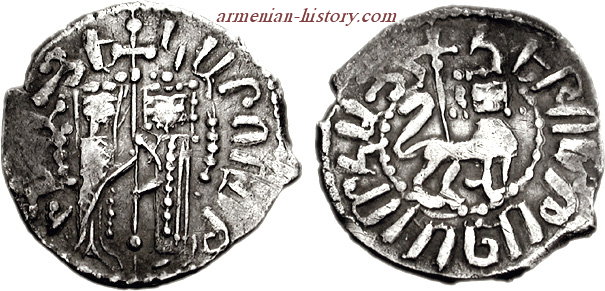
Double Dram (Tram) Silver Coin of Levon II (1187-1219) – King of Armenia (Cilician Armenia)
Coin inscription
Armenian – “ԼԵՒՈն ԹԱԳԱՒՈՐ ՀԱՅՈՑ” Translation “Levon King of Armenians”
Armenian – ԿԱՐՈՂՈՒԹԲՆ ԱՍՏՈՒԾՈՅ Translation “By the Will of God”

Pope names terms
In sending the crown to the new king, the Pope had demanded that he subscribe to several conditions, all relative to divergencies existing between the rites of the Armenians and those of the Latins. “When you have adopted these rites,” the Cardinal of Wittelsbach told him, “you will not have to trouble yourselves about the gifts and dues which you have to offer to the emperors and the Pope as tokens of Fealty for your crown. But if you refuse, IВ am instructed to demand of you very large sums of money in gold, in silver and precious stones.”
The conditions were as follows:
- To celebrate Christmas and other feasts of saints on dates adopted by the Latins.
- To recite in the church the prayers of the hours of the day and night — which practice had ceased in Armenia since the invasion of the Arabs.
- To break fasting on the day before Christmas and Easter (Christmas Eve and Easter Eve) by permitting the use of fish and oil.
Leon called the Katholikos and the bishops together and asked them how to reply to the proposition of the Latins. Upon their refusal to accept the stipulations, he said, “You need not be disquieted. IВ will satisfy them for the moment by dissimulation.” The bishops then gave their consent, and twelve of them signed the engagement.
Pope, Emperor and Khalifa recognize Leon
The coronation took place with solemn pomp, in the presence of fifteen bishops, thirty-nine feudal barons and a great number of feudal knights. The Khalifa of Baghdad sent presents. The assumption of a royal title was an act of great importance for the Byzantine government. Cilician Armenia was now shaking off its vassalage to the Empire; but a Byzantine denial of recognition of the new King would have been tantamount to defiance of the Crusaders. The Emperor, AlexiusВ III Angelus, took the wiser course by sending Leon presents and a crown, accompanying them with this counsel; “Do not put on your head the crown of the Romans, but the one we sent you, because you are nearer to us than to Rome.” It is believed by some that Leon had been given a crown three years before, inВ 1196, by the Byzantine Emperor.
The Frankish crown did not in any way modify the attitude of Leon towards the principality of Antioch. InВ 1203 he sent an expedition to enforce his claim against BohemundВ IV, but his army was defeated by the Knights Templars, who were supporting the usurper.
After inflicting a decisive defeat upon the Sultan Melik-ed-Daher of Aleppo, Leon again took up arms against BohemundВ IV and his allies, among whom were now enlisted the Templars. At the same time the Armenian King appealed to Pope InnocentВ III for adjudication of the dispute. The Pope delegated two Cardinals as arbiters. One of them, Cardinal Peter, made hasty and arbitrary decisions against the young prince, and finally, exceeded his authority by going so far as to excommunicate Leon. The Armenian King was not of a type to brook such treatment. In retaliation, he expelled all Knights Templars and Latin clergymen from his domain and detained the Princes of Antioch and Tripoli in confinement.
Furthermore, without waiting for the reconsideration of the case by the King of Cyprus and the Patriarchs of Jerusalem and Antioch, as recommended by the Pope, Leon again laid siege to Antioch. AВ great number of its leading citizens were by this time turned against the usurper Bohemund. They opened one of the gates, through which the Armenian troops made a triumphal entry, to be welcomed with music and song. Thereupon, inВ 1211, the ceremony of the installation of Raymond-Roupen as the ruler of the principality took place, with the Latin patriarch presiding. Leon gave to Raymond-Roupen in marriage his wife’s sister Helvis, the daughter of Amaury deВ Lusignan, King of Cyprus and Jerusalem. He also obtained from OthoВ IV, the German Emperor, the promise of a crown for his grand-nephew and protГ©gГ© as King of Antioch.
Later on the ban of excommunication was lifted from Leon by Pope HonoriusВ III, who also placed Raymond-Roupen and the state of Antioch under the protection of the Holy See. During his conflict with the Latins, Leon had entered into an alliance with TheodorusВ I (Lascaris), Emperor of Nicaea, by giving in marriage Philippina, the younger daughter of his brother Roupen. Through this coup, the western and northern frontiers of the country were to be made secure against the Seljuks, who had already erected a kingdom in the center of Asia Minor.
The Armenian King’s policy, however, did not undergo a fundamental change. According to chroniclers, Leon had visited Cyprus on the occasion of King Richard’s marriage with Princess Berengaria, even acting as one of his groomsmen. He had also sent Armenian contingents to the aid of the French and English forces during their siege of Ptolemais (St.В Jean d’Acre).
The Royal Court of Armenia
Leon organized his court and government after the pattern of those of Antioch and Jerusalem. He adopted courts of justice similar to the Assizes of Antioch — the Assizes of Jerusalem being in force among Christians of Syria and Palestine. The Latin and French languages began to be used by the clergy and court, together with the Armenian vernacular. The relationship between the Crown and the feudal lords became closer. Old titles and designations of rank were replaced by European ones, such as comte (count), baron, sir, countstable (connГ©table, constable); the last-named being an adopted form of the sbassalar, a agricultural or military commander. Leon created also two bailles (bajulus), in accordance with the practice of the Assizes of Jerusalem; one to protect and educate the future Queen, the other for the administration of the business affairs of the Crown. There were also a marshal, chamberlain, chancellor, a great cup-bearer (bouteiller), a grand courier (head of the King’s messengers), all in accordance with the customs of the courts of Europe, though a few functionaries survived from Greek originals — such as the Proximos, a financial officer of the kingdom, and the SГ©bast and the PansГ©bast.
Leon reserved to himself the right of bestowing knighthood upon the feudal barons under his suzerainty. By the extension of the royal authority, a great number of semi-independent barons became subject to him, thus expanding the frontiers of the State and including seventy-two fortresses within an area measuring two days’ march in width and sixteen days’ march in length. Almost all the passes of the heights of Taurus and Amanus had been incorporated within the Armenian kingdom, and many of them entrusted to the care of European knights — the Templars, the Hospitallers and others.
Commerce of the Armenians
The economic development of his realm was another major object of Leon’s concern. Situated between three competing elements — Latin, Greek and Moslem — Cilician Armenia enjoyed the advantage, from a commercial point of view, of serving as a link between East and West. The harbors of the Cilician coast, although not adequate for war galleys, afforded good shelter for such commercial vessels as came to cast anchor there. The Armenians, well acquainted with the trade routes of the Euphrates and Tigris, of Persia and India, had better knowledge than others of the value of Oriental goods in the western markets. They also came to an understanding with the Sultans of Iconium, the Khalifas of Baghdad and the Emirs of Aleppo with regard to duties on importations and exportations. After the fall of almost all Western Asia into the hands of the Moslem powers, the caravans began to move in comparative security between the Indus River and the Euphrates. The commerce formerly directed towards the Greek regions of Asia Minor were now gradually diverted towards Cilician Armenia, the new rendezvous of western navigators. Under LeonВ II, son and successor of the great first King, European merchants began to flock to Tarsus and Adana, and the harbor of Ayas was full of European masts. The republics of Venice and Genoa, whose business houses, once flourishing in Byzantine cities and on Syrian coasts, seemed now to be in decline, found a promising new field in Cilician Armenia. Both Venetian and Genoese merchants, always keen rivals with each other, were favored by a reduction of duties upon their transactions; they paid no more than one percent or nothing at all. But all others — those of Montpellier, Provence, Pisa, Sicily,В etc. — had to pay from two to four percent adВ valorem. However, when a later King of Cilician Armenia married a Sicilian princess, the Sicilian merchants were also placed upon the favored list.
The European merchants found in these emporiums all kinds of Oriental products — spices, perfumes, incense, soap, gems, raw silk, the fine textiles of India, the rugs of Iran and many other desirable articles. Out of this transit traffic, the Armenians derived immense benefit, the royal treasury being enriched by huge customs revenues.
King Leon is spoken of in Armenian history as “the Great” or “the Magnificent.” He was endowed with superb qualities, indeed, and achieved notable successes in the political, military and economic advancement of his nation, although he was not always entirely scrupulous as to the means he used to obtain his ends. It should be understood that the ethical standards of the period were inevitably lowered by the incursions of barbarians and the bitterness of conflicting interests. However, Leon fully deserves the admiration of his people for his beneficent innovations, his pious and charitable foundations and his progressive legislation. He prohibited the sale of Christian slaves to non-Christians, he established asylums for lepers — then numerous in the East — and enacted many measures for the welfare and prosperity of his subjects.
Queen Zabel (1219-1252)
Before his death, Leon designated for the throne his daughter Zabel (Isabelle), born of his second wife, Sybille, the daughter of Amaury of Lusignan, King of Cyprus and his queen, Isabeau Plantagenet. The young princess was proclaimed Queen under the regency of Adam of Gastin. But Adam was assassinated by Ismaelites (Hashishins) and the Baron Constantin, of the Hetoumian family was nominated as Baille or guardian. At this juncture, Raymond-Roupen, son of RaymondВ III of Antioch and Alice, daughter of RoupenВ III (who had been forced to abdicate as Prince of Antioch) set up a claim to the throne of Armenia and backed it by force of arms. But he was defeated and captured in the plain of Tarsus by Constantin, and executed. In order to clinch his military success over the Latins with a political stroke also, the Baille Constantin now (inВ 1222) arranged a marriage between the young princess and Philip, son of Raymond the One-Eyed, the Frankish Count of Tripoli. Philip’s treacherous nature, however, soon made his position untenable. In violation of his sworn pledge to “adopt the Armenian way of life (HayГ©nag), to maintain the church and altar in Armenian fashion, and to respect everybody’s right,” he betrayed the interests of the Armenians and offended their sensibilities. He even despoiled the royal palace, sending to Antioch not only its ornaments and treasures, but the royal crown itself. He was deposed after a reign of three years and confined in a prison in Sis, where he died, presumably poisoned, two years later.
The next step taken by the Baille Constantin leaves us in doubtas to his real motives. Zabel was then scarcely twelve years old but the Baille announced his intention of giving her in marriage to his own son, Hetoum. Some of the barons, resenting the idea of placing such power in the hands of Constantin, the master of the fort of Lambron, arranged the escape of the young Queen to Seleucia Trachea (Selefkeh), where her own parents were then living. The Knights Hospitalers, to whom the defense of the fort at that place had been entrusted by King Leon, were expected to protect the young princess, but when the Baille’s troops came to invest the place, Bertrand, the Grand Master of the Order, then also on the defensive against the Sultan of Iconium, was compelled to yield. Zabel was removed to Tarsus and consented to marry Hetoum, her guardian’s son, who, ipso facto, was to share the royal authority with her. The coins minted during that period bear the effigies of both Zabel and Hetoum.
Hetoum I (1226-1270)
Hetoum I was a vigorous and handsome young man when he ascended the throne, and his reign was longer than that of any other king of Cilician Armenia. But the beginning of his rule was inauspicious. Sultan Kaikobad of Iconium (Konya) invaded the country, forcing Hetoum to make territorial and economic concessions. In fact, coins were even struck, bearing the name of the Sultan in Arabic on one side, and that of Hetoum in Armenian on the other.
Invasion of Jinghiz Khan
At this time appeared on the eastern horizon the terrible Jinghiz Khan (Genghis), the scourge of the 13th century, advancing with his hordes from the wilds of Mongolia towards the West. He had already devastated northern China, northern Persia, Greater Armenia and Georgia. All the princes of Asia Minor, Christian and Moslem, united their forces in the hope of repelling this dreadful conqueror. Jenghiz Khan eventually fell back to Kurdistan, where he was assassinated inВ 1227.
Oktai-Khan
But the Mongol peril was not yet dispelled. Oktai-Khan (1227-1241), son of Jinghiz, took up the work of destruction in the countries west of the Caspian Sea. This was a world disaster, unprecedented in its swiftness and ferocity. InВ 1235 almost the whole population of Gandzak (Elizavetpol), was exterminated by the Mongols. The pillage of Lori, Ani and Kars followed two years later, and inВ 1242 came the destruction of Karin (Erzerum), Caesarea and Sebast, all ruled by KaikhosrouВ II, the Sultan of Iconium.
As the frightful wave of blood and fire approached his frontiers, Hetoum hastened to declare his submission to the Mongols. But their Khan, Batchou, demanded the surrender to him of the mother, wife and children of the Sultan of Iconium, who had taken refuge in Armenia. Hetoum regretfully submitted to the barbaric demand, upon which Kaikhosrov invaded Cilicia in revenge for this violation of the laws of hospitality. However, Hetoum, now supported by theВє Mongols, drove the Sultan away from his domain.
Alliance with Mongol King
The Armenian King, giving proof of his far-seeing diplomacy, then took another bold step towards the conclusion of an alliance with the all-powerful Mangou, the head of the Mongol princes. He repaired in person to the latter’s court, was received by him with honors, and after concluding the alliance, returned home triumphant and confident.
Strange destiny for an Armenian King! ” to travel the whole length of Asia to meet, in the depths of the mysterious wilds of Scythia, a barbarian overlord. Fortunate it was that the Armenian monarch had contrived to form an alliance with these pagan hordes which, after devastating the land of Ararat, were now turning their armed might against the Mohammedans.
The Kingdom of Cilician Armenia – Mongol Invasion

New scourge from Egypt
And now another scourge appeared on the scene to harass western Asia. The Memlouks were originally a cavalry corps established in Egypt from Turkish and other slaves sold to the Egyptian Sultan by Jinghiz Khan. In 1251 they seized the government, made one of their own number Sultan, and held power for more than 250 years. Bibars, their Sultan (1260-1277), took the field inВ 1266 with the fixed intention of wiping out all the Latin states in Western Asia. He invaded Armenian Cilicia at the moment when Hetoum was again on his way to the Mongol Khan’s court in quest of aid. The two royal princes, Thoros and Leon, strove to repel the foe, but their army was crushed, Thoros falling on the battlefield and Leon being taken prisoner. The Memlouks captured the most important centers of the country — Amuda, the fortress of the Knights Templars, Sis, Missis, Adana, Tarsus, Ayas — slaughtering the inhabitants as they went. Two years later, inВ 1268, Antioch itself fell to the Sultan. Almost every man in the city was butchered and the women were distributed among the soldiers. The booty taken was enormous.
Hetoum finally obtained peace from the conqueror, though on very harsh terms. His son Leon was given his freedom in exchange for some forts on the frontier and the release of Sonkor al-Ashar (the Red Falcon), the Sultan’s favorite friend, who had been captured by Houlagou. Soon after the return of his son, Hetoum, weary and disappointed, gave up the throne and retired to a monastery, where he died inВ 1270.
Leon II (1270-1289)
His son Leon was endowed with many good qualities. He was pious, generous and sagacious. He encouraged scholars. The Bible and several works of former Armenian writers and translators were copied under his auspices. However, he suffered many griefs, domestic and otherwise. Pestilence took away a great number of his subjects. Among other harrowing circumstances were the intrigues of several of his feudal barons who wavered in their loyalty to the throne. And while he was laboring to improve the morale of his people, a formidable army, led by the emirs of the Sultan, invaded his country without the slightest pretext. Lacking adequate means of resistance, the Armenians were doomed to a dreadful fate. The city of Tarsus was taken, the royal palace and the church of St.В Sophia burned, the state treasury looted, 15,000 civilians killed and 10,000 taken captive to Egypt. Almost the entire population of Ayas, Armenian and Frankish, perished.
Invasion by Bibars
A graphic account of that invasion is given by Makrizi, an Arab historian;—
“On the third day of the month of Shaban, 673 (Feb. 1st 1275), the Sultan left the castle of the Mountain, took the route of Syria and entered Damascus. From there he set out at the head of his soldiers and Arabs. The Khazinadar (treasurer) and the emirs having made an incursion” (into Armenia) “by land, surprised the city of Missis and killed all its inhabitants. They had brought with them on mule dismantled boats, which were to be used in crossing the Jihoun and the Nahr-i-Aswad (Black River), but these were not needed. The Sultan at the head of his troops rejoined the two emirs after crossing the Nahri-Aswad.”The army, despite numerous obstacles encountered en route, captured mountains and collected a prodigious spoil of oxen, buffaloes and sheep. The Sultan made his entry into Sis in battle array, and celebrated there a solemn feast. He sacked the city and demolished the palace, the belvederes and gardens of the takafor (king). AВ detachment sent by him to the defiles of Roum (Gates of the Taurus) brought in Tatar (Mongol) prisoners, among whom were a great number of women and children. The troops sent to the sea-coast seized many vessels, whose crews were slain. Other columns, in their drives through the mountains, captured and massacred the inhabitants and took quantities of booty. One division set out for Ayas, and finding that city undefended, despoiled and burned it. About two thousand Franks and Armenians from among its inhabitants who hadВє taken refuge on the vessels in the harbor were drowned. An incalculable quantity of plunder was seized.”
AВ contemporaneous Armenian writer, Vahram of Edessa, gives the following details in his rhymed chronicle ”
“They” (the Egyptians) “put to the sword all whom they caught on the plains. Only those who had taken refuge in fortified places escaped the carnage. All others, with no exceptions, were captured. Hemming in all our country, they laid the torch to everything. Tarsus the Great, the magnificent and illustrious city, was ruined. They burned the church of St.В Sophia and gave the city over to pillage.”
Leon Fights Valiantly
Armenia, however, was not yet completely beaten; her struggle against heavy odds continued relentlessly. Leon now efficiently supported by his nobles, succeeded in a few encounters. His uncle, the General Sempad, the grand old man of Armenia, marched to meet the Memlouks, whilst the King himself, with another force, undertook a detour to strike the enemy in the rear. Sempad lured his foes into a mountain pass and dealt them such a mortal blow that the bodies of the dead impeded the flight of the survivors (1276). Enraged at this reverse of his army, Bibars was about to launch a new expedition when he died from a wound received, according to some chroniclers, from an Armenian archer.
This victory, however, cost the Armenians dearly. They lost three hundred knights, and their General, Smbat, was accidentally killed when his horse hurled him against a tree. In appreciation of Leon’s valorous deeds, the Mongol emperor sent him a superb sword, offering also to turn over to him all the lands in Mesopotamia which had been conquered by the Mongol armies. Leon declined this offer, however, pleading very justly that the responsibility of defending two kingdoms would be too difficult for him.
Battle of Homs
Cilician Armenia had enjoyed a peaceful breathing spell of nearly four years when hostilities between Mongols and Memlouks broke out again. Mangou-Timor, at the head of 50,000В Tatars, supported by a Christian contingent of 25,000В Armenians and Georgians, clashed with the Sultan Malek-Mansour of Egypt in the plains of Homs, Syria, inВ 1281.
The allies suffered a crushing defeat, and the conquerors, pursuing the Armenians, entered Cilicia.
At length, through the mediation of the Commander of the Templars, a treaty of peace, to last ten years, ten months and ten days, was concluded between LeonВ II and the Sultan inВ 1285. But the terms imposed upon the Armenian monarch were very harsh. He was to pay an annual tribute of one million silver dirhems; to release all imprisoned Moslem merchants, indemnify them for their losses; to surrender the fugitives, to grant the Moslems full freedom to trade, even in purchasing slaves, whatever their nationality or religion might be. The Sultan, in turn, agreed to release prisoners and grant certain freedoms, except that he would not hand back fugitive Moslems or such Armenians as had embraced Mohammedanism. Leon was forced to subscribe to these onerous demands, but he enjoined the Genoese merchants of Cilicia from selling Christian slaves to Moslems or to nations dealing with them.
The remnants of the Latin principalities in the East were all in the same sad predicament as was Armenia. The chief concern of each was naturally the maintenance of its own existence; and there seemed no other way to achieve this than through compromise with the enemy. Certainly it could not be accomplished through armed resistance. Since the fall of Antioch the Armenian state was completely isolated from Christian or civilized contact; nevertheless, the peace treaty, harsh and humiliating though it was, gave it a respite of about eleven years, during which time Leon wisely carried on the work of relief and rehabilitation. Foreign vessels were again to be see visiting the port of Ayas, and commerce received a new impetus.
By his wife, Queen Ann (Kyr-Ann), Leon had eleven children, nine of whom survived him.
Hetoum II (1289-1297)
Christendom in the Levant was in a critical situation when Leon’s son HetoumВ II, ascended the throne. The Memlouks, now in possession of the principalities of Edessa, Jerusalem and Antioch, assumed an arrogant, even threatening attitude towards Armenia and the remaining Latin states. Melik Ashraf Kalaoun, the successor of Bibars, disregarding the treaty ofВ 1285, demanded the surrender to him of the cities of Marash and Behesni. Urgent appeals by the Christians to Pope NicholasВ IV and to King PhilipВ IV of France were of no avail. The Crusading fervor was almost entirely extinct. Nearly twenty years had past since the last unsuccessful Crusade under LouisВ IX (St.В Louis). Western European states were now competing with each other to win the favor of the Memlouks. King Alfonso of Aragon, King Don James of Naples and the Genoese Republic had already concluded treaties of commerce with them. And while Europe appeared to have forgotten its crusader colonies in the East, Kalaoun was pursuing his conquests, slaughtering male Christians and carrying their wives and children into captivity. Tripoli fell inВ 1289, and within two years Acre, Tyre, Sidon and Beirut suffered the same fate.
InВ 1292 Melik-Ashraf-Khalil, the son of Kalaoun, advanced to the Euphrates and invested Romgla, the residence of the Armenian Katholikos and a most important stronghold, which was being defended by Raymond, maternal uncle of Hetoum. After a siege of thirty-three days the place was taken, all the men were put to the sword, while the women and children, together with the patriarch Stepanos (Stephen), were taken captive. In the hope of staving off the complete destruction of his country, Hetoum abandoned to the enemy the cities of Behesni, Marash and Till Hamdoun.
Disasters in Egypt
Serious disasters — aВ deadly pestilence which swept the country, and bloody palace revolutions — now dealt severe blows to Egypt. Had any vestige of power or spirit remained in the Latin principalities, they could have taken advantage of this opportunity to revolt. But their morale was at its lowest ebb. Hetoum entered into negotiation with Melik Adil Zein-ed-‘Din Ketbougha (1294-1296), who had just seized the Egyptian throne from Nassir-Mohammed. As a result, the Moslem prince set free a part of the prisoners captured at Romgla, and restored the church vessels and relics taken from the same place.
King Thoros (1293-1295)
Discouraged by his many misfortunes, Hetoum abdicated inВ 1293 in favor of his brother Thoros and retired into a monastery; but in a short time he was forced again to take the reins of the state, at the instance of Thoros himself. This was for the purpose of making another appeal in person for aid at the distant capital of the Mongol Empire, now weakened by dissensions among the descendants of Jinghiz Khan. AВ truce having been patched up at the Tartar court, the old treaty of alliance with the King of Armenia was renewed. On his return to Sis, Hetoum was overjoyed at finding there two Byzantine envoys whose mission was to ask the hand of his sister Ritha-Marguerite for the associate Emperor, Michael Palaeologus.
Hetoum, more churchman than prince, and cherishing a real loyalty to the Papacy, longed to spend the rest of his life in spiritual seclusion; but he could not escape from his country’s pressing political necessities. After the marriage of his sister — who now took the name of XenГ©-Marie — to the Byzantine sovereign, Hetoum went to Constantinople on a state visit to his brother-in-law, turning the Regency over to another brother, Sempad.
Smbat and Constantin (1296-1299)
But this prince forthwith proceeded to usurp the throne. Hastening homeward, Hetoum found himself arrested and put into confinement by Sempad. He was released, however, by another brother, Constantin, who imprisoned the usurper, but who, in turn, seized the throne for himself.
During the short period of Constantin’s reign, a few months inВ 1299, the Egyptians made renewed incursions into Cilicia with two armies, one under the command of Bedreddin Bektash, and the other under that of Takieddin Mahmoud. The forces of two other emirs, who were advancing towards Ayas, were almost entrapped in the mountains by the Armenians, and saved themselves only by headlong flight. Several forts and towns on the eastern frontier of the country also were captured by the emirs of Aleppo and Hama — who, however, had to evacuate almost all of them because of the approach of a Mongol army.
Hetoum II returns to power
Hetoum now ousted Constantin and took the reinsВє of government again. Soon thereafter the Mongols reappeared in Syria, and supported by the Armenians, they won a great victory over the Memlouks near Homs (1299), drove them out of the valley of the Orontes and captured Damascus. This turn of affairs enabled the Armenians to regain all their possessions in Cilicia and vicinity. Four years later, however, the Egyptian Sultan took revenge near DamascusВ (1303) by crushing the allied Mongol and Armenian armies in the great battle of Merj-us-Safer. From the battlefield King Hetoum fled directly to Moussoul, where Ghazan Khan, the Mongol ruler, was then holding court.
For many years, Christian and Moslem priests had been competing with each other to win over the Mongol chiefs, each to his own faith. The precarious situation of the Frankish principalities of the Levant, due mostly to the growing indifference of Europe, and the increase on the other side of the military power of the common enemy, tipped the scales in favor of the Prophet. Hetoum and his successors were still being treated as allies by the Mongols, which fact served to intensify the irritation of the Egyptians against the Christians.
Hetoum crushes the foe
At this time Hetoum finally laid aside his royal power, and designated his nephew LeonВ III, sixteen years old, son of ThorosВ II and Marguerite deВ Lusignan, as his successor (1303-1307). But the young king had scarcely been crowned when an army of Memlouks under Kush-Timur menaced the country. The retired monarch, still Regent, emerged from his monastic cell once more, took the field in company with the youthful king inВ 1305, gave the marauders such a beating in the defiles of Bagras that few of them survived to reach their base at Aleppo.
Hetoum attempts church union
One of the deplorable episodes in Armenia’s long story of domestic friction occurred about this time. Some of her statesmen, backed by certain representatives of the higher clergy, had long favored a closer tie with the Roman Church, as proposed by the Papacy, in order to obtain more effective aid from Western powers. King HetoumВ II, an ardent advocate of this idea, convoked a general assembly or synod at Sis inВ 1307, composed of forty bishops and many dignitaries, lay and clerical. They adopted a resolution, ratifying the desired union of the churches, despite vehement protestations from the people at large, including women, who now began to be vocal in national affairs. Some of the opposition leaders, unfortunately, were so intransigent as to betray their own leaders to the enemy.
Mongols slay Leon and Hetoum
General Bilarghou, the representative of the Mongol Khan, who nursed a grudge against Hetoum for having prevented the erection of Moslem mosque in Sis, took advantage of this situation. He invited King Leon and the Regent, together with forty nobles, to Anazarba, as if for discussion of pressing political matters. As soon as the guests were inside the tent of the Tartar general, he unsheathed his sword and shouted, “Allah is great!” That was the signal for his soldiers to fall upon the Armenians and to slay them, including Hetoum and Leon, to the last man (Nov.В 18,В 1308).
Oshin (1308-1320)
Oshin, the fourth brother of Hetoum, who by a fortunate circumstance, was not present at this gathering, upon hearing of the dastardly murder of his brother and nephew, immediately placed himself at the head of a royal regiment and pursued the Mongol troops out of Armenian territory. He then returned to Tarsus, where he was crowned as King. His religious views were similar to those of Hetoum, and he thus aroused a violent opposition to himself among some of the nobles, beclouding and imperilling the early years of his reign.
The trend of thought of those days may be better understood from an incident recorded by the Armenian historian, Samuel of Ani” This year (1309-1310), there convened at Sis, the capital of the Kingdom, a multitude of monks, priests and deacons, as well as Vartabeds (doctors of divinity), bishops and many people who refused to accept the use of water in the chalice of the mass, as well as other innovations. The King Oshin in accord with the Katholikos and the grandees, seized all of them and confined the Vartabeds in the fortress. He put to death a considerable number of men and women, and some priests and deacons; then putting the monks aboard a vessel, he exiled them to Cyprus, where most of them died.“
Armenia in Cypriot troubles
Amaury, Prince of Tyre, had married Isabelle, sister of Oshin; and because of this fact, the King of Armenia now found himself involved in the affairs of Cyprus. HenryВ II (deВ Lusignan), deprived by his brother Amaury of his right to the throne of Cyprus, had been exiled to Cilicia and detained there by Oshin. After the death by assassination of Amaury, HenryВ II was set free and reconciled with Isabelle.
The Kingdom of Cyprus was now the last remnant of the Latin power in the Levant, the Armenian King’s dependable means of sending appeals to Europe. However, the West was no longer interested in the fate of Armenia; and the only help that Oshin could obtain consisted of 30,000В sequins contributed by Pope JohnВ XXII (1316-1334). During all this time the Egyptians and Turcomans continued their devastation in Cilicia, with the Armenians stoutly resisting in defense of their homes. But what could they hope for, isolated as they were in the midst of an ocean of enemies?
Leon IV (1320-1342)
Upon the death of Oshin his son LeonВ IV inherited the throne at the age of ten. His father had named Oshin, Count of Gorigos, as regent of the kingdom. This nobleman, a brother of Isabeau, first wife of King Oshin, was the uncle of the young sovereign. The Regent proceeded to make his own position secure by marrying Joanna, widowed Queen of King Oshin, also giving his daughter Alice in marriage to the little King, which ceremony required a special dispensation from the Pope.
Cilicia harassed again
Incursions by Egyptians, even by Tartar bands, now mostly converted to Mohammedanism, were still going on, undermining the vitality of the kingdom. Once again inВ 1322 the Pope intervened, appealing to PhilipВ V of France and to the Mongol chief in Persia. The latter sent 20,000В troops to the aid of the Armenian King, a move which caused Sultan Melik Nasser hastily to conclude a fifteen-year peace agreement. But not without profit to himself, however; the treaty specified that half of the customs revenue of the port Ayas and half of the proceeds of the sale of salt to foreigners must be turned over to the Egyptian treasury.
Nevertheless, this new relationship with the Latin World and his appeals to Europe for help brought Leon no relief. Instead, Melik Nasser, that dreaded Damoclean Sword dangling over Cilicia, angered by rumors of preparations for a new Crusade under PhilipВ VI of France, presently sent a large force to invade the country. Leon, who had taken refuge in the strong fortress of Gaban, in order to appease the foe was compelled to cede to him the entire territory lying east of the Jihoun River, together with seven other castles, also handing over 16,000В gold dinars (about 50,000В dollars), to indemnify the Egyptian merchants who had sold cotton to Venetian exporters, now fled from Ayas without paying their debts. And finally, to give full satisfaction to the Sultan, the Armenian King took a solemn oath, with his hand on the Gospel and the Cross, never again to have any dealings with the Franks, or to “send envoy or letter to the Pope of Rome.”
Latin church party
Having purchased security from the perpetual enemy at least temporarily, and at such tremendous cost, LeonВ IV cared little for the wave of resentment within the country, caused by his own arbitrary policy in religious matters. An Armenian Vartabed, named Johannes of Kerni, with the cooperation of a Dominican monk, established in Eastern Armenia a branch of the latter’s order called the “Unitor”, — the object of which was to engraft Latin practices upon the Armenian church. These men introduced the Latin language into the Liturgy and declared the Armenian sacraments void; they rebaptized laymen and reordained the clergy. The movement was favored by the King, who thus became the leader of the Latin party, as opposed to the Nationalist party headed by the Katholikos JacobВ II. The friction between the two cults assumed such proportions that the Katholikos threatened to excommunicate the King, but found himself check-mated when the King deposed him from office.
The young King’s lack of proper education and his bad temper added much to the gravity of the national situation as he became of age. But though his conduct was reprehensible, history should not pass judgment upon him before considering the conditions in which he lived and acted. The caprice, arrogance, avarice and murderous lust for power of Oshin, his guardian, undoubtedly had a deplorable effect upon the young prince’s character. Oshin had eliminated by death or exile all those who refused to cringe to him. Isabelle, his own sister and Amaury’s widow, was one of the Regent’s victims. Four of their five children lived in Cilicia; of these, two died, allegedly poisoned, and the other two were driven out of the country.
King Leon is slain
Upon reaching maturity, the King found it impossible to endure his uncle’s iniquities any longer. At last, in a fit of temper, he ordered the execution not only of Oshin, but of his brother Constantin, and finally of his own wife, accusing her of infidelity. InВ 1333 he married Constance Eleanor, daughter of FrederickВ II of Sicily and widow of HenryВ II of Cyprus.
The religious struggle within the kingdom was brought to a tragic end inВ 1341, by the assassination at the hands of Nationalist extremists, of LeonВ IV at the early age of thirty-two.
French-Armenian Dynasty: End of Kingdom
Guy de Lusignan (1342‑1344)
Having no male issue, Leon had chosen as his successor Guy de Lusignan, the fifth son of his father’s (Oshin) sister Isabelle, who was living in the Greek islands at the time when his mother and brothers lost their lives in Armenia. The throne thus passed to a French petty royal family, and the preponderance of this foreign influence portended a great change in the national life. Guy, also known as Constantin II, nephew of Henry II of Cyprus and a close relative of the Imperial family of Byzantium, accepted the offer of the crown after some hesitation, and entered Armenian territory, escorted by an armed force.
The powerful neighboring Moslem states, uneasy over this change in the royal line of Armenia and at the tightening of the connections between that country and Europe, now sought a pretext for intervention by demanding payment of the annual dues which they had been collecting from Leon IV. Guy rejected their demands and for a time succeeded in thwarting their attempts to collect the money by force. Meanwhile, following the policy of his immediate predecessors, Guy was endeavoring to bring about a union with the Roman church, in the hope of receiving the military and financial aid so indispensable for the safety of his country. He sent two embassies to Avignon, France, the new seat of the Papacy, and convened an assembly to discuss the terms of the proposed union. The King’s project was rejected by some of the nobles, who preferred to obtain peace through concessions to the Moslems rather than try to withstand them, relying on help from the West. During a riot fomented by his enemies, Guy, together with many of his Frankish bodyguards, was killed after a brief reign of two years. This, says the chronicle of Jehan Dardel, the friar confessor of Leon V, the last king, was “grand dommage pour la chrétienté que la mort d’un si bon prince, car il était hardy, preux et de moult grand entreprise.”
Constantin III (1344‑1363)
The nobles now elected Constantin, son of the Marshal Baghdin (Baldwin) of Neghr, who had died in the dungeon of the Emir of Aleppo in 1336. He was the first of the kings of Cilician Armenia in whose veins ran no drop of Hetoumian blood; but he was related to the royal house through his marriage with Marie, daughter of Oshin, the Baille, and Jeanne of Anjou.
The first domestic act of the new king was a shameful portent of his future course. With the intention of uprooting the Lusignan connection from the local scene, he confiscated all the property of the Lady Soultan, a daughter of King Gorgi VII of Georgia and wife of Jean de Lusignan, the brother of King Guy-Constantin II. The King then confined the princess, together with her two sons, Bohemund and Leon, aged five and two years respectively, in the island-castle of Gorigos. Warned of further treacherous designs of the King, the Lady Soultan succeeded in escaping, with her children, to the island of Cyprus on a fishing boat. The King of Cyprus, Hugues IV (de Lusignan), took the refugees under his protection, the little boys being the grandsons of his paternal uncle.
Invaders ousted
The Armenians, compelled to battle during all this time against their enemies, once again lost the port of Ayas. The situation was growing worse day by day, and there were no signs of any intervention or aid from European powers. Thanks to the help of Dieudonné de Gozon, the Grand Master of Rhodes, the port of Ayas was given back to Armenia in 1347, but about the end of the same year the place was blockaded by the Egyptian fleet, and the Turcomans of Iconium (Konia) marched on Tarsus. Sultan Nassir, however, died about this time and disturbances arising in Egypt over the question of the succession weakened the Memlouks’ war effort, with the result that the Armenians, in the next few years, recaptured Ayas, Alexandretta and other territory, and drove away all the marauding bands.
Later on, in 1359, the troops of Sultan Melik-en‑Nasser Hassan invaded Cilicia, laid waste all the land and carried away an immense quantity of booty. The Moslems of Karaman in the meantime, besieged the seaport of Gorigos, which, however, was rescued in 1361 by King Pierre I (de Lusignan) of Cyprus.
Pierre I of Cyprus
The Cypriots thereupon equipped a fleet of one hundred and forty-six galleys, which was joined by the naval forces of the Knights of Rhodes and those of the Pope. Pierre, at the head of this great force, won some signal victories; the notion of inciting Europe to embark on a new Crusade began to seethe in his mind. Accordingly, he set sail for Venice and thence to other capitals of the West, where he succeeded, with the support of Pope Urban V, in arousing some interest and obtaining a considerable sum of money.
Constantin IV (1365‑1373)
In 1363 Constantin III died without leaving any heir. One party in the capital appealed to the Pope, claiming the succession for the heirs of Guy. Urban V, however, preferred Leon, a kinsman of Pierre of Cyprus. But the Nationalist party, scorning the Papal wishes, elected the son of Hetoum the Chamberlain, nephew of the Marshal Bohemund, the father of Constantin II, and enthroned him as Constantin IV. Pierre consented to the “fait accompli”, and lent the new sovereign his full support against his foreign enemies. Other Western nations — the Venetians, the Genoese and the Aragonians — remained neutral. They had signed commercial treaties with the Sultan of Egypt, despite Papal threats of excommunication against Christians who dared to trade with Moslems.
Raid on Egypt by Pierre I
Pierre I, undismayed by their indifference, organized an expedition and sailed from Venice in 1365 with a fleet of thirty galleys, carrying knights and soldiers of several nationalities — French, Italian, German, English and Greek. With this little army composed of 10,000 infantry and 1,000 horsemen, he made a landing at Alexandria, Egypt, and sacked the city, but abandoned it when a counter-attack was being launched by the Memlouks. From Egypt he turned northward and devastated all the Syrian coast, finally arriving in front of the Ayas, which he could not reduce because of the Armenian King’s failure to give him assistance.
The King of Cyprus then returned to the West for additional subsidies and troops. While in Venice, he received a deputation which offered him the crown of Armenia. He took the matter seriously, for, sailing from Venice in 1368, he reached Cyprus with the intention of proceeding to Cilicia to be crowned king of that country; but he was assassinated in Nicosia, by some of his own nobles.
The death of Pierre emboldened the Egyptian, Syrian, and Anatolian foes to commit further ravages in the country. It was during this period of desperate and heroic resistance shown by the Armenians that there arose the intrepid figure of Libarid the Valiant, the last great Armenian general, whose very name spread terror and unwilling admiration among all the Moslem nations of the Near East.
As to King Constantin IV, he was, according to Jehan Dardel — not a wholly unbiased reporter — a tyrannical and selfish ruler, indifferent to the welfare of his country and to any possibility of its deliverance from its Moslem oppressors. He was finally assassinated in 1373, during a palace revolution. His wife, Queen Marie (Mariam), the widow of King Constantin II, who seems to have been always active in political affairs, sent ambassadors to his uncle, Philip of Tarentum (Southern Italy), titular emperor of Constantinople, and then to Pope Gregory XI, who endeavored to rally all Europe to the support of Armenia.
Unfortunately, a quarrel arising between Christian nations was to result in the loss, for all time, of the cause of Christendom in the Levant. Some petty wrangle over precedence between the Venetians and the Genoese flared up in Cyprus. The island was devastated by the Genoese, who then levied a tribute upon it of 40,000 sequins. Upon the restoration of peace, Pierre II was crowned at Nicosia as King of Cyprus, and in Famagusta, as King of Jerusalem (January, 1372).
Pope Urges Aid to Queen
Leon, the only surviving grandson of Zabel (Isabelle) of Armenia, had been brought up in Cyprus. Pope Urban V had, as early as 1365, favored him for the throne of Armenia, but the prince had been detained in Cyprus by various intrigues and exigencies. Even before the assassination of King Constantin, the rebellious nobles had confided the regency to Queen Marie. In a letter written on February 1st, 1372, Pope Gregory XI informed Philip IV of Tarentum, that, “Marie, the Queen of Armenia, niece of Philip of Tarentum, requests that the Pope may come to her aid against the Moslems, who have put her realm in great danger. She has sent as ambassador to the Holy See, Johannes, Bishop of Sis, who expresses a wish that the Queen may find a husband from among the Latin princes, capable of defending and governing Armenia. The Pope urges Jehan, Prince of Antioch, Regent of Cyprus, the Venetians, the Genoese and the Knights of Rhodes to help the Armenians. He names Othon of Brunswick, a man combining the necessary qualities, to become the consort of Marie.”
Leon De Lusignan chosen as King
But the pontifical letter had no effect. Queen Marie thereupon sent to Pierre II of Cyprus a deputation consisting of the knight Leon of Hamous and two prominent citizens of Sis. The letter credential which the deputation presented was a request for the dispatch to Cilicia of Leon de Lusignan, as the rightful heir to the throne. It was concurred in by the Armenian nobility and clergy, and the two queens, Marie and Jeanne. But Leon, a feudatory of Pierre II, because of the fiefs of his wife, Marguerite de Soissons, was not able, however, to set out at once for Cilicia. The chief reason for the delay, as alleged by King Pierre, was the troubled state of the island due to the recent incursions of the Genoese; but another and major reason was the lack of funds with which to finance the journey.
The Armenian envoys returned home by way of Gorigos, the only port that had not fallen into Moslem hands. They were accompanied by the Knight Constant, equerry of the King-elect, and by Manuel the interpreter, to act as guardians of the royal treasury. Upon arriving outside of Sis, these man had to cross the lines of Bektimour, the Governor of Damascus, who had invested the capital — though he was later forced to raise the siege.
Leon Blackmailed for Permission to Leave Cyprus
Matters were meanwhile becoming worse for Leon in Cyprus. The piratical Genoese, now become the lords of the island, demanded as indemnity and interest, exorbitant sums from everybody — from King Pierre down to the humblest citizen. Leon, too, was forced to pay a “tax” of 280 gold livres (36,000 silver besants). His silver plate, his crown and wardrobe were seized, and restored only on payment of 300 ducats. The admiral of the Genoese fleet kept for himself the finest stone of the crown, a ruby. For permission to leave the island, Leon was compelled, moreover, to transfer to Catherine of Aragon, the mother of King Pierre, the fief of his wife, which yielded an annual income of 1,000 gold besants. Leon had also to undertake under oath not to enter the castle of Gorigos, on that west coast of Cilicia which was inhabited mostly by Armenians, but to land on the island. The Cypriots, to whom the main castle of Gorigos had been ceded by the Armenians, denied the local population the happiness of greeting their national sovereign. Leon resented this double humiliation by the Genoese and Cypriots, but refrained from expressing his feelings, for the reason that he might be forced to depend upon both for help against the Egyptians and Turcomans, who were blocking his way to Sis. By selling almost all his valuables, he obtained some cash, for which the King of Cyprus lent him a hundred gendarmes, under the command of the French equerry, Sohier Doulçart. This small force, with the addition of some cross-bowmen and archers recruited at Gorigos, was all that Leon could muster as an army with which to face his enemies. The Genoese admiral, even though he had accepted the sums of money which were sent to him, had refused to supply him with vessels with which to attack Tarsus by way of the river, “because of the trade agreement which the Genoese had made with the Saracens.”
Leon Escapes from Cyprus
Pondering the dire consequences which might result from the groundless reports of projects attributed to himself in favor of King Pierre’s rivals, Leon saw that he had not a moment to lose. He sent his wife and mother to the city of Gorigos, and, leaving the island where he had remained as he had promised, he set out with a few followers, under cover of the night, and arrived at a spot near the mouth of the Adana River, thirty miles from Gorigos. Doulçart, the knight, joined him the following day with twenty-five horsemen and as many arbalesters. Moving forward cautiously, the party had to avoid Tarsus; the rest of the journey was a hazardous one, the whole country being infested with hostile hordes. Leon procured guides from the bowmen, who were on foot, so that they might traverse shorter and safer mountain trails. Leon and his horsemen, twenty-five in all, rode two days and nights, almost without a halt. They dismounted before dawn at a distance of three miles from Sis, and sent a messenger to inform the city of their coming.
Leon V (1374‑1375) greeted with Joy
The citizens, led by the Katholikos, the bishops, priests and nobles came out in great number with music and dancing to welcome their king. They were transported with joy, for many of them had been so discouraged that they were planning to revolt, put the members of the Regency to death and surrender the city to the Moslems. Four days later, a force of a hundred and fifty armed men was dispatched to bring in the mother of Leon and the Queen. They arrived safely at Anazarba, and from there travelled to within a lieue (league) of Sis. Here, they were met by the King at the head of a procession of troops and conceptions, each one with a torch in his hand, making the occasion one of joy and festivity. Little did the jubilant throng dream that the church bells which rang for the coronation of Leon may be said to have tolled also the funeral knell of the last of the Armenian kingdoms.
Finds Empty Treasury
The first care of Leon, after the days of rejoicing, was an examination into the state of the treasury. To his bitter disappointment, he found it empty and the accounting unsatisfactory. Upon further investigation and after hearing testimony from government functionaries, he found that the members of the Regency — Mariam, the dowager of Constantin III and Baron Basile — were responsible for the defalcation. They deserved severe punishment, but Leon granted them pardon as a grace in honor of his coronation day.
Leon’s Coronation
Leon’s wish was that he be consecrated by a Roman bishop, but he found that this desire had to be modified. On September 14th, 1374, the coronation ceremony was performed twice in the cathedral of St. Sophia at Sis; first by the Archbishop of Narbonne in accordance with the Latin ritual, and then under Armenian rites by the Katholikos Boghos (Paul), Queen Marguerite of Soissons, the daughter of Jehan the Baille of Famagusta in Cyprus, was crowned in the same manner.
It is difficult now to say whether this double consecration was a political mistake on the part of Leon, but it certainly offended the Nationalist party and brought about unpleasant consequences.
Siege of Sis
Almost all important cities and castles in Cilicia, except Sis and Anazarba, were occupied by the troops of Melik Ashraf Shaban of Egypt; and two Turcoman chiefs, Davoud Beg and Aboubekr, each with eleven thousand warriors, threatened the very outskirts of Sis. Curiously enough, they did not conduct themselves like ordinary foes, but supplied the Armenians with the necessary provisions. Having received presents from Davoud Beg on his coronation day, Leon returned the courtesy and renewed the truce under the old terms. But a dissatisfied group precipitated a quarrel and Sis was subjected to siege for three months. The Frankish bowmen saved the situation by their skill, and the Turcomans were compelled to abide by the old agreement and to supply the capital with victuals, in consideration of the payment of the stipulated tribute.
The Renegade
There lived in Cairo at this time an Armenian renegade, named Ashot, son of Baron Oshin and brother of Constantin III’s wife. The anti-Latin party among the Armenians, claiming that Ashot had a right to the crown, encouraged him to come at the head of an Egyptian Army, to take possession of his domain. Jehan Dardel has given the following picture of this invasion, although some scholars do not give full credence to the story.
Treachery in Sis
The Turcoman chief, Aboubekr, a satellite of Egypt, received orders from Cairo to starve the Armenian capital. Within the city, Leon’s domestic enemies were secretly negotiating to deliver the city to the besiegers. The King, warned of the intended assault, gathered the population within the upper part of the city and in the castle, both well fortified.
The lower city did not seem likely to be able to hold out long, but the royal palace, surrounded by a massive wall and vast enough to shelter a considerable portion of the citizens, could adequately be defended. Within this enclosure, referred to by Dardel, as “the bourg”, were other edifices, among them the metropolitan church of St. Sophia. Because of the ruggedness of the rock upon which they were built, the walls of the castle were irregular and unequal in height. These irregularities divided the castle roughly into three parts, each with flanking towers and bastions, resting upon the three principal pinnacles of the rock. Open spaces separated these distinct constructions, which, however, were connected by sunken ways cut in the rock and along the precipices. The southern side, where the donjon rose, was fortified more carefully than the other points of the stronghold.
Lower City Captured
On January 15th, 1375, Aboubekr, at the head of 10,000 men, captured the lower part of the city, which was given over to pillage, but the upper city and the castle remained impregnable. The anti-Latin faction had decided to obtain peace for themselves by submission to the Sultan. The Katholikos Paul (1374‑1378), was one of the principal authors of this movement, thus “demonstrating,” says Dardel, “that he preferred the temporal domination of a Moslem sovereign to the spiritual supremacy of the Pope.”
Upper City Evacuated
In response to the appeal of the traitors, the governor of Aleppo, Seifeddin Ishk-Timour, sent 15,000 men to assist the Turcomans, and on February 24th the Egyptians were moving under the walls of Sis. More than 30,000 of the enemy thronged around the fortress, amid the ruins of the city and of “the bourg.” Leon, anticipating the final assault, assembled the grandees and the clergy, made them all swear on the Gospel to remain loyal to the Christian faith and their sovereign, and promise to die for Christ. He then evacuated the upper city and set it afire by night.
King wounded
The enemy began the attack on the following day; but the only accessible point on the steep rocks was the platform which extended in front of the gate. The besieged put up a vigorous resistance, and the King himself was manning an arbalest when he was struck by an iron projectile which broke his jaw and knocked out three teeth. He retired to the castle to have his wound dressed, while the Saracens, considerably mauled, were retreating.
That same evening Ishk-Timour dispatched a letter, informing Leon, “that his lord, the Sultan, wants him (the King) to know that if he is willing to surrender the castle and become a Mohammedan, the Sultan will make him a Grand Admiral and restore his country.” Leon’s reply was that he would perish rather than renounce his God; but he offered to pay tribute to the Sultan as in the past, if the siege were raised and his possessions restored to him.
Traitor kills King’s guards
This rebuff infuriated the Moslem commander, who thereupon intensified the assault. In the meantime he was informed by traitors of the King’s injury, and that the besieged were in a serious plight because the food supply of the fortress was exhausted. The Nationalists, moreover, won to their way of thinking the Cypriot knight, Matthew Chiappe, who had recently married the widow of King Constantin III. Chiappe was the sort who would stop at no treachery to effect his ends, even making an attempt on the life of the King. Together with a number of Frankish accomplices, he broke into the donjon where the King had his quarters, and killed Leon’s Armenian guards to the last man. The King in great fear for the life of his wife and twin infant daughters, imprisoned in the donjon at that moment, took refuge in Queen Mariam’s rooms. He offered to pardon the insurgents, but in vain, and a terrific struggle ensued. Four times the loyal Armenians attempted to enter the donjon, and each time failed.
Leon yields
Meanwhile the rebels were letting the enemy in by means of ropes. A Jacobite friar, a companion of the Bishop of Hebron, who happened to be among the prisoners in the donjon, secretly let Armenians enter who took possession of the fort. Other conspirators instigated the mob to turn against the King, and determined to give the place over to the enemy, they admitted them into the outer works. Leon, wounded and in bed, had beside him only his wife and children and the faithful knight, Sohier Doulçart; a few soldiers still defended the donjon keep. Resistance being no longer possible, Leon sent an emissary to enemy headquarters.
Fall of Sis. End of the Kingdom
Receiving a letter of safe conduct from the Egyptian commander, Ishk-Timour, Leon, though scarcely able to walk, rose from his bed, his wounded head in bandages, and descended from the tower, accompanied by his family and escort. And so, on April 13th, 1375, only ten months after his landing on Armenian soil, Leon V gave up his sovereignty, and with it the last Armenian kingdom passed out of existence.
The Memlouk general made a triumphant entry into the city of Aleppo with the captives in his train — the Armenian King, his Queen and children, the Dowager Queen Mariam, the knight Souhier Doulçart, his wife the Countess of Gorigos, the Katholikos Boghos I, many Armenian barons and dignitaries of Sis. These captives were forced, on many occasions, to prostrate themselves before the conqueror in public. From Aleppo, Leon was taken to Cairo, where he arrived in July. The coming of the Armenian captives brought on a three-day public celebration, noisy with the beating of cymbals and other instruments. Thereafter, yielding to the entreaties of prominent Armenian residents, the infant Sultan, or rather, his all-powerful minister Barquq, released Leon for detention, and allowed him a daily pension of sixty dirhems and privileges accorded to royal prisoners. Nevertheless, he was always under strict police surveillance.
It is through the chronicle of Jehan Dardel, the Franciscan monk, a native of Etampes in France, that the events of the short and tragic reign of Leon V are known to us. This monk’s judgment upon the “Armins” (Armenians) is quite severe, but mature reflection upon the desperate state of the last defenders of the Christian kingdom against the Moslems and the famine that raged within the castle of Sis, may win for them some indulgence in their final recusancy.
Cilician Armenia Continuously harassed by foes
From the day of the unfurling of the banner of revolt by Roupen, to the hour of Leon’s emerging from the castle for his capitulation, Cilician Armenia was a scene of almost perpetual warfare. Hundreds of times its towns and countryside were devastated by the invading Moslems, and its people slain or carried away into slavery. And the fall, one by one, of the Latin states of the Levant, inevitably undermined Armenian morale and fortitude.
For other wrongs suffered by the unfortunate kingdom, most of the blame rests upon the Armenians themselves. On many critical occasions, when the nation was threatened by a foreign enemy, religious intolerance and political and personal ambitions within the State, divided and betrayed it. The call to patriotic duty would have been more eagerly heeded by the Armenians, of course, had they not been disheartened by the action of their fellow-Christian nations, both near and to the west, who sacrificed spiritual and moral interests for the sake of temporal and material gain. It was not unusual for an Armenian landlord to be attacked by a Frankish baron — sometimes backed by a Moslem chieftain also. This explains why, several years after having been greeted as God-sent messengers, the “nation of the Franks” was referred to by Michael the Syrian in his chronicles as “oblivious of all benefactions lavished upon them.”
De Morgan’s praise of Cilician state
“Whatever it may be, says de Morgan, “the Cilician state, founded by men from far off in the East and Europeanized through its contact with the Crusaders, has left a beautiful page in the grand epic of the Middle Ages. Despite troubles and wars, in the midst of the greatest dangers, the Armenians of Cilicia devoted themselves to literature and arts, built churches, monasteries, castles and fortresses and flourished in commerce. This principality, even in the midst of all the horrors of war, displayed a surprising vitality, by comparison with the timidity with which most other peoples of the Near East succumbed to the brute force of foreign conquerors. The heroic resistance which a handful of brave Armenians offered for three centuries, should command our recognition and admiration.”
An appraisal by Langlois and others
That this last episode in the story of Armenia is full of romance, is admitted by all those who have studied the subject. In a passing remark about the monuments of Cilicia, Gustave Schlumberger refers to it as “the glorious kingdom of Lesser Armenia.” Here is the testimony of Victor Langlois: “Numerous are those events, those brilliant traditions, — and however lamely we may follow the course of Armenia’s victories and progress; however hastily we may examine the organization of her aristocracy and clergy; however slightly we may study her relations with the Western nations and the wars which she waged against the enemies, still shall we see that . . . the historical documents of this country contain the memories of a glorious past.”
Leon is ransomed
Leon’s life in Cairo was not a happy one. He lost by death not only his wife, Marguerite de Soissons, but also his two children. In March, 1377, the King of Cyprus appealed to the Sultan for the liberation of Leon, but without success. In July of the same year, many pilgrims — nobles, knights, esquires and others — passed through Cairo on their way from Europe to Jerusalem. Among them was friar Jehan Dardel. He was invited to say mass for King Leon, engaged in long conversations with him and became acquainted with the story of his misfortunes and his hopes. He was finally persuaded to remain with Leon, as his chaplain and counselor and eventually became his ambassador. Bearing the royal ring and letters addressed to several of the sovereigns of Europe, Dardel left Cairo two years later, on September 11th, 1379. Arriving in Spain, he received from the Kings of Castile and Aragon considerable sums of money to be used toward the purchase of the liberation of Leon. These, plus 3,000 squirrel coats, a golden cup with silver and a gilt jar, at length obtained permission for Leon to leave Egypt. On October 7th, 1382, he sailed from the port of Alexandria, together with Dardel, upon whom, when they reached the Island of Rhodes, he conferred the title of Chancellor. From Rhodes he sailed for Europe, prompted not only by a desire to express his gratitude for assistance, but by new hopes for a betterment of his fortunes.
His life, thereafter, was like that of all exiled kings. The sovereigns of Castile and Aragon were generous towards him, the Pope of Avignon, Clement VII, whom Leon had preferred to the Pope of Rome, awarded to him the decoration of the “Golden Rose,” and the King of Navarre, Charles II, whom he visited, lavished gifts upon him. But these favors cost the donors little and availed the wandering monarch nothing. Nowhere did he encounter any disposition to aid him in recovering his domain.
Leon as an Apostle of Peace
Paris, the capital of France, offered the ex-king a more extensive field for diplomatic activity. He was received by King Charles VI, in a manner due to kindred royalty. The appreciation in palace circles of Leon’s “sagacity, moderation and penetration,” was of more import and value to him than the annual pension, opulent lodgings and warm affection bestowed upon him. It was because of this confidence in his guest that Charles accepted a serious proposal submitted by him. In Leon’s opinion, an Anglo-French accord was indispensable for the political rebirth of Armenia. But he observed with deep anxiety that the existing truce between these two powers was soon to come to its specified end. He hoped that he might utilize the respect felt for him by the French court to bring about an extended peace, and then appeal for their cooperation.
Having been given free access to the floor of the French Parliament, he attended the meeting in which the resumption of hostilities was discussed. The majority favored war. Those who were for peace requested the King of Armenia to become their advocate. Although “a prince of ardent spirit and great perspicacity,” he had maintained silence until then, because his knowledge of the Latin language was defective and he spoke French with difficulty. However, he now took the floor and spoke as follows;—
“Honorable Dukes, I must admit that the desire of revenge for injuries inflicted on one’s homeland is a noble sentiment. And yet, with the permission of the King, I must say also that it would be advisable, even to forgo this legitimate revenge, to comply with established rules, and to avoid anger, which always leads to tragic ends. I think, therefore, that although your enemies have often violated truce pacts, you would in the present case be wise to beware of precipitate steps, and delicately invite them to conciliation. If they obstinately remain haughty and implacable, the justice of your cause will be more manifest. Your ancestors have ever adopted this policy. For my part, I shall be ready, if it pleases you, to undertake any mission in this affair, so that the sincerity of my word may be unquestioned. No friendly connection whatsoever binds me to the English, and yet an appeal by me may, perhaps, be more fruitful than one by a delegate from your own nation, against which they cherish inexorable hatred.”
These utterances of Leon carried weight. He had been unfortunate during his brief reign, but he was not a stranger to the diplomatic field. Although short of stature, “he was great in valor, ardent in spirit and exceptionally clever in practical dealings. His exquisite civility won distinction for him. His external grace and decorum were the characteristic marks of princely lineage.”
Leon in England
The dethroned King of Armenia was at last dispatched to England as an envoy of the French Government. King Richard II considered it a rare honor, enjoyed by none of his predecessors, to welcome such an eminent prince to his realm. Attracted both by the luster of Leon’s fame and the repute of his bravery, the English monarch was moved to offer him a reverential hospitality. He sent a number of high functionaries of the palace and dignitaries of the court to meet the guest, while he himself went forth with a mounted escort to the approaches of the city, where he greeted and embraced Leon affectionately, manifesting by words and countenance his joy over the arrival of the royal delegate.
A true delineation of the efforts of Leon for peace, is beyond our power; but we possess a precious document — the text of the speech delivered by him before King Richard and the Lords in Westminster Palace at the beginning of the year 1386. It is as follows;—
“I wish to tell you, not by way of flattery, but prompted by brotherly love, that the people of the Orient have until now admired your accomplishments, and they would not forbear to praise you, had you and France consented to achieve friendliness between you. But fate compels me, helas! to make a sorrowful and bitter confession. It was only because of your discord that the unbelievers were able to oppose me victoriously with their arms. I declare to you that I, once a king and now an exile, ruled in tears and mourning. The fickleness of force cast me into an abyss. Henceforth, the Crown is to me only a mournful adornment, and the royal turban once the decoration of my brow, will be as a veil of sacrifice, destined to immolation. O mighty princes! had you been willing to dedicate the support of your arms to Christ, the Christians of the East, who were saved by the blood of Christ, would not have been condemned to languish in grief, misery and slavery. The places long identified with the Christian faith, especially the Holy Cradle of Jesus in Bethlehem, and Zion, glorified through His miracles, would not have been subjected to the intolerable yoke of the Turks, Saracens and Persians. You, however, straying from the true course, have been supplying deadly weapons against the Christian world.”Through a stretch of full sixty years, neither side can boast of anything but invasion and destruction of cities, the plundering or burning of villages and the imprisonment of the inhabitants of the countryside. The war was marked by alternate successes, the net result being only bloodshed. Tell me, I adjure you, which side is the winner? Let men of experience and erudition answer. If you boast of your victories, you must at least confess that their cost is too high. Should you count the French fortresses subjugated by you — all but one, by the way, lost already — your opponents might retort that it is better to preserve a country than to expand its frontiers. Illustrious princes, if I am to speak the truth rather than utter honeyed words, I shall not hesitate to declare that the motive which has so far kept the flame of war alive, is your ambition to invade France. The kings of that country had, by long possession, assured themselves of the crown which they had so valiantly earned; and if the strength of a throne is based upon the obedience of its subjects, I must consider the throne of France unshakable. The hostility between the two nations has dragged on too long. In my opinion, both rivals should be implored to be satisfied with their vast territories, to cease the struggle between their peoples, so that they might be able to smite the enemies of Christ and to throw off the yoke of the Christians scattered through the Orient — those Christians who are day by day waiting for your help and humbly solicit it, O exalted princes!”
Here ended the exhortation of Leon. His audience was moved and felt deeply the urge of chivalrous sentiment and Christian duty. The English King, too, expressed his disposition towards new negotiations and willingness to postpone warlike preparations in accordance with the request of “our cousin, the King of Armenia,” (nostre cousyn, le roy d’Armenye).
Leon returned to Paris, uplifted by ardent hopes. Once more parleys were held, but the desire objective, alas! was not realized. War was again declared and carried on with the usual fury and obstinacy.
Last years of Leon V

Leon’s later visits to the courts of European rulers were a series of glittering pageants. He was greeted at the wedding of the King of Castile as the best man, and was honored with the title of Chief Magistrate of the cities of Madrid, Villareal and Andujar. He received magnificent gifts and pensions from the Spanish monarchs, as well as those of France and England, and was everywhere promised aid in his political ambitions. None of it ever materialized, but he never ceased hoping until his death which occurred November 29, 1393, in the royal palace of Tournelle, in the Castle of St. Ouen, where he had spent his last years. His funeral was largely attended by royalty and nobility, who witnessed with curiosity the strange Armenian burial services, and the use of white mourning garb instead of black. He was buried in the monastery of the Celestins, but during the French Revolution, his ashes, together with those of other sovereigns, were scattered to the winds. His tomb was later placed in the basilica of St Denis. The epitaph thereon reads (in translation), “Here lies the most noble and excellent prince, Leon de Lysigne Fifth, the Latin King of the Kingdom of Armenia, who rendered his soul to God on the 29th day of November, in the Year of Grace, 1393. Pray for him.”
Leon left two sons, Guyot, who became a military captain, and Philippe, who was ordained an archdeacon.
After the death of Leon, Jacob I, King of Cyprus, a kinsman and heir, assumed the title of “King of Cyprus, Jerusalem and Armenia.” The last of the Lusignan family, Catherine Cornaro, the Queen of Cyprus, was the daughter of the Knight Marcus, grand-daughter of the Doge of Venice. On her death in 1510, the line of the Lusignans of Cyprus was extinguished, and the title of “King of Armenia” abolished.
The other captives from Sis, Katholikos Boghos and several dignitaries, had also been released. Ex‑Queen Mariam, the Count of Gorigos, Cilicia and his princely wife Fimi, departed to Jerusalem and spent their latter years in the Armenian convent of Sourp Hagop (St. James). Mariam, also known as Maroun, had a daughter, Josephine Pinna, who passed away in Jerusalem in 1405. Their tomb is in the Armenian Convent.