Tigranes the Great – Տիգրան Մեծ
Tigran II, known as Tigran the Great (Տիգրան Մեծ), was one of the most powerful king in Armenian history, ruling from 95 to 55 BCE. His reign marked the peak of Armenian influence, expanding the kingdom into a major regional empire that rivaled Rome and Parthia.
Early Reign and Parthian Bargain
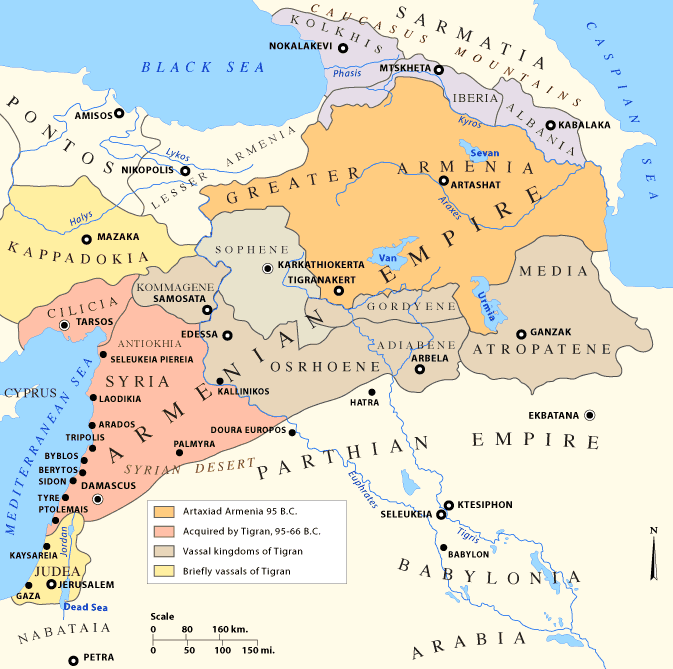
Tigran II, younger brother of Artavazd II and ruler of Armenia from 95 to 54 B.C., obtained the throne by ceding to the Parthians the districts which their predecessors had wrested from the Medes and Iberians, a seizure which supplied the excuse for the expedition of Mithridates II of Parthia. A quarrel arose between him and King Ardan (or Vardan) of Sophene, and Tigran attacked the latter, vanquished him and took over his domain.
When Euphratean Armenia was thus suppressed, Tigran’s kingdom then extended from the valley of the Kur to Melitine and Cappadocia. Mithridates VI of Pontus, who aspired to the annexation of Cappadocia, sought an alliance with Tigran by marrying one of his daughters to him. So by the treaty which followed the marriage, Cleopatra, a girl of courage as well as high education, became the Queen of Armenia.
Rome drawn into imbroglio
The ensuing invasion of Cappadocia in 93 B.C. compelled Ariobarzan, its king, to yield and hurry to Rome for aid. His appeal won a ready response. The great Roman general Sulla came to Asia Minor, reinstated Ariobarzan on his throne and forced the Armenian army to retreat to the east bank of the Euphrates. The Eastern allies did not, however, admit defeat. The civil war which raged in Rome in 90 B.C. gave them the opportunity of regaining their advantage on the field of battle, and once more Ariobarzan was put to flight.
Conquests and the “King of Kings”
Tigran’s star was now in the ascendency. When Parthia’s great king, Mithridates II, died in 86, Tigran felt himself equal to the task of proving his supremacy over the Parthians. He recaptured the lands which had been ceded to them, and marched still further to seize Atropene, Gordiene and a part of Mesopotamia, thus once more subjugating the territory of old Nairi-Urartu. To this were soon added the domains of Adiabene, Mygdonia and Osrhoene.
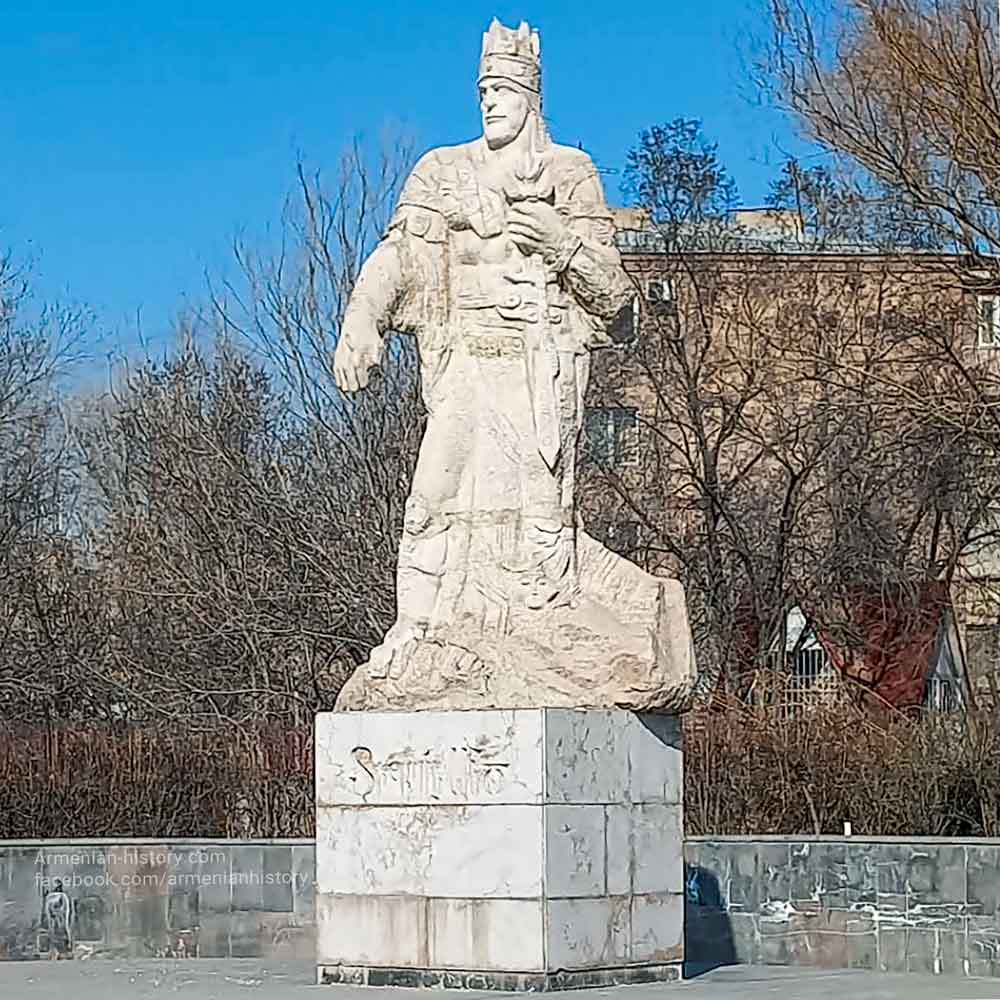
The Armenian armies penetrated further into Greater Media and reduced its capital, Ecbatana, in whose royal palace Tigran had once been held as a hostage. It of course followed that he had now become the “King of Kings,” a title which he inscribed on his coins. So the supremacy of Asia, which had belonged to Parthia under the Achaemenids and Seleucidae, was in this triumphant moment transferred to Armenia.
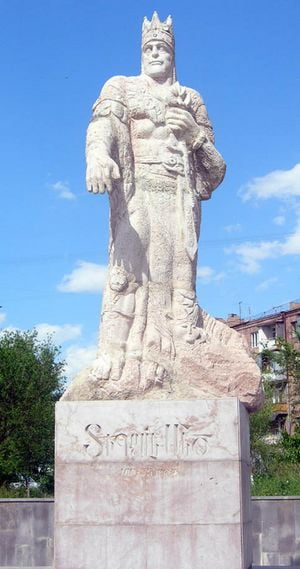
Tigran’s glory attained its apogee when he was invited to Antioch in 83 B.C., and offered the crown of the Seleucid dynasty. Syria, which had long been torn by internal strife, under Tigran’s rule enjoyed full peace for eighteen years. His power reached even beyond the confines of Syria proper, to include Palestine on the south and Cilicia on the west. But like most Oriental monarchies, his kingdom was only an assembling of uncongenial peoples, with no cohesion.
Building Tigranocerta: A New Capital
The expansion of his domain to the south and west made necessary the creation of a new and more centrally located capital. Artashat (Artaxata), the old capital, isolated in a remote province, lay too far to the north. Tigran therefore built in the southern part of Armenia the new city of Tigranocerta (Tigranakert), named in his honor. It was probably northwest of Nissibin, at the foot of the spurs of the Taurus chain. As one enthusiastic writer says, the city seemed to spring from the earth as if by enchantment. In the splendor of its palaces, gardens and parks, in the richness of its ornaments and stored treasure, it is thought by some to have rivalled Nineveh and Babylon. Its walls were fifty “brasses” or fathoms (300 feet) high, and stables for the horses were built into their lower parts. The royal palace was in the suburbs, surrounded by a park, in which were many dens for wild game and ponds for fish. Tigran also constructed a strong fort near the palace.
By royal order, the grandees of Armenia were compelled to transfer their residence to the new city. Thousands of Greek families were deported from Asia Minor, as were others from Adiabene, Assyria, Gordiene and Arabian Mesopotamia, to build up the population of the new capital, which at once took on a cosmopolitan character.
Oriental pomp
Tigran’s public appearances were spectacular. He displayed all the pomp and magnificence becoming to a successor of Darius or Xerxes. Theoretically an equal of the gods, he clothed himself in a tunic striped in white and purple, and a mantle entirely purple. He always wore everywhere (even when hunting) a tiara of precious stones. Four of his vassal kings stood about his throne, and when he rode forth on horseback, they ran on foot before and beside him. When he received persons upon affairs of state, these kinglets stood around him, “with crossed hands.”
Hellenistic Influence
As polygamy was the rule in the East, great numbers of concubines were kept in a gynaecium, where Cleopatra ruled as Queen. Although the entire region was oriental in all traditions, under the influence of the scholarly Queen, Greek manners and culture were to a certain degree introduced into the kingdom. The royal princes were taught the Greek language and sciences. Tigran himself, called upon to occupy the throne of the Seleucidae, could not have been a stranger to Greek art and letters. A theater was built in Tigranocerta, and the King invited Greek actors there to give performances in their own language. According to historians the plays performed were of the Bacchic or sensual type. Metrodorus, the Greek writer, a native of Scepsis, in Troy, once a minister of Mithridates, spent several years in the palace, writing the life and achievements of Tigran. Unfortunately, his history has not been discovered. Another famous Greek, Amphicrates, the rhetorician, was among those invited to Tigranocerta. Artavazd, the King’s son, wrote dramas and histories in Greek. Remains of his works survived as late as the first century A.D.
Tigran was forty-seven years of age when he married Cleopatra. By her he had three sons, two of whom were slain by his own hand; one of them during a rebellion, when the son took up arms against his father. On another occasion, while hunting, Tigran fell from his horse, and a second son, instead of rushing to his aid, picked up his father’s crown and placed it on his own head; whereupon the infuriated King struck him dead. The third of these sons, also named Tigran, having expressed profound regret and sympathy for his father at the time of this accident, was given a crown by Tigran, but later on he too revolted against his father. The son, Artavazd, who succeeded Tigran, was not the child of Cleopatra.
Despite some objectionable aspects of his social, domestic and public life, Tigran deserves honor as a torch-bearer of Hellenistic culture. “The two great kings of Pontus and Armenia,” says Jacques de Morgan, “were the last ones capable of reproducing in their states the beautiful civilization of Hellas.”
Contradicting Mommsen’s assertion that the Armenian and Pontian struggles were reactionary movements, Professor Manandian claims that Tigran’s progressive measures met strong opposition in Armenia from the old partisans of Oriental ways of life. He further declares — and is supported by other scholars — that the conquests and achievements, as well as the wealth and prosperity attributed by Khorenatsi to Tigran I, should be credited to Tigran II, the Great. Khorenatsi, misled by ancient popular songs and traditions, ascribed even the building of Tigranocerta to Tigran I, who lived 560 years before “the Great.”
The Lucullus Campaigns
However, great though Tigran II was in ability, the empire created by him was doomed to be short-lived and a mere flash of lightning in history because of Roman ruthlessness and the mad audacity of his father-in‑law Mithridates. The verbal treaty made between Sulla and Mithridates in 84 B.C., was only an armistice. Murena, the Roman governor of Asia, arbitrarily and without the approval of the Roman Senate, renewed hostilities, but his attacks were repulsed. Mithridates appealed to Rome for peace, but in vain; the internal politics of Rome required brilliant victories abroad.
Lucullus came to Asia with a powerful army and navy, and Mithridates, forsaken by his own officers, was badly beaten, even his son seeking favor with the invaders. There was nothing left for him but to take refuge in Armenia.
Tigran alone hesitatingly promised him aid, though it meant fighting not only the Romans but also the Parthians, who (according to Gutschmid) held a bitter grudge against him and were already formally at war with him. Plutarch, always ready to besmirch Tigran, attributes to him a cold and unconcerned attitude towards his father-in‑law.
Other historians give us a different picture of Tigran, who in answering a demand by Lucullus for the surrender of Mithridates, replied: “The whole world and my own conscience would condemn me if I should surrender the father of my wife to the enemy.”
Oppressions of Lucullus
The outcome was inevitable. The entire territory of Pontus was seized by the Romans and pillaged. The large and flourishing cities of Heraclea (modern Eregli) and Amisus (modern Samsun) were ruthlessly sacked and destroyed. Not content with enormous sums of money demanded as war indemnity from the impoverished population, all private property — lands, houses, personal adornments of women — were subjected to heavy taxes. The people, reduced to bankruptcy by the rapacious conqueror, had, in the space of only fourteen years, acquired a debt of 2,000 talents, about $20,000,000.
Lucullus had been secretly planning a sudden assault on Armenia, without a declaration of war. Immediately after the rejection of his peremptory demand for the person of Mithridates, the Romans marched upon Tigranocerta. Upon his return from a Phoenician expedition, Tigran had refused to believe the news of the appearance of Romans on Armenian soil; but now, facing the cold reality, he issued orders for resistance, at least to the extent of retarding the movements of the enemy. But it was now too late. One of his generals, Mihrbarzan, at the head of an infantry division and 3,000 cavalry, was defeated and slain in an engagement with the vanguard of the Roman army under Sextellus. The Armenian troops were dispersed Tigran, upon hearing of this disaster, fled to the northern part of his country, leaving his treasure and wives in Tigranocerta.
Another Roman force under Murena pursued him hotly and seized his baggage. Meanwhile, Sextellus invested the new capital and captured the suburbs and the palaces situated outside the walls.
Allies in Tigran’s army
Tigran still possessed enormous resources in the form of territory, money, soldiers and munitions. Encamped on a plateau on the northern slope of the Armenian Taurus, he reinforced and reorganized his army. In response to his appeal, the Kings of Adiabene, Atropatenes, Iberia and Albania came to his aid, as well as some Arabian chiefs. Having thus collected an army, whose numbers some estimate as high as 100,000, and learning that Lucullus had laid siege to his capital with a comparatively small force, Tigran disregarded the advice of Mithridates to surround the enemy and cut off its supplies, and instead, thought only of rescuing his treasures. A corps of 6,000 of his cavalry succeeded in piercing the enemy lines by night and bringing off the women and a part of the valuables.
Now emboldened by this achievement, Tigran sallied forth with his main army, in the hope of scattering the besiegers. When he reached a height from which Tigranocerta was visible in the distance, Lucullus left Murena with 6,000 cavalry to watch the city and prevent a sortie, and himself marched with 10,000 infantry and some horsemen to meet the King. “If they are coming as emissaries,” Plutarch represents Tigran as saying, as he looked down in some perplexity upon the small advancing force, “they are too many; if as antagonists, they are very few.” The story that he made such a remark is derided by Manandian, in view of the inaccuracy of the quoted strength of the two armies.
Plutarch gives 14,000 to 15,000 as the number of Lucullus’s troops; Ammianus and Mommsen accept this estimate and place the strength of Tigran’s host at 300,000. This great disparity of 1 to 20 has been questioned by several scholars, who propose 70,000 to 80,000 as the number of the Armenian army, and add to the Roman forces the number of their Anatolian allies, another 15,000, thus reducing the ratio 1 against 2, or thereabouts.
Armenian disaster
It was an autumn day, October 6th, 69 B.C. when this milestone in Armenian history was reached. Lucullus began the attack by leading two cohorts up a hill which Tigran had neglected to occupy. From there the Romans dashed down upon the cavalrymen, who recoiling from the shock, fell back upon the infantry, throwing the latter into disorder. Within a short time the army of Tigran was defeated and scattered, and the King in flight lost his tiara and diadem.
Tigran and Mithridates could not avoid the fact that their situation was critical. All the provinces lying south of Taurus were lost. Greek troops entrusted with the defense of Tigranocerta mutinied, and despite the efforts of Mancius, the commander of the place, these mercenaries surrendered to the Romans the portions of the city they were supposed to defend. So with the promise of the Romans that the wives and property of the alien citizens be spared and they be repatriated to their respective homelands, Tigranocerta fell. The city was then given up to plunder. The booty was enormous; the treasury alone contained 8,000 talents in gold coin, not to mention other riches hoarded there. Each Roman soldier received 800 drachmas as his share of the spoil. In the still uncompleted theatre, the victory honoring Lucullus was celebrated.
Lucullus spent the winter (69‑68 B.C.) in Gordiene, seeking alliances among the petty kings of the neighborhood, who were ready to shake off the yoke of Tigran. The Roman labored to win the friendship of Phraates, who had succeeded old Sanatruk on the throne of Persia. Phraates, however, held aloof, for he had received messages from Tigran and Mithridates which informed him that the Romans were casting greedy eyes upon his empire, too. Lucullus had in fact been contemplating an attack upon the Parthians, but his army was not just then in condition to undertake a campaign. He broke camp around the end of spring, to cross the mountains separating the valley of the Tigris from the plain of Mush, and arrived in Armenia at the right season, when the wheat was not yet ripened.
Tigran’s army, reinforced by Mithridates, had taken strong positions on hills, while the cavalry, commanded by the King himself, endeavored to cut the Roman’s supply line. Lucullus, at the head of his legions, ascending the valley of Arzania, marched towards Artashat (Artaxata). This ancient capital of Armenia contained much wealth, including the remainder of King Tigran’s treasury.
Indecisive battle
Tigran, maneuvering to draw the Romans away, marched along the opposite bank of the river, menacing the enemy’s rear. The armies met in battle in September, 68. The Median cavalry and Iberian lancers at first seemed invincible, but when Roman infantry forded the river and attacked them, they took to flight. While these fugitives were being pursued by the Roman horsemen, Tigran attacked the legions, and Mithridates harassed them from the rear. For a moment the Romans were in real peril, but Lucullus, plunging desperately with his cavalry into Tigran’s own regiment, threw Mithridates into confusion. The armies drew apart after both had suffered heavy losses, but the result was indecisive, and the allies were able to execute an orderly retreat and occupy new positions in force.
Lucullus retires from Armenia
Artashat was still far out of reach of the Romans, and the Armenian summer was near its end. After the Roman army had marched a few stages, its advance was halted by a sudden cold wave and heavy snowfall. This, climaxing his failure to crush Tigran during several months of campaigning, discouraged Lucullus. He abandoned the project of reducing Artashat, and moved back towards the South, consoling himself with the capture of the city of Nissibin, in Mygdonia, whose governor was Guras, Tigran’s brother. During the eight years of this campaign, with no decisive victory, the Roman army appeared to have become a mere convoy for the loot which Lucullus took from cities, temples and palaces for his own private gain, and which made him a wealthy man and a noted gourmand for the rest of his days.
As Lucullus withdrew into Mesopotamia, Tigran and Mithridates returned to their countries. The King of Pontus even fought an engagement against a lieutenant of Lucullus and killed 7,000 of his troops. The allies took the offensive soon after this, again invading Cappadocia and driving the Romans out of Pontus. Tigran eventually became the master of all the provinces north of the Tigris River. So the Romans lost all the gains of recent years; the great victories of Lucullus vanished like a dream.
Tigran in his old age had the misfortune of seeing his home broken up by domestic dissensions. Although the children which Cleopatra gave him were impatient to reign, none of them did. Zareh, who was the first to revolt, together with several other malcontents, lost his life in battle.
Decline and Surrender
Rome could maintain her Asiatic possessions only by continuing the mortal struggle to crush Tigran and Mithridates. Pompey, who succeeded Lucullus in 66 B.C., was now at the head of considerable forces in Cilicia. After spending the winter in that country, he marched against Mithridates. The King of Pontus had been struggling hard to win an alliance with the Parthians, but the emissaries of Pompey forestalled him and succeeded in concluding a pact with Phraates. As for the younger Tigran, Pompey offered to Phraates, his father-in‑law, aid in undertaking a powerful diversion in his favor in Armenia. While Pompey, at the very first encounter, put Mithridates to flight, Phraates and young Tigran penetrated into Armenia, compelling the old king to retire to the mountains; but they lost much time and drained their strength in a siege of Artashat, which offered a stiff resistance. Phraates, lest a longer absence augment domestic troubles, finally returned to his country. The younger Tigran was defeated by his father and fled to the Roman camp.
Pompey set out towards Artashat with his army, but was still fifteen miles away when the heralds of old Tigran appeared, followed by the King himself. He had come humbly to ask for peace. At the gate of the camp, a lictor helped him to alight from his horse. When he saw Pompey, he removed his diadem, and was about to prostrate himself before the Roman general, but the latter prevented him, made him sit by his side, and consented to a peace, on condition that Tigran renounce his acquisitions in Syria and Asia Minor, and pay 6,000 talents indemnity and recognize young Tigran as the King of Sophene.
The aged, weary monarch accepted these terms, promising to the Roman troops a gratuity of fifty drachmas per soldier, one thousand per centurion, and one talent to each tribune. But his son, who had hoped to occupy the throne of Armenia, could not conceal his discontent. He carried on secret intrigues with the Parthians which were presently discovered, and he was put in chains by Pompey. This was a violation of such international law as prevailed then, and was a humiliation inflicted upon the King of the Parthians. Phraates sought the liberation of his son-in‑law but in vain; young Tigran, his wife and children were sent to Rome to be paraded in the triumph of Pompey. The peace granted by Pompey obliterated all the conquests of Tigran the Great, and reduced Armenia’s terrain once more to her ancient borders.
There were a number of reasons for Armenia’s greatness being so short-lived. She was surrounded by an agglomeration of peoples whom she could not assimilate until she could overcome the powerful Roman and Parthian influences upon them. Also, Armenia herself was disrupted by internal strifes, the result of her feudal form of government. This explains to some degree why the attempt of Tigran the Great had been unique in his country’s history, and why he, notwithstanding his mistakes and defeats, represents a brilliant page in the story of Armenia.