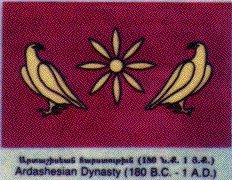
Artashesian Dynasty
Artashes, founder of Armenian Independence
The establishment of Roman supremacy in Asia Minor also brought about the independence of the two Armenian princes. With the Roman Senate’s approval, both Artashes and Zareh assumed the title of king, and gradually extended their respective domains, at the expense of various neighboring peoples. “The Armenian language,” says Strabo, “was then spoken in that entire region.” As to the wars of conquest waged during this period, we have only the somewhat unreliable narrative of Khorenatsi. He tells us how Artashes captured from Erouand, the usurper, the stronghold of Erouandakert and the district of Shirak; how later on he reduced Armeno-Media, east of Ararat, taking it from Argam, a dynast of the powerful family of the Maratzis (or Mouratsans), descendants of the Median king, Astyages-Azhtahag.
Many acts attributed to Artashes II and his son Artavazd by Khorenatsi fit better into the known picture of the historic Artashes. Even the legend related to the capture and marriage of Satenik, the daughter of the King of Alans, should be placed in the reign of the founder of the Armenian kingdom.
The newly-born Armenian kingdom had to face internal difficulties. Local princes, lords of vast domains, showed a tendency to contravene the royal authority in the provinces. But the new kings knew how to win the loyalty of these nobles of the conquered countries by respecting their prerogatives and by honoring many of them with positions, high-sounding sinecures at court.
New capital, Artashat
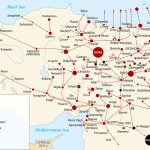
It was decided that a new capital must be created to replace Armavir, which the River Arax, by changing its course, had left dry and indefensible. The new capital, Artashat (Artaxata or Artaxhsata) named in honor of its royal founder, was also built beside the Arax, but in a strong position on an eminence laved on three sides by the river. There is a tradition that the fallen leader, Hannibal of Carthage, a refugee in Armenia after his defeat by the Romans, selected the site and planned the city. It was located near the point where the rivulet Medzamor empties into the Arax. Its ruins may be seen about fifteen miles south of Erevan.
King Zareh also possessed many strongholds. One of these, Domisa on the Euphrates, had a position of both strategic and commercial importance, being on the caravan route connecting the Halys River with the valley of the Tigris.
Troubles with the Seleucidae
The claims of the Armenian kings to independence did not long remain unchallenged. Antiochus Epiphanes, of the Seleucid dynasty of Syria, after waging successful wars in that country and in Egypt, coveted new extensions of his authority and turned his eyes towards the East. Artaxias suffered defeat at his hands in 165 B.C., but soon recovered his losses, taking advantage of internal troubles in Syria, which compelled Antiochus to return home. Artashes was thus enabled to retain his throne, and Zareh, too, was saved from peril. The former died in 160. His son and successor, Artavazd, according to legend, was subject to spells of dementia, and committed suicide while on a hunting expedition. His younger brother is said to have abandoned the government to a court dignitary, he himself preferring to live in obscurity in Akilisene.
Armenization of Asia Minor
The region lying west of this province, towards the Halys and Lycus Rivers (Kizil-Irmak and Kelkit) was colonized by Armenians, settled amidst the remnants of older populations of Cappadocia, such as the Tibarens, the Chalybes and the Cataons. This was Armenia Minor, which had its national rulers, often in alliance with those of Armenia Major, but sometimes acting independently. Armenia Minor for a time fell under the domination of Pharnac, King of Pontus (190‑156 B.C.), the most powerful prince in Asia Minor at that time. The Euphratean Armenia of Sophene escaped a similar fate, thanks to the help of the King of Cappadocia, who had guaranteed its independence in return for the cession of the fortress of Domissa. The Kingdom of Pontus, already engaged in war with the Romans, was unable to retard the expansion of Armenia, which was soon to shine with glory under Tigran the Great.
The rise of Parthia
But now a new colossus had arisen in the East. The Parthians, emerging from Bactriana, had subjugated Media, Persia, Babylonia and Mesopotamia as far as the Euphrates. Their monarchs had assumed the title of Arshak, and one of them, Tirdat I, had defeated Seleucus II and taken him prisoner. The brilliant campaign of Antiochus the Great had not arrested their surge, and the Parthians finally dominated all western Asia. Mithridates II, the Great (114‑86 B.C.) otherwise known as Arshak IX, after having assured his eastern frontiers by a great victory over the Scythians, turned his arms against Artavazd II, King of Araxian Armenia. The latter had taken from Media and Iberia many districts, the restoration of which Mithridates demanded.
Checked by Armenia
But the stubborn resistance which the Parthian King met in Armenia forced him to conclude peace, his only compensation being the taking as a hostage the heir apparent, who later became Tigran the Great. Mithridates failed in his attempt to reconstitute the ancient Persian empire, while Armenia survived her fiery ordeal and preserved her independence. But this denouement unhappily led Armenia into tempting fortune. She expanded her territory until it extended from the Caucasus to Mesopotamia and Syria, without being disturbed, either by the Parthians, occupied by internal dissensions, or by the Romans, with Mithridates of Pontus kept in check.
The kingdom of Armenia was then bordered on the north by Iberia (Georgia), inhabited by Caucasian tribes dwelling since the remotest antiquity in the valleys of the Kur and its tributaries descending from the Caucasus. The Iberians, living in the plain, had adopted the costumes and manners of the Armenians and Medes. They cultivated the land, but those living in the mountains, bellicose by nature, were devoted mostly to military activities. Artaxias and his successors had contested their possession of the portions of the Gogarene, where the Armenian element was in the ascendency. Later on, however, these two peoples became more friendly. The Armenians and Iberians, as well as the Albans (Aghuanq) were compelled to accept the supremacy of the powers which had arisen to east and west of them; but they maintained a measure of autonomy and their own royal dynasties.
Neighboring principalities
The region of Mesopotamia adjoining Armenia was divided among several independent principalities, such as Atiapene, Commagene and Osrhoene. The last-named, inhabited by Syrians and Greek colonists planted there at the time of Alexander the Great’s conquest, had Ourha or Edessa as its capital. The existence of Osrhoene dates from the time of Antiochus (136 B.C.). Its kings, all bearing the surname of Abgar, were of various origins — Syrian, Mede, Persian and Armenian. They recognized the supremacy of Rome and maintained friendly relations with Armenia.
The invasion of the Arshak, Mithridates II, had not altered the aspect of affairs in this part of Asia. But according to Khorenatsi, sixty years after Alexander’s death in 323, Arshak the Brave ruled over the Parthians in the land of the Kushans, and his grandson, Arshak the Great, conquering the entire East, bestowed the throne of Armenia upon his brother Vagharshak (Valarsaces), who thus became the founder of the Arshakuni dynasty of Armenia. This story has its elements of fact. One Vagharsh did become the first Armenian Arshakuni king, but his accession actually took place later, towards the end of the second century B.C.
SOURCES
armenian-history.com