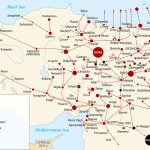
Artashesian and Zarehian Kingdoms of Armenia

Decline and fall of Seleucid Empire
Possessions in India were lost to the Seleucid Empire in 305. Fifty years later Diodorus, governor of Bactria and Sogdiana, rebelled and founded a separate kingdom. Cappadocia, Pontus, Armenia and Atrpatakan had already secured semi-independence. There after, in the third and second centuries B.C., the Seleucids were confronted with two mighty rivals в” the Parthian Arsacids (Arshakists) and the Romans.
Arsaces-Arshak I founded the Parthian kingdom in 249 B.C. His brother and successor, Trdat-Arshak II, won a victory over Seleucus II, consolidated his rule in Parthia and subdued Hyrcania, modern Asdrapat, on the southeastern border of the Caspian Sea. In the meantime Rome extended its rule over the eastern countries of the Mediterranean (218-201 B.C.) and through the Battle of Magnesia, was solidly established in Asia Minor. Rome at first made a pretense of acting as the protector of oppressed nations, but in reality its policy tended towards domination and exploitation of them all.
Artaxias-Artashes and Zariadres-Zareh, the governors of Armenia, appointed by Seleucus the Great, sided with the Romans and declared the independence of two new kingdoms created by themselves. That of Artashes was the larger. According to Strabo, it included the Caspian area ” Phaitakaran, Vaspurakan (province of Van), Phaunitis (, Taiq, Xorsene (Ardahan), Gogarene (Gougarq), Karenitis (Erzerum), Derzene (Derjan) and Tamoritis (Timoriq). In the invasion of Armenia by Seleucus in 165В B.C., Artashes suffered defeat, but he soon recovered his rights.
Armenia flourishes under Artashes
The great achievements of Artashes supplied material for many songs and folklore of ancient Armenia, some of which Khorenatsi has fortunately preserved for us. A song about the city of Artashat begins as follows: “Artashat went to the spot where the waters of Arax and Medzamor intermingle, and being pleased with the hill, he there constructed a city, calling it Arashat, after his own name. The Arax River aided him with the timber of forests; he therefore carried out the construction easily and quickly, and erected therein a temple.”
Here Khorenatsi had the legendary Armenian world-conqueror, Artashes II, in mind.
The advent of Artashes I is described by Strabo as follows: “Armenia was first ruled over by the Persians and the Macedonians, and then by the Seleucians, who had conquered Syria and Media. The last ruler, Orontes, was an issue of Hyrcanis, one of the seven Persians. The country was thereafter divided into two nations by Artaxias and Zariadres . They governed by the recommendation of the King (Antiochus the Great), but after his defeat, they reigned separately, and were declared as kings.”
The Orontes mentioned above is the Erouand of Khorenatsi’s History” though he is confused as to the exact time, place and connections. His account of the construction by Erouand of the city of Erouandashat is worth quoting:
Building of Erouandashat
“In his time, the court was transferred from the hill called Armavir, because the Arax River had changed its course, and during the long winter, when cold north winds blew, the stream froze entirely, so that there was not enough water for the royal residence. Thus discomfited and likewise in search of a stronger location, Erouand transferred the palace to the West, upon a rocky hill, almost surrounded by the Arax, with the Akhurian flowing in front. He encircled the hill with fortifications, and in many places within the wall, he cut the rock as low as the base of the hill at the river’s level, so as to permit water to run into the cisterns for the drinking supply.”
It may be deduced from the above statement that the city of Erouandashat was built about the beginning of the second century B.C., or even earlier, by Orantas-Erouand, the predecessor of Artashes I.
Frontier-Markers
Two inscriptions of Aramaean characters discovered on the shore of Sevan Lake bear the name of Artashes I, according to Prof A.В Barisov of the Leningrad Ermitage. These tower-like square pillars were probably frontier-stones, mentioned by Khorenatsi in these words:
“After all the virtuous deeds and meritorious acts he (King Artashes) gave orders to fix the limits of villages and farms, because he had increased the population of the land of Armenia by bringing in many people from abroad and settling them in mountains, valleys and plains. And for the boundaries, he established such landmarks as these; he ordered square stones hewn, and buried in the soil, with sockets cut in them and square pillars erected thereon, a little higher than the ground. Artashir, the son of Sassan, jealous because of this, ordered the same to be done in the land of the Persians, and that it be called after his own name, so that the name of Artashes would no longer be remembered. But it is said that no uncultivated land, either on the heights or on the plains, had been left in Armenia at the time of Artashes, because the country had become prosperous.
The discovery of stone landmarks with inscriptions in Aramaean letters is exceedingly important, for it proves the existence of a written literature in Armenia even before the invention of the Mesropian alphabet. This very fact, besides placing Artashes I among the great figures of history, explains the phenomenal blossoming within so short a time, of the Golden Era of Armenian literature, in the fifth century A.D.
Parthians halted by Tigran
During the reigns of the successors of Artashes I, the Parthians under Mithridates I invaded many Seleucian possessions in the East. Their conquests were expanded by the succeeding king, Mithridates II (123-88В B.C.), who had waged war also on Artavazd, the son of ArtashesВ I, and carried away as hostage the young Tigranes (TigranВ II), the king’s nephew. “The Parthians,” says Strabo, “conquered the countries of the Medes and Babylonians, but not Armenia. Invasions were repeated again and again, but the country was not subdued by force. On the contrary, the Parthians were vigorously resisted and vanquished by Tigran,” Artavazd’s brother and successor.
SOURCES
armenian-history.com