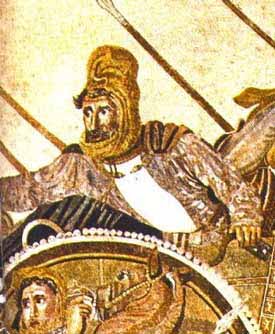
The centralized government of Darius III began to disintegrate in the fourth century B.C. The provincial satraps were
striving for independence, and the Greeks were looking with covetous eyes upon the wealth of the East. Philip of Macedonia, after unifying all Greece under his sway, was ready to embark upon an expedition against the Persians when he was assassinated. His son Alexander (336B.C-323 B.C.), overthrew the Persian Empire in three great battles, and at Babylon in 331, proclaimed himself sole ruler of the united Macedonian-Persian empire. But only eight years later, Alexander, after expanding his conquest to the borders of India, died at the age of thirty-three. Three of his generals thereupon divided his new empire among themselves, one centering his rule in Macedonia, another in Egypt, while the third had has capital at Antioch, Syria, which was founded by the general Seleucus Nicator (the Conqueror).
Greek culture
Alexander, a pupil of Aristotle, had pursued an ideal, the welding of Asia and Europe by the introduction of Greek culture into the East. He had exchanged groups of inhabitants between the two continents, had built new cities in the East and populated them with Greek colonists. He encouraged intermarriage between the two racial elements, himself taking as his bride a Bactrian princess, Roxana. It was thus that Hellenic culture literature, science and philosophy ” was diffused through Asia. This intellectual intercourse, with its accompaniment of extended commercial connections, gave impetus to the development of crafts and productivity. Cities sprang up and quickly attained opulence. Colossal amounts of gold and silver, captured from the treasury of the Persian kings by Alexander, now came into business circulation.

New era for the Armens
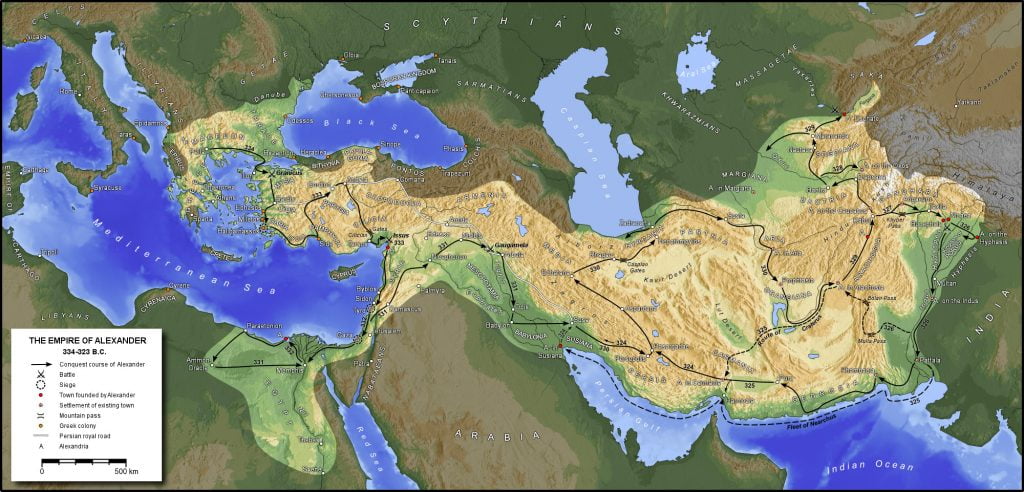
The Empire of Alexander the Great
Through the Macedonian conquests and the subsequent Seleucid domination in Hither Asia, there opened for the Armens a new era of political and economic advancement, which lasted 140В years from В 330 to 190В B.C., at which latter date the kingdoms of Artaxias (Artashes) and Zariadres (Zareh) were founded. The events of this period are not clearly recorded by national and foreign historians, but the study of Greek and Roman chronicles is helping to solve many problems and to correct erroneous assumptions hitherto adopted by many authors. The occupation of Armenia by Alexander’s forces, for example, as related by Strabo and others, should be confined to Armenia Minor, whose government had been entrusted by Alexander to the Persian satrap Mithrines (Mihran). As to Armenia proper, it had by that time its own governor, Orondes-Erouand, who led the Armen army against the Macedonians in the battle of Arbela (331В B.C.), which was the death-blow to the Persian Empire.
The kingdom of Cappadocia had been reduced by the Macedonian commander Eumenes. “But Ariarat, the son of the slain king,” says Diodorus, “escaped to Armenia in company with a few men, and later on, procuring soldiers from Ardoates, King of the Armens, fought and killed the Macedonian general, Amuntas, quickly expelled the Macedonians from the country and regained his father’s kingdom.” Reinach and other Armenists have proposed to read the above name Ardoates as Artavazdes. Marquart and Manandian prefer the reading Artoandas (Orontes, Erouand). The date of the founding of the Cappadocian kingdom through the aid of the Armen king must have been about 270В B.C.
Under the Seleucidae
The Seleucid empire stretched from the Hellespont to India. Armenia Major, Armenia Minor and Sophene maintained at that time their autonomous identity by paying money tribute to the suzerain and giving him military aid when called upon. Armenia Major then included a part of the Armenian plateau only four of the fifteen provinces of later date, namely, Fourth Armenia, Aghtzniq, Tourouberan and Airarat. In the third centuryВ B.C., the city of Armavir, in Aiaratat, was the capital of the Erouandian dynasty, known to Khorenatsi as the Haikazants, Haikazian or Araratian. Greek annals tell us of the existence under the Seleucids of native “kings” of Armenia Minor and Sophene. One of them, whose name is unknown, had, according to Memnon of Heraclea, tendered shelter and aid to Ziaelas, son of the King of Bithynia, and enabled him to occupy his father’s throne, which he did from 250 toВ 228.
Another Greek author, Polianus, says that the Seleucian Antiochus Hierax, in revolt against his brother, King Kallinikos, entered Armenia through Mesopotamia and took refuge at the court of Arsabes, the King, in 230 B.C. This monarch may be identified with Arsham, King of Sophene, who founded the city of Arshamashat, in the so‑called Beautiful Plain, between the Euphrates and Tigris. The defeat suffered by Antiochus III in 190 B.C. was a signal for uprising in all nations subject to or threatened by the Seleucid regime. The Armenian lands, though not included in the Seleucid empire, had been subjected to Hellenistic influence. The coins minted in the Armenian area during that period bear inscriptions in Greek. The province of Sophene, particularly that part adjacent to the northern border of Mesopotamia, near the international trade route, had all the advantages necessary to make it a great center. The fortress of Damissa, on the western bank of the Euphrates, was a halting station for caravans moving to or from Persia.
As another emporium in Sophene, its capital city, Gargatiokert, has been mentioned by Pliny and Strabo. Marquart proposes that the name be corrected by Argatiokerta, assuming that its founder was Argatias, son of King Zariadres of Sophene. The site of the city, according to Marquart, may be found in the ruins of the fort of Anggh, near the modern Egil or ArghanaВ Su, one of the sources of the Tigris River.
SOURCES
armenian-history.com