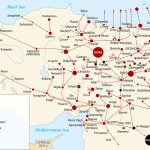
Kingdom of Urartu, Van, Ararat Kingdom – 9th-6th Centuries B.C.
A Redoubtable Foe
One of the great chapters in the history of Armenia is the epic of the monarchy which the Assyrians called Urartu but which was known to the Hebrews as Ararat. Herodotus called its people Alarodians. Urartu is regarded by history today as one of the earlier incarnations of Armenia. In Urartu was manifest not only the indomitable fighting spirit of the later Armenians, but also the same tendency towards development of a higher culture. As a noted authority, H. A. B. Lynch, remarks, Urartu was “no obscure dynasty which slept secure behind the mountains, but a splendid monarchy which for more than two centuries rivalled the claims of Assyria to the dominion of the ancient world.”Urartu,


Its Peak Years
As a nation, it lived through many more centuries than that, but it was only between 860 and 585 B.C. that it actually disputed with Assyria the right to dominate western Asia. Its beginnings are lost in the mists of pre-history. Its people must have migrated from somewhere to the west into the Armenian plateau, then for the most part known as Nairi. They called themselves Khaldians or children of the god Khaldis, just as the name of the Assyrians reflects the name of their god Assur. The cuneiform characters of their inscriptions were for centuries Assyrian; but later on the language changed to or was absorbed in the local one. The Assyrian was a Semitic language, while Urartean was neither Semitic nor Indo-European. Urartean culture is believed to have been similar to the Hittite and Assyro-Babylonian, blended with native characteristics. The later Urartean monuments still hold a mystery for us as to their affinity with the Armenian language, witness of a glorious past. It has not yet been possible to decipher these inscriptions with any aid from the Armenian language. N. Marr, Nikolsky, Lehmann-Haupt and earlier scientists have classified them as in the Japhetic speech-group, and the Armenian experts, A. Calantar and G. Ghapantsian, agree in this finding. Professor Nikolsky has found hundreds of words, both nouns and verbs, showing affinity between the Urartean and the modern Utean. As early as 1879 H. Hübschmann pointed out in the Urartean inscriptions several words and suffixes — such as ili, ini, and uni — borrowed from Caucasian idioms, especially Georgian and Aghouanian (Albanian).
Mystery of Origin
Where did these people come from? From Asia Minor, declares Lehmann-Haupt, seeking proof for his assertion in their metallurgy, architecture and folkways. Professor Shestokov, a Caucasian author, wrote in 1939 that “The oldest states of the Soviet Union were founded 3,000 years ago to the south of Transcaucasia. The oldest among them, that in the Ararat area, by the Lake of Van, was called Urartu. Its kings ruled over Georgian tribes.” Here is another theory as to the origin of the people once dwelling in Nairi, which comprised the entire Armenian plateau. Even when the greater part of that tableland became Urartu, the regions on two flanks of it, from Amit (Diarbekr) to Anzitene (Harpout), together with Habushkia in Zab Valley, and Paddira, south of Musasir, were still called Nairi. The name Nairi-Urartu reveals kinship with Hurri, Namri, Kirruri and other names with the suffix ri, having no connection with Semitic idioms.
Professor Edward Schultz was one of the first to obtain original information on Urartu, when he visited Armenia in 1827. He was murdered there by a Kurd, but his papers, containing 42 inscriptions found at Van and in its neighborhood, were saved. The later discoveries of Burnouf, Lassen and Rawlinson stimulated interest in Oriental antiquities. Layard visited Van in 1850 and took new copies of the inscriptions. Of special interest were one tablet on the rock of Van, and an inscription on a stone in a ruined wall. The first contains the name of Xerxes, son of Darius, in the same characters as those of Behistun and Persepolis. The second resembles Assyrian writings. All others are of a language peculiar to Van. Another mysterious text was read by Hincks in 1847, and following these Professor A. H. Sayce added “a new language and a new people to the museum of the ancient Oriental world.” Thereafter the known Vannic texts were doubled in extent by the German archaeologists, Lehmann and Belck, who, in the words of Lynch, called up “a vanished civilization from the grave.” But even so, alas, they could evoke only a broken and fragmentary body; so much has been lost by the ravages of war and vandalism and time.
![Urartian bell with inscription - 789–766 B.C. The Urartian cuneiform inscription reads: "From the arsenal of [King] Argishti."](data:image/svg+xml;base64,PHN2ZyB4bWxucz0iaHR0cDovL3d3dy53My5vcmcvMjAwMC9zdmciIHdpZHRoPSI2MzAiIGhlaWdodD0iMTAyNCIgdmlld0JveD0iMCAwIDYzMCAxMDI0Ij48cmVjdCB3aWR0aD0iMTAwJSIgaGVpZ2h0PSIxMDAlIiBmaWxsPSIjY2ZkNGRiIi8+PC9zdmc+)
Urartian bell with inscription – 789–766 B.C. The Urartian cuneiform inscription reads: “From the arsenal of [King] Argishti.” 
Urartu Sphinx 
Plaque fragment inscribed with the Urartian royal name Argishti (probably Argishti II), 8th–7th century B.C. 
Part of a throne with deity on a bull, late 8th–7th century B.C. 
Belt fragment ca. 7th century B.C.
![Urartian bell with inscription - 789–766 B.C. The Urartian cuneiform inscription reads: "From the arsenal of [King] Argishti."](https://armenian-history.com/wp-content/uploads/2021/03/Bell-inscribed-with-the-Urartian-royal-name-Argishti-786–756-B.C.-scaled.jpg)


Van-Tosp
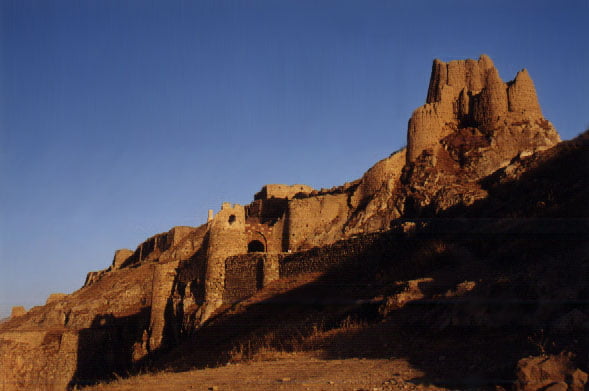
The seat of this theocratic monarchy was Thuspa, capital of the territory of Biaina, corrupted into the form Van. The Armenian national historian, Moses of Khoren (Khorenatsi), mentions Van as “in the province of Tosp.” In some of the ancient inscriptions, one finds, “King of Biaina, inhabiting the city of Thuspas.” Going back into history we find Tiglat-Pileser I, King of Assyria, asserting that he conquered twenty-three kings of Nairi in 1114 B.C. These “kingdoms” must have been very small, indeed; and when we find that this same Tiglat claimed to have slain with his own hand ten elephants and 920 lions, we are inclined to receive his statements with reserve. In an inscription of the Assyrian Assurbelkala (1077‑1060 B.C.), first appears the name Uruatru. A Shalmanaser of Assyria (1028‑1017 B.C.), claimed the conquest of “the entire country of Uruatru” in three days. In inscriptions of Ashurnasirpal (885‑859 B.C.) the name appears as Urardhu or Urarthu. The succeeding king Shalmaneser, now called by most historians the Second (859‑825 B.C.) sent an army against a king of Urartu named Aramé, whose capital was Arzasku or Arzaskun, identified with the modern Melazgerd, north of Lake Van. Aramé, who, according to Adontz, was the first organizer of the Urartean Empire, was defeated and his capital taken by Shalmanaser in 857 B.C.
Arame
To say that he was the “organizer” of the Empire, means that he combined the “Nairi countries” into a confederation under the aegis of the god Khaldis, supplanting an earlier Biaina confederation. Some authorities believe that not Aramé but Sardur I (844‑828) was the organizer of the confederation. Sardur was the son of Lutipris, who succeeded Aramé. He left an inscription in the Assyrian language, calling himself King of Sura, which, according to Professor Albrecht Goetze, is the same as Subaru. If this is so, the Urartean kings’ claim of Hurrite descent entitled them to domination in Subari, or Upper Mesopotamia. Sardur’s other titles were “Great King,” and “Ruler of Four Regions,” i.e., Shar-Kishatti, according to Babylonian and Assyrian inscriptions.
Sardur I
Sardur built a fortress of huge stones west of the Rock of Van, and Ispuinis, his son and successor, chose that rock as his residence and as the holy seat of the god Khaldis. Ispuinis was a contemporary of Adadnirari IV of Assyria, son of Shalmanaser and husband of Queen Shammuramat (Semiramis). Ispuinis fought and defeated his powerful rival, and was thus enabled to found a Khaldian colony at Musasir, west of the Pass of Kelishinin, where he erected a commemorative stone with inscriptions in Khaldian and Assyrian. Ispuinis and his son Menuas brought the empire to its peak. Under them it extended from the Zagros Mountains in the East to Palu in the North and Malatia in the West.
During their reigns great works were constructed around Van, including the aqueduct of Shamiram‑Su, 45 miles in length, completed by Menuas, which brought the pure water of the Khoshab River to the eastern shores of Lake Van (whose water is undrinkable), enabling the King to found there a “Menuas city.” This canal irrigates the plain of Van even to the present time.
Ispuinis and Menuas
Officials were appointed to inspect the canals, to keep their channels clean, to distribute the water according to regulations and to plan effective measures against overflowing. Menuas planted a garden, dedicated to the memory of the wife of Ispuinis; he repaired and embellished the temple of Khaldi in Van, and he strengthened the great fortification of Melazkert. No better location for a fortress against a power operating from the southern lowlands could have been chosen by the builders of an empire on the Armenian plains. Made more secure by a fleet on the lake, and by the fortification of the passes of Mount Varag, the place became of first-rate military importance only when the centers of hostile force lay in Mesopotamia. These facts explain the comparative immunity and rapid development of the empire of the successors of Sardur I, at a time when Assyria was ruled by warlike monarchs. The period of Ispuinis and Menuas is perhaps the most brilliant in Urartean history.
Argistis I
The political ascendancy of Urartu was enhanced further by the weakness of Assyria under Shalmaneser III (782‑772). Under Argistis I (785‑755), son of Menuas, the Vannic Empire was still at the zenith of its power. The future city of Armavir rose on the bank of the Arax River in honor of Khaldis. The whole Armenian tableland was subject to Urartu, and its inscriptions recording conquests are found from Lake Urmiah to the Euphrates River at Malatia. Thus having become an unrivalled power in Hither Asia, it imposed its suzerainty in 775 B.C. upon the kingdoms of Kummuch (Diarbekir), Tabal (west of Malatia) and several other kingdoms and principalities. Later on, in 758, after crushing the revolt of the Hatti king of Milidu (Malatia), Sardur III, successor of Argistis I, moved southward, put the Great King of Carchemish (Jarablus) under tribute, and captured the whole territory as far as Halpa (Aleppo). The empire of Assyria was then encircled, says the Turkish scholar, Professor Shemseddin, as if “in an iron hoop.”
Sardur III
Argistis left a record of fourteen years of his reign on the walls of chambers hewn in the Rock of Van, while Sardur III’s victories are inscribed on a monument erected on a spot called “the Treasury Gate” in the fortress of Van. The Urarteans, then in close contact with the Hittites in the west, had in the east as neighbors the Minni or Manni, in the southerly portion of the Urmiah basin. Records of victories are also found inscribed farther north, on the shores of Lake Sevan, at Alexandropol (now Leninakan), at Hasankala (Erzerum), etc.
This brilliant era of Urartu did not last long. Sardur III’s Assyrian contemporaries, Assurnirari (755‑745) and Tiglat-Pileser III (745‑727), waged war upon him, and the latter dealt him a telling blow, routing him, together with his allies, the kings of New Hatti (in Malatia), of Gurgum (Marash) and a score of others. The Menuas-city was destroyed in 735 and the conqueror claimed to have taken 73,000 prisoners. Hatti princes thereupon recognized the king of Assyria as their suzerain lord, instead of the Urartean potentate. Sardur fled deep into his mountains with a broken spirit and health, and sank into a physical decline, of which he died in 734 B.C.
Rusas I
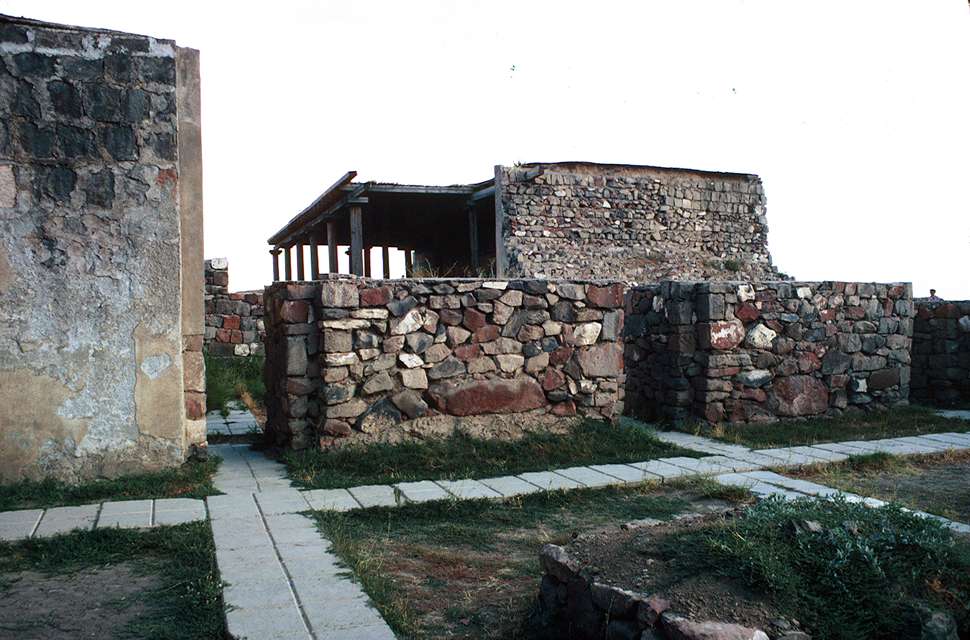
Rusas I (733‑714 B.C.), a vigorous and sagacious prince, reorganized the army, suppressed domestic turbulences and revived the morale of the people. From Thuspa he transferred his seat to a hill later known by the Turkish name Toprak-kaleh (the earthen fort). This Rusas-city was supplied with water from an artificial lake in the side of the Varag Mountain. All this he recorded on a stele which in 1898‑9 was taken to the Museum of Berlin.
However, he was given little opportunity to rebuild Urartu’s old eminence. Sargon II (722‑705), the most terrifying figure among the occupants of the Assyrian throne, darkened the political horizon of all the Near-Eastern lands. Tusas organized a coalition of the states of Western Asia and strengthened the position of Urzana, King of Musasir, his vassal and ally. But in a sanguinary battle described in an inscription found near the shore of Lake Sevan, the Khaldian army, though resisting stubbornly, was defeated by Sargon, who also overwhelmed Musasir and plundered its temple. In the vast quantity of spoil carried to Nineveh were many idols belonging to the Urartean kings.
Even after this terrible loss of men and material, Rusas did not yield to despair. Whilst neighboring nations were trembling with fear of the Assyrian scourge, Rusas replenished the reservoirs of his strength and for the time being, saved his kingdom from destruction. But another black chapter was in the making for him. Cimmerian hordes from the North, sweeping through the mountain defiles, down into the regions of the Urmiah and Vannic lakes, surprised Urartu and wrought great destruction. According to one version of the outcome, the army of Rusas, unable to offer adequate resistance, melted away, and Rusas committed suicide in 714. But T. A. Olmstead, in his History of Assyria, questioning the reliability of the Assyrian royal scribes regards this as a mere spectacular raid, without enduring results. One inscription, speaking of the fate of Rusas, says “With his own iron dagger, he pierced his heart as he would to a pig and ended his life.” Olmstead compares this with a slightly later Assyrian inscription in which the defeated king is pictured as being ill, though there is not a word about suicide. It may well be that this malady caused his death.
Argistis II
Argistis II (714‑680), son and successor of Rusas, rid himself of the Cimmerian hordes by deflecting their trend to westward, into Cappadocia. As to his relationship with Assyria, the latter’s reports are silent, the explanation undoubtedly being that Sargon was not victorious at the time, but had been forced into a defensive attitude. Argistis II, however, was engaged in secret activities, the center of which was the province of Harda or Kharda, the modern Kharberd or Harpout. The canton of Inzit, the Hantzit of the geography of Armenia, was then a part of the province of Alzi or Aghtzniq.
Sargon, once so boastful of his devastation in Urartu, now sent envoys to Argistis, professing great friendship. The Urartean king, however, did not alter his plans; he continued his preparations, and increased his pressure upon Assyria in the Eastern Tigris basin. Sargon’s son, Sennacherib, then a provincial governor, urged his father to send more troops to that area, informing him of Argistis’s order to his prefects to “seize the governors of the Assyrian king in Kumai and drag them before me.”
Sennacherib was assassinated in 681 — by two of his sons, Adramelech and Sharazer, according to the Bible. Professor N. Adontz ascribes this crime to the second son only, Ardi or Arad-Ninlil, who, allied with Adramelos Nebusaresur, the governor of Maraski, fought against his own brother Esarhaddon. Defeated at Carchemish, the two fled into Armenia.
Efforts have been made to decipher the cuneiform inscriptions of Armenia through the present-day Armenian language. The failure of these attempts has led some to believe that the inscriptions in question must be in some unknown, alien tongue, neither Indo-European nor Semitic.
Linguistic Connections
One investigator, P. Jensen, finds a certain similarity between the Urartean language and that in which the letter of King Tushratta of Mitanni (found at Tel-el‑Amarna, Egypt) was written. For example, the name of the god Tesub of the Mitanni closely resembles that of the god Teisbas of Urartu. Another scholar thinks that ancient Armenia or Urartu had a cultural connection with Asia Minor and Syria — citing the Hurri-Mitanni or Subarean remains in upper Mesopotamia and Syria as having points of resemblance to the characters of the Khaldian inscriptions.
There appears to have been a pre-Indo-European substratum of speech which strongly influenced the Indo-European-Armenian. Professor N. Marr, a Khaldist authority, suspects that the language of the Vannic cuneiforms is of the type of several modern Caucasian dialects of the Japhetic class. however, the Aryo-European must have exerted great influence upon the Urartean, even long before the times of the Vannic Empire.
On the other hand, E. Meyer cites names of royal princes many centuries before Christ in the Taurus area and Palestine, and later in Commagene; names such as Arta-tama, Arta-skana and Artamana, all more Iranian in character than Indian, and all bearing the Arta prefix which persists in Armenian names to this day. But there were names such as Kundaspie and Kustaspie, which were originally Indian, their forms then being Vindaspa and Vistaspa. Other significant links are found in the Hatti-Mitanni treaty (1387‑1367 B.C.), which contained the names of other than gods, and in the Sanskrit numerals, yeka (one), tria (three) and panja (five), as found in the treatise upon horse-training by Kikkuli of Mitanni (1400 B.C.).
The Subarean (Asianic-Hurri-Japhetic) language is the basic stratum of the various above-mentioned tongues; it was topped and strongly affected by the Aryan-Mitanni language, from which mixture the Urartean sprang up, it being related in turn to the old Hatti-Asianic, the new Caucasian and through Indo-European elements, to the Aryan languages. On this Indo-European-Armenian foundation was superimposed the Urartean speech, which was forced upon the conquered natives, from whose dialects also an additional stock of words was assimilated in the course of time. Traces of anthropological types of culture, religion and social customs are being discovered from time to time under the Armen stratum. The same may be said of the linguistic heritage of the past.
In his analysis of the known Iso-Urartean root-words, Professor Ghapantsian of Erevan University identifies one-fourth as of Hittite character. Many other root words and grammatical forms of non-Indo-European types have been found, but belonging to an Asia Minor group. All non-Indo-European elements, the Urartean and others, descend from the Subarean common origin. The same applies to the anthropological strata of the population of Armenia, whose chronology is stated by Professor A. Hatch as follows: