Ayrudzi, Naxarars Cavalry, Armenian Horseman, Horse Archer

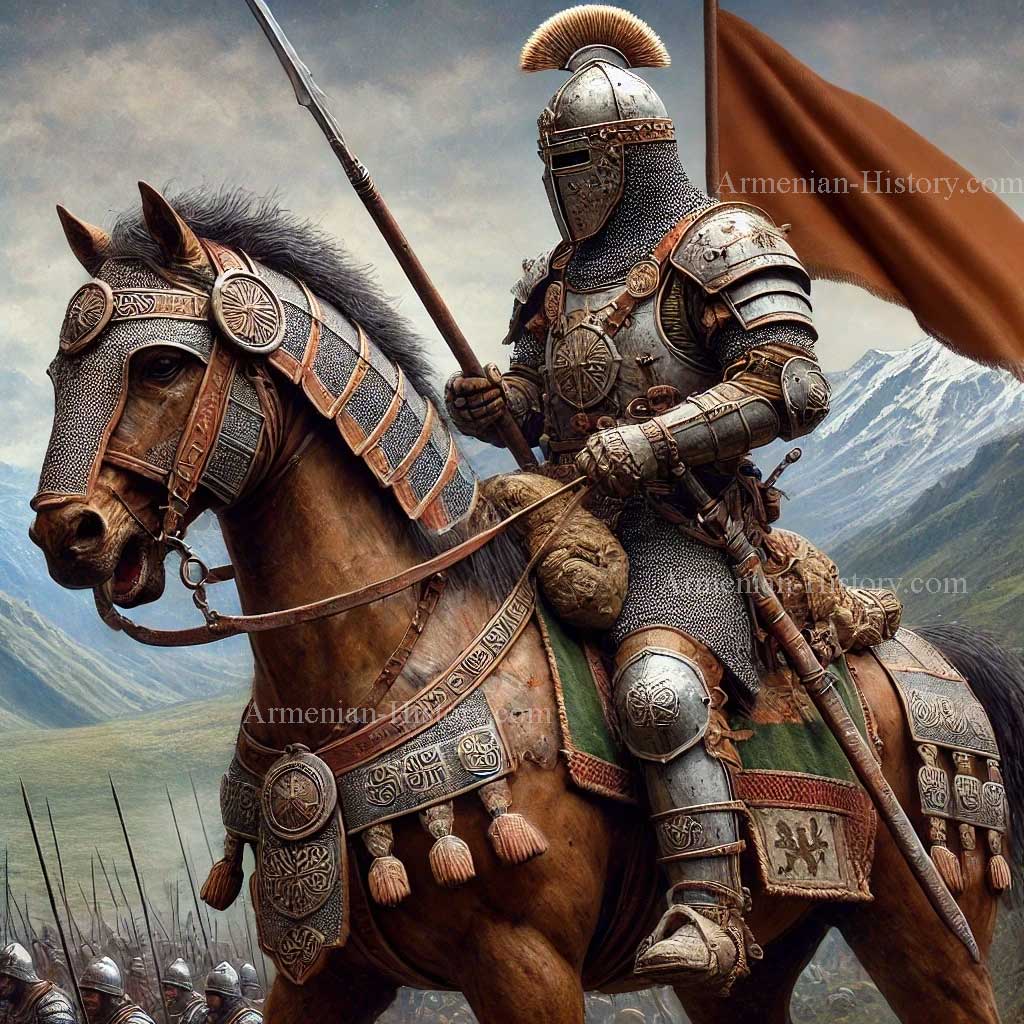
From ancient times in Armenia, there existed an elite cavalry known as the “Azatavrear,” initially composed of the elite of Armenian tribes and later from the Armenian people. The “Azatavrear” cavalry was a central part of the Armenian king’s court. In medieval times, this elite cavalry, later known as the Ayrudzi (meaning “man and horse” or “horseman”), was formed from the noble families of Armenia, often composed of the youngest sons of Armenian lords.
During peacetime, the Armenian cavalry was divided into small groups, taking on roles such as guarding the king, his family, and the Armenian lords. A part of the cavalry also patrolled the borders of Armenia under the command of the Armenian general, or sparapet. The group responsible for the protection of the Armenian king and his family during ancient times consisted of 6,000 heavily armored horsemen, while in medieval times, this number was reduced to 3,000 horsemen. In times of war, the number of Armenian cavalrymen could rise from 10,000 to 20,000, or even higher. In addition to the heavy cavalry, Armenia also had a light cavalry primarily composed of horse archers.
V. Chapot wrote: “What they say about Armenia bewilders us. How could this mountain people develop such a cavalry that was able to measure itself against the horsemen of the Medes? One thing which is certain is the fact that Armenia …was a source of excellent, well-bred horses. The people in this country had discovered that horses were not just an economic asset, but could also be used for military purposes.” 1
Armenian Heavy Cavalry After Armenia Lost Its Independence

When Armenia lost its independence in 428, its heavy cavalry was not disbanded. Instead, it was absorbed by neighboring kingdoms and empires, such as the Byzantine Empire and Sassanid Persia.
In Sassanid Persia, the Armenian cavalry was granted a status similar to that of the elite “Savaran” in the Persian army. The equipment of the Armenian cavalry was, in fact, similar to that of the Savaran. Pro-Sassanian Armenian cavalry units fought under the Sassanid banners and were even permitted to enter the royal capital, Ctesiphon. The Armenians were honored for their services; for instance, General Smbat Bagratuni was given particular recognition by Khosrov II. In 619, after his victory over the Turks who then resided in Central Asia, Bagratuni received lavishly decorated robes and command of a portion of the king’s royal guards. Khosrov II also elevated him to the third rank among the nobles of the court. Furthermore, pro-Sassanian Armenians provided excellent light cavalry and infantry, notable for their use of slings to repel enemy cavalry and spears for close combat.
SOURCES
- V. Chapot, La frontière de l’Euphrate de Pompée à la Conquète arabe, 1907, Paris