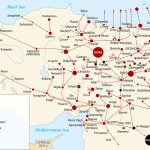
Since the middle 1920s special sabotage groups of Dashnaks, Mensheviks and Musavatists periodically under took attempts of passing the state frontier of the USSR from the territory of Turkey or Iran.
Sabotage and reconnaissance groups passed important information to those states with whom they were working at that moment and who they were being finest with.
The slogan – “to do everything”, to cooperate with all those who are interested in the discord and dissention of the Soviet country and communist system in the Transcaucasians countries” – had never changed in the course of those decades. This slogan and ideas of regeneration of free and sovereign states became ordinary for many of them who even gave out all their means for the formation and training of special groups of rebels. The main training camps and headquarters of the Mensheviks, Dashnaks and Musavatists where located in Turkey, Iran, as well as Lebanon and in some other countries of the Near East. Only since 1922-1939 more than 50 attempts had bean made by some groups of emigrants – rebels to pass onto the Soviet Transcaucasus.
Mainly this attempts ended in failure: they got bogged down in the blood of Dashnaks, Mensheviks and Musavatists’ saboteurs, scouts and propagandists.
Some groups such as “Pandukht”, “Sakartvelo”, “Momavali” and “Kavkaz”, managed to pass and join anti-Soviet underground organizations in the Transcaucasian republics (in spite of heavy battles).
One of the first numerous groups was “Pandukht” which consisted of 23 Armenian dashnaks, who tried to pass the Armenian border (which was a part of Transcaucasian Federation at that time) in the middle of October 1922 from the side of Iran[1].
The main task of the group “Pandukht” was to unite with the Dashnak and other anti-Soviet organizations and to form armed formations in order to raise a revolt. The armament for the groups had to be got from the secret warehouses in the mountains of Zangezur and bordering villages or Iran.
The group was led by Karo Sasuni, Hakob Ter-Hakobian, Khosrov Tutunchan and others. Later in 1923-1925 the main part of this group was liquidated. Nevertheless the communists could not fully cope with the anti-Soviet organizations.
In 1923-1939 the groups of Ashot Artzruni and Petros Marzpanian passed to the territory of Armenia from Turkey; the group of Gerasim Atachanian tried to pass the border but was liquidated together with its leader; Tevan Baghdasarian lost the major part of his group in the exchange of fire when passing the border.
The Georgian Mensheviks also made the attempts to penetrate into the territory of Georgia through Turkey. One of such groups was “Sakartvelo”, whose leaders, planning in uprising, were adherents of combined operations with the Armenian and Azerbaijan rebels.
Having provoked some riot of the territory of Georgia at the end of 1924, they suggested the Armenian underground groups operating together[2]. The leaders of the Georgian underground groups were Vachnadze, Ramishvili, Chabriadze and others.
It’s known that Karo Sasuni met with the leaders of the Georgian anti-Soviet groups. A resolution was adopted about joined actions diversions on the territories of Armenia and Georgia, and also about carrying on anti-Soviet propaganda among the masses who had suffered greatly because of the collectivisation.
The plane of the combined revolt failed as the major part of the saboteurs was liquidated and the rest, for fear of death began to cooperate with NCHA (National Committee of Home Affairs) to disclose underground units in Georgia and Armenia.
Since 1934 “Prometey” (“Prometheus”), i. e. Warsaw, began to attend much concern to the sabotage groups, trying by all means, to get exact information about what was going on in the Transcaucasus.
The reconnaissance party “Kavkaz” was the most useful among the transported groups as in its ranks there were radio-men, demolition men and specialists who created harmful anti-Soviet attitude of mind among ordinary people. This group mainly consisted of the natives of Azerbaijan.
After a short pause in early 1935 the groups “Musavat” and “Araks” tried to pass to the territory of the Soviet Transcaucasus throw Iran and Turkey. The passing of this groups was carried out at night, but there were detected and suffered great losses among the personnel and later ceased their existence.
Unlike the group “Musavat” which consisted only of Azerbaijanians, “Araks” was a mixed one, including both Armenians and Azerbaidjanians.
Evidently, either Karabakh or Nakhitchevan had to be the place of the operations.
According to some dater the saboteurs acted actively not far from the Karabakh Autonomous region, carrying on propaganda and demolition work in this area. This group acted till the end of the war.
At the end of may 1945 after some secret operations of SMERSH and NCHA the main part of the group was destroyed in the exchange of fire.
Dozens of time analogous formations passed or tried to pass the border before the war, but unsuccessful activities in the Transcaucasian republics became the reason that such anti-Soviet special groups or parts of them dispersed in the mountains and thick woods in different places of the Transcaucasus.
Some groups survived the war and surrounded or simply broke up in early 50s.
As for the groups that submitted to Abwher, admiral Fridrich-Willhelm Kanaris signed orders in 1940 about the preparation of scouts and agitators and saboteurs from the national-emigrant organizations and later on to pass them to special departments of military secret service.
It is a well-known fact that from 1935-1943 Abwher’s work was led by W. Kanaris who in 1938 reorganized its structure on the base of which the board “Abwher – Zagranitsa – Foreign countries” in the headquarters of Armed Forces of Germany was formed. The board was given a task to organize a wide demolition and reconnoitering work against potential enemies of the Third Reich and in the first place against Moscow and London.
The board “Abwher – Zagranitsa” consisted of the following departments:
Abwher-1 – secret service
Abwher-2 – sabotage, diversion, terror, insurrection, demoralization of the enemy armies
Abwher-3 – counter-espionage (security service)
Abwher-Ausland – Foreign department
CD – center department[3]
Practically representatives of different nationalities from Caucasus began to serve in all these departments.
The process of forming special groups began. These groups were planed to be used in Turkey, Iran, Great Britain (Aghabekov’s special group), Iraq and other countries of Europe, the Near and Far East.
Before attacing the Soviet Union in June 1941, the board “Abwher – Ausland” formed a special organ called “Walli” headquarters. The main task of this organ was to organize the sabotage reconnaissance and counter-espionage activities. The structure of the staff corresponded to the structure to “Abwher-Ausland.” “Walli” department carried out the general management of the military and economic secret service on the Eastern front or in the deep rear of the Red Army.
Major and then lieutenant-colonel Baun was appointed chief of the department. At the end of the war Baun yielded to Americans and cooperated with them against the USSR.
Reconnaissance Abwher – detachments and Abwher – groups submitted to “Walli” department and were sent and used for reconnoitering and sabotage operations at the corresponding parts of the front.
Special Abwher-groups also acted for carrying out economic reconnaissance. There existed a special “Walli” detachment “1G” which provided the agents, sent to the Soviet rear, with forged documents.
German engravers and some former prisoners of war cooperating with Germans who knew clerical work in Red Army and Soviet institutions formed that sub-unit. This detachment was engaged in collecting, studying and making different Soviet documents, rewards, punches and seals of the Soviet military units and enterprises. Furthermore, numerous storehouses of trophy Soviet armaments (arms, uniforms and outfit) were under the command of “Walli – 1”[4]. This detachment was engaged in the activities and formation of special groups of scouts and saboteurs from the people of Baltic and Caucasian nationalities.
“Walli – 1” was always located very close to the unit of foreign armies of Oberkommando der Wehrmacht. The department ”Walli-2” led Abwher-detachments and Abwher-groups carrying out sabotage work against divisions and rears of the Red Army.
Major Zeiger, Senior lieutenant Muller and captain Bekker were chiefs of the detachment in succession.
Since July 1941 till the end of July 1944 the detachment was located in Suleyuvek from where during the retreat of the German Army it moved inland of Germany.
Department “Walli-3” was engaged in counter-espionage activities, that is it formed and led Abwher-groups and Abwher-detachments whose tasks were to fight against intelligent service to discover and destroy staffs and centers of partisan movement of the occupied territories and in-front line zones as well. In 1944 “Walli” staff was reorganized and its three departments joined the structure of the military administration of “Milliamt’s” 4th and 5th boards getting the new name of “Leitschtelle fur front Aufklerung I Ost” (“Leading front reconnaissance organ in the East”). After the reorganization Abwher-detachments and Abwher-groups got the name of “Front Aufklerung Kommand / Gruppe”, preserving their numeration.
The forms and methods of their work remained the same.
On the eve of the war all the three departments of “Walli” included separate emigrant groups from the Caucasians, in particular; earlier formed groups of saboteurs and scouts joined the ranks of Abwher.
In spite of the primary mistrust of these groups, the Command still decided to use them widely in the reconnaissance and sabotage purposes of the front-line.
To begin with, under the aegis of Abwher, special camps and schools for training future scouts, demolition men, radiomen, agitators and so on, were formed.
Special separate reconnaissance-sabotage groups consisting of Armenians, Georgians, Azerbaijans and North Caucasians were formed in the staffs of the three departments of “Walli”.
Beforehand the national committees were charged with the task of forming not numerous detachments from ideologically reliable people ready for any actions[5].
Soon Abwher-groups and Abwher detachments of Caucasian scouts and saboteurs were formed in the department of foreign armies of OKW of Abwher and passed to different branches of “Walli”.
One of the first of such groups including foreigners was Abwhergroupe – 101 which was divided into three detachments: the first detachment consisted of the Germans, the second – of White emigrants and the third – of Dashnaks, i. e. Armenians. Abwhergroup – 101 was formed in May 1941. Its call signs were “Puma”, “Murder”, “Alligator”[6]. The sub-unit acted in the Southern grouping of the German troops. It was commanded by captain Faist, later by major Foggt and captain Ranter. This Abwhergroup carried out, besides reconnaissance operations, also recruitment of former Soviet soldiers in camps for the prisoners of war. In particular individuals of the Armenian and Georgian nationalities were recruited and sent to the training camps of Abwher, Wehrmacht or SS.
As former Armenian prisoners of war from Mozdok and Pyatigorsk camps recall “Armenian Dashnakists dressed in the German uniforms came to there camps and in good Armenian suggested us joining the ranks to safe from famine and diseases”. They also tried to persuade them that “the German governing bodies fight against Bolshevism and give the Armenians a chance to liberate their motherland from Communist and Turkish invaders”.
Abwhergroup – 101 like other analogues organ often changed its dislocation, leaving behind special armed detachments formed from Tatars, Georgians and Armenians. After September 1942 economic and cartographic detachments and also a transport detachment joined this group.
In the middle of November 1942 the group – 101 had two front-line posts that operated at army corps.
At the beginning of 1943 some Armenian special detachments consisting of 20 men set of to the Crimea and joined the 11-th Armenian company of the Caucasian regiment “Bergmann”[7].
Its necessary to point out that according to the archives data and independent investigations this group trained Armenian saboteurs-descents who later joined this formation. Abwhergroup – 101 operated most actively in the Crimea and Rostov region. One of the reconnaissance groups of Abwhergroup – 101 were “Be-1” or “Rose” (led by Tade Petrosian) and consisted of 11 men, and the reconnaissance platoon of Simon Philiposian, operating in Odessa[8].
Abwhergroup – 101 ceased its existence in 1944 after the liberation of Winnitsa by the Soviet troops.
After the battle of Stalingrad the leaders of Abwher began their work at creating a special Armenian group. Some agents of Abwhergroup – 101 made up its basis. It was completed by the reconnaissance group of General Dro Kanayan, 70 men in number. This Abwhergroup was formed at the beginning of April 1943 and got its number 114 and name “Sonderkommand Dromedar”. It became a group of special purpose “Dromedar”. At first it was planned to send the group to Armenia at night by Herring’s planes “Junkers”, but because of the tense situation on the front the German command and the military staff of General Dro had to change the plan.
At the end of April 1943 “Sonderkommand got independence and status of Abwher-group. Abwhergroup “Dromedar”’s call sign was “Irena”.
As it was afore mentioned, Dro was the leader of this Abwher-group. He appointed Kuro (Nikolay Tarkhanian) as his deputy, and Tigran Baghdasarian became Staff Commander. Nikolay Tarkhanian was one of the leaders of so-called “Liberation Committee”.
Misak Torlakian was appointed responsible for reconnaissance-sabotage operations. Dro’s adviser in his work with the group was his old friend captain Pulloy[9].
Investigating the materials concerning this special detachment, it became possible, to some extent, to put right its personnel though all the members operated under assumed names.
Thus the reconnaissance-sabotage group AG – 114 “Dromedar” included the following leaders: Drastamat (Dro) Kanayan – the same “general Dmitriy Kalyayev”[10], “general Zvezdinskiy”; Kuro – the same “Sardarov”, “Kerch”; Petros Yuzbaschan – the same “professor Gunter”, “Smetanov”; Aram Mirimanian – the same “Shaman”, “Dervish”; Tigran Baghdasarian – the same “Tigris”; Nikolay Gevorgian – the same “doctor Sikorski”; Aghasi Charchian – the same “Kharib”; Harutune Harutunian – the same “Valtsov”, “Ugryan” and others.
The group organized and carried out reconnaissance and sabotage operations in the rear of the Soviet troops in the North Caucasus, as well as in the region of Kerch peninsula together with Georgian reconnaissance and sabotage platoons of the special formation “Bergmann”.
Recruiters of AG – 114 were Armenian agents, former soldiers of the Armenian army of 1918 – 1920, and others. Some of the recruited Armenians who joined the group voluntarily and had a higher education took a course of scouts and wireless operators, but the others (about 25 men) were sent to a special reconnaissance school not far from Warsaw. Natives from Armenia who earlier dealt with secret service and sabotage also conducted the training of future agents. About 24-25 Armenian agents were trained at the courses. Among them were those who belonged to the fighting part of Abwher-group “Dromedar”. They were mostly volunteers from Armavir and Sochy and some former prisoners. The fighting group “Dromedar” numbered 65 men. So-called “brain washing” from Soviet ideology was carried out rather thoroughly.
In July 1943 the personnel of the group numbered already 110-120 men. The members of “Dromedar” wore German uniforms of a new pattern but the armament was mixed – both of the German and Soviet production.
All the personnel wore the chevron of the Armenian three-color (1918-1920) on the right sleeve of the coat – the shield “ARMENIEN”, which was compulsory for all Armenian legionaries who served in the German army – from the private to general.
The formation had propaganda, reconnaissance-sabotage, economic and transport detachments situated on the territory of the central headquarters.
AG – 114 entirely displayed all its abilities when occupying and keeping the town of Kerch, where the parachute landing the party from the scout group “Dromedar – 1” was sent too. They had with them documents of retreating Soviet soldiers and there were radio-apparatus, cameras, maps of positions and relief of rear regions of the Soviet front in there camouflage bags.
More than once the group got in touch by radio and contacted with reconnaissance groups and agents of the special formation “Bergmann”[11]. Joint sabotage and agitational operations were successfully carried out by the group. This group maintained contacts with the Caucasian Abwhergroup – 201 “Darious” and AC – 106. After fulfilling the task the group “Dromedar – 1” crossing the front-line, used code words “Kars”, “Kars – 1110” or “1S – Pushkin”. After liberation of Kerch the reconnaissance-sabotage activities of the group ended in success.
One of the former agents of the group Misak Torlakian rote in his memoirs: “…being in full disguise we moved towards Kerch. By stealth we managed to enter the town and settle down there under the guise of the Soviet soldiers and ordinary citizens. The group operated successfully passing important information to the headquarters of the general for one month”[12].
The group had four advanced reconnaissance points on the front-line area in the North Caucasus: the first point was to the north of Petigorsk in the stanitsa of Nikolayevsk. Tigran Baghdasasrian (“Tigris”) was the leader. This post headed by him carried out the launching of agents to the regions of Nalchik, Mozdok, Stavropol, Grozni and the passes over the Caucasus ride. The second point of Abwhergroup “Dromedar” headed by Harutune Harutunian (“Valtsov”, “Ugryan”) [13]was dislocated in Krasnodar and sent agents to the regions of Tuapse, Sochi and the Black Sea coast.
In March 1943 it arrived in Taman peninsula and, having united with some Caucasian groups of the special regiment “Bergmann”, “Dromedar”, “Tamara” and others, took up a defensive position on the front-line, periodically carrying out reconnaissance-sabotage operations in the near rear of the Soviet troops[14]. The third point AG – 114 was in Stavropol and its leader was Petros Yusbaschan (“professor Gunter”, Smetanov”). This group carried out counter-espionage activities on the occupied territory of the North Caucasus spreading its agents among the Armenian population and carrying out continuous anti-Soviet propaganda among them. The forth point was also in Stavropol headed by Nikolay Gevorgian (“doctor Sikorski”, “Gevorgov”[15]), who was a former SS officer. Gevorgian was a son of the known dashnakist Seto Jalalian. Besides anti-Soviet propaganda and counter-espionage this post formed local committees ANC* and national formations which later were sent to the Crimea and other regions to protect the Armenian population. According to the accounts and letters of the local Armenians ANC had practically its centers and staffs in all the areas aiming to help the Armenians in every possible way, distributing special documents to the particular category of people. Besides the pecuniary aid the committee used any chance in order to elevate Reich and show the people that only Hitler could “take such care” of the Armenians.
Began the moving of the representative of this nation to small “national” towns and blocks where only Armenians had to live. Special separate schools only for the Armenians were set up, the standard of this schools didn’t yield to the German ones. An active propaganda was carried out among the children for establishing of Great Armenia under the protection of the Third Reich. And as it was written in one of the letters “the Russians said that the Germans were merciless killers and shot everybody, they wanted to annihilate or enslave the people of the USSR in order to settle the Germans on that territory, but I assure you, dear Gayaneh, that all this is delirium, they are friendly to everybody, especially to us – Armenians”.
However, it’s impossible to call “friendly” those atrocities which the same Germans had committed to the Armenians in Byelorussia as if “taking them for the Jews”[16].
German non-commissioned officer Beniamin Yost recalled: “We were told that very many Jews gave themselves out to be Armenians, that’s why there was an order – those who wouldn’t be able to read Armenian books must be treated like the Jews”. This “friendliness” went on for nearly two weeks until it be came known to the Ministry of the Occupied Eastern Territories and ANC after which these groups were given Gestapo Armenian-agents.
As far as Abwhergroup “Dromedar” is concerned, is began to operate actively on the territory of the Crimea in early summer 1943. The members of the counter-espionage post Tigris, M. Torlakian, Ashot Ter-Avetissian and others also began to organize Armenian formations of self-defense and at the same time persecute Soviet agents, partisans, detecting and liquidating them[17].
However, in spite of these operations General Dro and his helpmates didn’t know that in the “Soviet” rear some groups had been disclosed and re-recruited and very often they passed information which was dictated from Lubyanka and General Headquarters conducting continuous radio game.
Some Armenian sabotage groups of “Dromedar” took part in the operations of transporting reconnaissance-sabotage groups to the territories of Georgia and Armenia and the North Caucasus as well[18].
After bloody battles of the front-line “Dromedar” was withdrawn from the front and in July 1944 some scores of agents of AG – 114 headed my T. Baghdasarian preserving the name, were sent to Nidersee (East Prussia) and in November 1944 they operated not far from Berlin in a small town of Eshenbach. The main part of the personnel of the special formation left for Belgrad where after reinforcement, the sub-unit “Einheit Schturm”[19] was formed.
“Dromedar’s” collaboration with the special formation “Bergmann” lasted till 1944, carrying out joint and independent operations simultaneously. For example, preparation of insurrectional groups, scouts, propagandists and saboteurs for transporting them to Armenia was carried out jointly. Without delving deeply into the history of this sub-unit we’ll simply mark that its members were ardent anti-Communists and sincerely believed in the idea of “Free Armenia”. They simply couldn’t imagine the life of the Armenian people, the unity and normal development of the population in the bounds of the “bolshevist terror”. That was how the former agents recalled in their memoirs, without accepting and in some cases speaking with hatred about Nazis, their actions and power – “We are not Nazis, we are simply patriots who are trying to liberate fatherland from terror of Bolsheviks and set the people free from this oppression carrying the idea of the country where everyone will live the way he likes – having at the same time his own property”, repeatedly announced the leaders of the ANC (Armenian National Committee).
That is to say in its propaganda the ANC compared the Soviet Union with the Ottoman Empire, and serving in the German Army was considered by them like something “patriotic” and “right” act.
It was often spoken about atrocities and mass taunting and scoffing at people in the years of collectivization and “five-year plans”, about hundreds of thousands of people who died of famine, and about division of the country, they meant the separation of Karabakh, Nakhichevan, Kars and so on.
Under the influence of this propaganda a great number of people began to believe in the idea of liberation, and some people, the emigrated youth in particular, began to treat the Soviet power with hostility. The same happened in other emigrant circles, especially in Georgian and Azerbaijan ones, who connected the “liberation” of their countries with the help of Germany.
In the fighting detachments it was especially often spoken as follows – “now that we set free our country from Stalin and Turks, than will make an agreement with the Germans about the realization of our separate policy like the Bulgarians, the Rumanians, Slovaks and Croats”.
Some legionaries were convicted by the German court martial for such words; this was a serious argument proving that Germany in any way led false policy towards the Caucasians. However, there were those whom the Germans didn’t “touch”.
It’s impossible to evaluate objectively the given problem without studying all the facts and documents thoroughly, without examining the relations of emigrants with Hitler Germany.
Another Caucasian reconnaissance-sabotage group of special designation was “Tamara”, composed from former military men of Georgian Mensheviks and youth from Georgian emigrant organizations. This unique special sub-unit was formed in September 1942 by Abwher and operated in the group of the army “South”. Originally the Georgian Abwher-group consisted of 40-50 men and carried out reconnaissance-sabotage activities on the front-line area. The order for the formation of the organization “Tamara”- 53/41 was given to the department of foreign counter-espionage on the 29th of June 1941 by the staff “Rumania”. The formation was made up on the voluntary basis in France, and the major part of the personnel was later sent to the East front. The Georgian military committee headed by Mikhail Kedia watched carefully for the training and preparation of 35 Georgian saboteurs in the reconnaissance-school not far from Paris, they were to become the backbone of the special formation “Tamara”.
Some time later the special sub-unit was given the following tasks:
1. To pass to the territory of Georgia by small groups and carry out reconnaissance-sabotage and agitational work, to prepare the Georgian population for the revolution against the communist power to destabilize inner situation in the country by organizing anti-Soviet actions, and in every possible way to help the common people to withstand Bolsheviks.
2. To charge senior-lieutenant doctor Cramer (the 2nd department of counter-espionage) with the leadership of the organization. Sergeant-major doctor Khaufe (counter-espionage 2) was appointed deputy of the leader[20].
3. The organization must be divided into two secret-service groups: A. “Tamara – 1” must consist of 16 Georgians trained for sabotages; the group must be led by non-commissioned officer Hermann. B. “Tamara – 2” must be an operative group consisting of 90-100 Georgians united into foxholes. Senior-lieutenant doctor Cramer is appointed leader of this group.
4. Both operative groups “Tamara – 1” and “Tamara – 2” are placed at the disposal of 1C RCA (reconnaissance department of the Chief Command of the Army).
5. The outskirts of the town of Yassi must be chosen as the assembly point of the operative group “Tamara – 1” and the triangle –Brailov-Kalaras- Bucharest- as the assembly point of “Tamara – 2”. The department of the secret service 2 is in charge of providing “Tamara” organizations with armaments.
The agents of the group “Tamara” like the ones of “Dromedar” wore a German uniforms of the new pattern, but the armament was mixed. Some agents preferred “old Mauser”.
This fighting-men later got national distinguishing signs on the right sleeve, i.e. chevron of the Georgian flag of 1918-1921 and the inscription “GEORGIEN” in the upper part of the shield.
Senior-lieutenant Cramer was Commander of the whole organization including both groups “Tamara – 1” and “Tamara – 2”.
The agents, except the Parisian reconnaissance special school, had their training with the Armenian agents in Vienna, Warsaw and Rumania (in the towns of Fokshanti and Brailov).
During fierce battles for the Caucasus, the group “Tamara – 1” carried out reconnaissance-sabotage operations on the territory of the North Caucasus. At that time nearly 60 from the group “Tamara – 2” headed by A. Tsiklauri were included into the Alpine company of the German rifle-division[21].
The group operated in the region of the mount Elbrus and in other regions of the Caucasian range.
It’s known today that about 20 agents from this Georgian group were prepared for transporting inland, but by some reasons it was not a success.
During the counter-attack of the Red Army in the Caucasus the reconnaissance-sabotage group “Tamara – 1” was transported to the rear and, coordinating its actions with the group “Dromedar – 1”, retreated after having completed the task set before it.
At the end of 1942 the group was transported to the Crimea to form the Caucasian fighting and auxiliary companies that were later included into the special formation “Bergmann” and protected in its battles for the Crimea.
As far as the group “Tamara – 2” is concerned, after some week of fierce battles it was withdrawn from the rifle-division and sent for reinforcement.
Besides emigrants, former military men of the French army and Georgian soldiers- prisoners from the Rumanian camps were included into the group.
The fighting-men of this formation like Armenian Abwher-group members were emigrants from Germany and France, who heated the Soviet system and were ready to do everything “to throw Bolshevik killers and oppressors off the shoulders of long-suffering Georgia”[22].
That is to say those were people who had lost their power, respect houses and fatherland after the Bolsheviks’ advent to power, and certainly they didn’t recognize Soviet Georgia as state.
For the youth educated in the same spirit to join the German army-“liberator” was regarded as “national feat”. There were even cases when Georgian volunteers in France were seen off with songs and wine and toasts to “free Georgia”.
Off course there were also so-called “scoundrels”, “rascals” who dreamt about their personal revenge hiding under patriotic slogans and calls to fight. But speaking to some Georgian emigrants it becomes clear that the people who believed in “free Georgia under the aegis of Reich” considered themselves “liberators”, “liberators” of their country and people from “Russian invaders”, sincerely believing in the propaganda of Georgian national committees and emigrant parties that became “toys” in Hitler’s hands.
At the beginning of the war while “governments in expatriation” were being creating a new ideology appeared. This ideology was based on the national consciousness, i.e. it opposed the ideology of Bolshevism based, at that time, on repression and terror and brought forward an idea according to which each man could have “his own” opinion and “his own property”.
That’s why in many newspapers the propaganda of the Armenian, Georgian and other committees compared the Soviet Union with the Ottoman Empire, which enslaved freedom-loving nations of the Caucasus. For example, after some legionarie’s stories about famine in the Armenian villages and there criticism of Bolsheviks’ policy towards collective arms, German commanders and Armenian propagandists declared that the collective farms on the occupied territories would be kept to the end of the war and than the Germans would divide the land among the families, and farms would develop individually[23]. Each peasant would be able to have his own cattle in unlimited numbers.
Though in the years of repression very many people were shot and exiled, many things in the emigrant newspapers were often exaggerated. However, during the war thousands of Soviet soldiers-caucasians passed the front-line with the white rag in the raised hands only because “red commanders treated them as if they were animals, sending them to certain death and shooting down wounded or retreating soldiers”.
Yet, the greater part of the prisoners didn’t admit the idea of “liberation” as they grew up in the Soviet time, had the Soviet upbringing and weren’t guided only by the national idea. Many of them simply thought: “What do we need a new war and new changes for? And why do we have to believe Fascists who have enslaved most people of Europe?” And yet, why were there so many volunteers from Europe if they had been enslaved? What where they fighting for?
That was the struggle for ideas and nothing else. The struggle of ideas between Communism and National-Socialism, and the one which will take possession of the brains of the majority of the people will win the combat.
It’s quite clear that the German government attacking the USSR relied on his own army and idea which would be able to dispose most nations of the Soviet Union to his side.
But in spite of this, the “Caucasian experiment” failed, and only after studding the actions and history of the emigrant committees and Caucasian nations separately, it will be possible to find some answers to the raised questions.
There were cases of desertion in the Abwher-groups “Tamara – 2” and “Dromedar” that speak about poor psychological-ideological training of the volunteers though at the beginning the situation in national legions was even much worse.
Realizing the problem the German leaders periodically conducted ideological lessons and purging of the formations from “untrustworthy elements”.
Having turned emigrants and prisoners of war into “patriots-liberators” the German leaders sent them to the hell of battles where the Caucasians fought rather well.
Eduard Abramian
[1] Martirosian R. Anti-national activities of the Dashnak party during WW2. Yerevan – 1987. P. 17.
[2] “Hayrenik Daily” – 21/04/1963. №11.
[3] Chuev S. G. Special services of the Third Reich. Book 1. St.Petersburgh. 2003. P. 11.(in Russian).
[4] Ibid. p. 54.
[5] Angriff und Abwehr: Berichte, Kommentare, Dokumente zum Streit um Adveniat u.d. Theologie d. Befreiung (Veroffentlichungen des Studienkreises Kirche und Befreiung), Pattloch-1978, 178. p. 183.
[6] The materials of the Committee of State Security of the Armenian SSR. 1966. D. 23342. P1, pp. 40-42.
[7] NCHS. Armenian SSR. A. D. № 17, D. 2331. 1950. p. 121.
[8] NCHS. Armenian SSR. A. D. № 4, D. 1451. 1948. p. 18.
[9] The materials of the Committee of State Security of the Armenian SSR. 1966. D. 23342. P1, pp. 38-39.
[10] Martirosian R. p. 96. (in Russian).
[11] From the diary of one of the agents of “Dromedar” – V. Soghomonian, personal archive of the author.
[12] Torlakian M. With my days. Los-Angeles. 1953, p. 494. (in Armenian).
[13] NCHS. Armenian SSR. A. D. № 121, D. 23781. 1948. p. 102.
[14] BA – MA, WNA – 31/38, 62 p. 189-191.
[15] Chuev S.G. Book 1. p. 68.
* (ANC) Armenian National Committee.
[16] From the interview with the former sergeant major A. Menze, May-2001, personal archive of the author.
[17] Torlakian M. With my days. P. 511.
[18] Kosikov I.A. Saboteurs of the Third Reich// New and newest history. 1986. #2, p. 225.
[19] NCHS. Armenian SSR. A. D. № 17, D. 23321. 1949. p. 54.
[20] “Department of Foreign counter-espionage #53/41, Berlin, 20th June 1941” (from Chuev’s archives – Moscow).
[21] Drobyazko S.I. Eastern Legions and Cossack formation of Wehrmacht. Ast/ Moscow – 2001. P. 23-25; NCHS. Armenian SSR. A. D. № 30. D. 23341. 1951. P. 28.
[22] The Georgians under the German banner during the WW2. Tbilisi 1994. pp. 485-492. (in Georgian).
[23] Drobyazko S.I. Under the enemie’s banners. Moscow – 2005. p. 376.