In the initial stage of the war on the Eastern front the German Command organized the headquarters of so-called “Eastern Legions”. On Hitler’s order national legions were formed which had to fight against the Red Army for liberating their own oppressed national states on equal terms of the allies of Germany[1]. In 1941 only four legions where formed which were armed organizations of the corresponding national committees in Berlin. In November-December of 1941 on Hitler’s order the following national legions were formed: Turkistan, Caucasian-Mohammedan, Georgian and Armenian[2].

Subsequently new legions were formed and some of them were re-formed. They all submitted to the headquarters of the Eastern legions under general-major Max Ilgen’s command who in 1943 was replaced by Ernest Kostring, general of the cavalry. In spite of the fact that the German ministries were official organizers and creators, the real initiators and guardians were national committees, the members of which were anti-Bolshevik White-immigrants, Dashnaks (Armenians), Musavatists (Azerbaijanis), Mensheviks (Georgians), nationalists or representatives of this or that immigrant organization.
National Committees fulfilled the function of “governments in exile”, but in the middle of 1944 they were officially acknowledged as governments, and national legions were renamed into United national liberating units[3].
Special training camps and staffs were organized on the territory of General-Governorship (Poland) for fighting units of national legions.
The Armenian national legion had camps and headquarters in the area of the towns of Radom, Pulawa, Demblin but the central forming staff was situated in the region of the town of Pulawa, Lyublin region, on the bank of the river Visla. National immigrant leaders from the Caucasus in the rank of the German service-men were sent to the camps of the Red Army prisoners of war, they gathered the representatives of their nationalities, carried out explanatory work, trying to save them from the inevitable death, explained to them that Bolsheviks and Stalin’s regime but not Germany were their enemies. Many POW’s (Red Army Armenians) having heard the calls of national heroes such as Garegin Nzhdeh, Dro Kanayan, Hayk Asatryan and others, voluntarily joined the service in the National liberating legion.
However, in fact, majority of those volunteers joined the legion because of having no choice, only in order to survive and to come back to their native land. Some of them were forced by the Germans.
Besides that, because of poor moral-psychological state, some of the battalions dispersed during the defensive fights, and legionaries often deserted and passed to the side of the partisans and the Red Army.
It should be mentioned that none of the former legionaries was rehabilitated in the Red Army or had any rights to continue the military service. Some time later they fell into Soviet death camps.
By forming national battalions from the people of the Caucasus the German command set out the task of using them in propaganda war against the Soviets without sending them to the front line like ordinary infantry units.
In one of the articles about the first (808th) battalion of the Armenian legion of Wehrmacht I tried to reveal real causes of desertion, transition of some legionaries to the side of the Red Army and the causes of final reorganization and disbandment of the battalion, and the lessons which were taken into consideration by the Germans in forming other units.
The 809th infantry battalion of the Armenian legion of Wehrmacht in comparison with the other Caucasian formations, was more efficient and of greater endurance; the personnel was brave and faithful to the German command, to their oath of allegiance and ideas of liberating fight against Bolshevism. Officially the second infantry battalion of the Armenian national legion was formed according to the order of the 29th of August 1942 in the camps of Pulawa and Radom.
Immigrants recruited more than 700 former red-army soldiers-Armenians, prisoners of war from Demblin, Benjamine, and Riga camps for Radom combined camp from which, afterwards, only 500 men agreed to fight against the “Bolshevik plague” with arms in their hands. All that time the immigrants devoted much time to the prisoners of war in the camp. They told them about the terror in Armenia during the twenties and thirties, about the plans of the German leaders towards “the red” and to create a large independent country under the patronage of the Third Reich. Such ideological training was carried out all the time up to the time of sending the legionaries to the task. The future legionaries from the combined camp were sent to the forming training camp of Pulawa, where national and German commanders and over 300 legionaries recruited from the first battalion and afterwards left for new units, were already waiting for them.
Here the legionaries dressed in French and Belgian trophy uniforms were divided into companies, squads and departments started training which at the first stage included physical training and drill, learning German commands and regulations. Some time later the immigrants A. Jamalian and H. Asatrian brought over 300 future legionaries from Dubnin and Lyublin POW camps. At the same time 2 Armenian non-commissioned officers and 2 interpreters were brought to the camp from the school of propagandists to carry out additional work with the future legionaries. As a rule, they were Armenian immigrants from Germany or from other European countries who voluntarily joined the Armenian legion; besides that, former red-army soldiers who had basic knowledge of the German language were chosen as interpreters.
The latter, in their turn, were also sent to different schools to master the language and so one.
Moreover, their where other schools and vocational schools where the representatives of the Caucasian nationalities could have training.
With the aim of preparing national officers and non-commissional officers the German command formed seven constantly working schools and collages from the former red-army soldiers and immigrants who showed excellent results in fighting.
Vocational schools for the commanding complement were opened in the towns of Legionovo (Poland) and Bich (Elzas) and schools for junior commanding complement were opened in the towns of Pulawa (Poland) and Kasters (France)[4].
Simultaneously, the German gendarmerie arrested suspected conspirators within the personnel of the 808th infantry battalion and sent the companies of the battalion to the military town in the suburb of Radom for the additional trainings; later the battalion was sent to the Eastern front[5].
The personnel of the forming second battalion did not avoid arrest, either. In the end by sending the battalion to the front the German command had completely got rid of the “untrustworthy elements”*.
The National Committee carried out corresponding trainings with the personnel of the battalion on the history of Armenia and on the history of the army. Trainings and discussions about the Genocide of the Armenians in Ottoman Turkey were carried out as well.
Debates about the future of the Armenian nation were carried out too: immigrants and Germans convinced the legionaries that the German leaders knew the history and fate of the Armenian people and that the German leaders counted on the National Committee creating battalions. The legionaries were also told that after the liberation from Bolsheviks their land would be given to the peasants and the country would be come independent and have national leaders. They were “allowed” to return the territories of Western Armenia and perhaps Cilicia which was under the Turkish heel. More than once announced that Great Armenia was advantageous for Germany to pursue its foreign policy in the Near East; that Hitler had done the Armenian soldiers the honor to liberate by themselves their lands from the Bolsheviks and further on from the Turks. At the same time filling the legionaries’ slightest doubt the Germans announced that the Armenians were acknowledged by the German scientists as the ancient Aryan people; that was the main reason for realizing profitable plans by both sides. Besides that, the Germans aloud the legionaries to express themselves freely by creating a friendly atmosphere between them. In its turn the German propaganda spread false information among the legionaries about the success of the German army on the Soviet front and about mass transition of the Armenians to their side in the foothills of the Caucasus; however the latter had a mass character only in August-October 1942.
Further on legionaries-propagandists from the 809th battalion will effectively carry out propaganda calling the red-army soldiers-Armenians – to pass to their side and together with the liberation army to return home honorably. Besides that for stronger anti-Soviet sentiments, the German spread among the Armenian legionaries the information that “Stalin had decided to exile very many Armenians to Siberia” and that “the Soviets treated the Armenians as the Germans treated the Jews”[6]. The German propagandists also told the Armenian legionaries over and over again about the cruel reprisal with them by the Soviet bodies in case anyone risked deserting and passing to the side of the Red Army. Both the Germans and Armenian propagandists or immigrants threatened them in the initial stage[7]. All this went on until a legionary was absorbed in propaganda and as it was said in one of the editions of the weekly magazine “Hayastan” (“Armenia”), “each legionary regarded his entry into the German army a right and necessary action for the sake of liberation of his own country; he did that for the sake of future, for the sake of freedom”. Besides that, the best legionaries, 15-20 in number, were sent on the excursion to the cities of Germany. There Armenian legionaries were shown architectural monuments, plants, Germans’ everyday life; they were told that such care-free life was in store for them after National-Socialism had been established in Armenia. In the evening the legionaries were taken to the theater, to the banquets where the highest political figures including Goring, Bormann, Gebbels and even Hitler spoke before them. There were cases when groups of legionaries from the 809th battalion were also sent on the excursion. They returned with deep impressions and told other legionaries what they had seen.
One of the most important events was the triumphal meeting of the legionaries with the immigrant leaders and national heroes. The latter made a great impression on them and had left influence on the ordinary soldiers.
As a rule they drove in the expensive cars, had a squad or a company of the German guards, and had the rank of general or colonel of the German army. In early October 1942 general Drastamat Kanayan (Dro) arrived at the headquarters of Pulawa. Drastamat Kanayan was one of the founders of the Armenian legion, a national Armenian hero and a respectable person in the Command of Wehrmacht. He didn’t come alone, but with three German generals who in their turn had to speak before the personnel of the 809th Armenian infantry battalion. In the morning of the 8 of October drew up in the square of the town of Pulawa. First the German flag of the armed forces was raised on the flagstaff and then the three-color flag of the Armenian Republic of 1918-1920 was raised on the other flagstaff. At that moment one of the generals handed over the battalion banner to the aide-de-camp of the Commander H. Becker’s battalion.
Hermann Becker was a Baltic German and spoke good Russian. He was a senior-lieutenant of the German army and 1942 got the rank of the captain and was appointed commander of the forming Armenian battalion[8].
After the order – “Attention!” the solders raised the point and middle fingers of the right hand to the eyebrow. Then they read the text of the oath of enlistment first in the German and than in the Armenian languages. The text was as follows: “I swear before God and Adolph Hitler to be devoted to the German country and Armenian land and to fight to the last for the cause of National-Socialism against Bolsheviks and Imperialists”. After that from the central platform rose Dro Kanayan and spoke about the importance of struggle against Bolshevism. In particular he especially pointed out the birth of new Armenia whose authors were the legionaries themselves. He announced that Germany and not the USSR was the ally of Armenians. The next was the German general – an official from the Ministry of Occupied Eastern Territories. He said that general Dro asked to keep them from bloody collisions with the Red Army, and those who wouldn’t like to fight would be sent to the rear and would join the national auxiliary units. And then Dro asked if there was anyone among the present who didn’t want to go to the front with the arm in hands and with the battalion banner to enter Yerevan together with him.
The words of devotion came from the rows: nobody refused. A few minutes later Dro thanked “the real sons of the Armenian people” and expressed hope to meet them soon in Yerevan.
During two months the soldiers passed drills, mountain-preparatory, shooting, tactical preparations, learned German commands, regulations of the German army and the parts of the German and Russian weapons.
First of all the main attention was paid to training shooting and offensive activities. According to the reminiscences of some German officers from the Stuff Armenian legionaries always began the attack with the cry “Hurray”, which caused bewilderment and panic in the ranks of the Soviet units. However, on the eve of sending legionaries to the front they were dressed in the old German uniform of 1933-34 pattern, some were even dressed in the uniform of the soldiers of the Red Army, they got horned helmets of the time of the World War I. The weapon was mixed – of the Soviet and German model.
According to the German officers – witnesses of mass transition of some legionaries to the side of the Red Army or partisans, the legionaries had first of all to deserve the modern German uniform with the eagle embroided on the top of the right pocket – the symbol of the Aryan superiority.
However, as far as the 809th Armenian battalion concerns, its solders showed steadiness, devotion and courage at the fronts.
At the end of September 1942 the battalion had the following structure:
| The 809th Armenian infantry battalion | |
| Staff of the battalion | Commander of the battalion: captain Becker Hermann |
| Field-post No. 33705 | Aide-de-camp: lieutenant Hirmer Oscar |
| Treasurer: Werner Michael | |
| Translator: Sonderfuhrer Rudith Eduard | |
| Armourer: non-commissioned officer Rudolph Martin | |
| Translator: non-comm. officer Karapetyan Gevorg | |
| Special commission officer: senior-lieutenant Sergeev Serge | |
| Battalion doctor: Dr. Norbert Marold | |
| Staff company | Commander of the Co. Sonderfuhrer Chalayev Hakob |
| The 1st field-engineer squad | Commander of the squad: lieutenant Atoyan Vazgen |
| The 2nd engineer squad | Commander of the squad: lieutenant Donoyan Serge |
| The 3rd communication service squad | Commander of the squad: non-comm.-lieutenant Markaryan Karapet |
| The 4th anti-tank squad | Commander of the squad: senior-sergeant Mirzoyan Andranik |
| The 1st infantry company | Commander of the Co. senior-lieutenant Karl Ekhold |
| The 1st infantry squad | Com. of the squad: sergeant Jerdishanyan Khachik |
| The 2nd infantry squad | Com. of the squad: sergeant Minassian Mamikon |
| The 2nd infantry company | Commander of the Co. senior-lieutenant Bunz Wilfred |
| The 1st infantry squad | Com. of the squad: non-comm. sergeant Sarkissian Aleksey |
| The 2nd infantry squad | Com. of the squad: lieutenant Mkrtchyan Apet |
| The 3rd infantry squad | Com. of the squad: senior-sergeant Donoyan Ashot |
| The 3rd infantry company | Commander of the Co. senior-lieutenant Petri Gerhard |
| The 1st infantry squad | Com. of the squad: lieutenant Shakoyantz Michael |
| The 2nd infantry squad | Com. of the squad: senior-sergeant Davidyan Pavel |
| The 3rd infantry squad | Com. of the squad: Feldwebel Avetisyan Misha |
| The 4th machine-gun company | Commander of the Co. senior-lieutenant Witte Friz |
| The 1st machine-gun squad | Com. of the squad: lieutenant Pashinyan Alexander |
| The 2nd machine-gun squad | Com. of the squad: sergeant Khachatryan Abo |
| The 3rd machine-gun squad | Com. of the squad: lieutenant Arzugansyan Harutyun |
| The 4th mortar squad | Com. of the squad: senior-sergeant Ervanyan Vladimir |
| Special squad “S” | Com. of the squad: Sonderfhurer Chalayev Hakob |
The battalion consisted of 913 Armenians and 45 Germans.
The German regular personnel was withdrawn of the complement of the 205th depot infantry battalion that settled in the barracks of Wehrmacht in the region of the city Frankfurt-on-the-Main and was the main battalion for reinforcement of Armenian national units of the Armenian legion by the German regular personnel[9].
The armament of the battalion made 640 rifles of the German and Soviet production, 280 pistols, 6 machine carbines, 38 light machine-guns, 12 heavy machine-guns, 9 light anti-tank rifles, 6 heavy anti-tank rifles, 3 optical anti-tank guns. The battalion also had 6 portable field kitchens, 2 cars, 67 auxiliary means and 225 horses[10].
In the complement of the battalion there was a special squad “S” which was intended for destruction of enemy’s fortifications.
n the morning of the 13th of October 1942 all the 5 companies of the battalion hurriedly, but kipping the discipline, got into the trains at the station in Pulawa and were ready to go to the Caucasian front. From Pulawa the battalion was sent to the front by the route: Gomel – Kharkov – Rostov – Tikhoretsk (1 day rest) – Armawir – Pyatigorsk. The 809th Armenian battalion arrived in Pyatigorst on the 14th of October in the evening and officially joined the complement of the 13th Tank division of the 1st Tank Army of Wehrmacht. From Pyatigorsk the battalion walked to the town of Nalchik[11].
The 805th Azerbaijani infantry battalion, which had just arrived disposed in Nalchik but soon was sent to the front-line. The 809th Armenian battalion got a task to guard the stuff of the 1st Tank Army. The battalion got his first baptism of fire three days later, when together with the German and other voluntary units were sent to the north of Nalchik for anti-partisan operations. Details of the operations are unknown, but there is a clear fact that the legionaries accepted the battle befittingly and later were favored with the commander’s thanks. The legionaries fulfilled there task well and it was decided to send them to the front-line. Further on, appreciating the experience of using the units of the Eastern legions on the Caucasus, general-lieutenant Greifenberg pointed out that “the 809th Armenian infantry battalion had often operated in the large wooded regions independently, successfully fought with bands and detachments of the enemy and made a great contribution in the cause of securing pacification of these regions”[12].
A week later the Armenian legionaries walked to the front-line. Heaving reached the village of Nizhniy-Chegem because of high mountains legionaries could not use transport means and were obliged to carry unit transport on their shoulders and on the backs of the donkeys; moreover, they didn’t have special mountaineering equipment. On the 18th of November heaving covered more than 3200 meters of the mountainous area; they came across the units of the Red Army disposed in that region.
During a fortnight of offensive in the highlands it was impossible to use the field kitchen and the legionaries had to do without hot meals and in addition the supply of the food products was pure and they hadn’t any food at all. In spite of that the moral spirit of the soldiers was on the high level. This was proved during the continuous defensive battles in the mountains on the 20th of November in the district of the village Chegem. In the battles since the 20th of November till the 22nd the Armenian soldiers occupied the settlement of El-Tubu and mount Kayarta[13].During the whole period of battles the Red Army soldiers of the 2nd Mountainous division under the command of general-major Zakharov resisted the Armenian legionaries. They had an order to guard the road in the mountains. In spite of the numerical superiority, the units of the 2nd division retreated to the village of Babugent and took a defensive position.
By the end of November the companies of the 809th Armenian infantry battalion had reached the village of Babugent and joining the German and Georgian units they dug in. Sonderfuhrer Chalayev Hakob was one of the officers of the Armenian battalion, the commander of the squad Aleksey Sarkissian who was promoted and appointed commander of the company, Shikoyantz Michael who was appointed commander of the company, and also Davidyan, Mirzoyan and many others displayed heroism.
Some officers and soldiers were rewarded with Iron crosses and medals for the Eastern people.
Hakob Chalayev was one of the first national commanders of the battalion. Together with his family he lived in Kabardino-Balkaria; his father emigrated from Western Armenia to the North Caucasus during the genocide of the Armenians in Ottoman Turkey in 1915-1917. From the very beginning he didn’t approve of the Soviet regime, subsequently Chalayev’s father and his elder brother were exiled to Siberia in 1938 for the anti-soviet agitation and they were considered “kulaks”[14] (rich peasants exploiting others’ labor). The story how Hakob had escaped that lot is very tangled.
According to the evidence of the Germans he said that with some Armenians and Kabardinians he went to the mountains and then they surrendered to Germans. However, the discrepancy of that evidence is in the fact that Chalayev’s group was in Kabardino-Balkaria and they couldn’t surrender before the formation of the 809th battalion, because only at the end of the summer the German troops reached the Caucasus.
The story of the former legionary of the 809th seems a bit probable; according to him Chalayev served in the penalty battalion and was taken prisoner in the Eastern Ukraine at the beginning of 1942.
After the events in the 808th battalion the Germans began to treat the Armenians-the citizens of the USSR – with obvious distrust, they were not charged with the command of the companies, the rank of the commander of the squad was conferred on them reluctantly. The commander of the squad had to show heroism in the battlefield to be an ardent anti-communist in order to be promoted. In the 809th battalion a number of German lieutenants were replaced by Armenians who proved their devotion to the ideas of the National Committee and loyalty to the German oath of allegiance. Practically all the officers joined the party “Dashnaktzutyun” or the National-Socialist party “Armenakan” specially created for the soldiers. The former officer of the Red Army Alexander Pashinyan got the rank of the commander of the company in 1943.
On the 3rd of December by order of the general-lieutenant Steinbauer the infantry company, 200 in number, from the 805th Azerbaijani infantry battalion, the Georgian cavalry squadron, 230 in number, of the special formation of “Bergmann” and the German shooting guard company, more than 60 in number entered into the subordination of the headquarters of the 809th battalion. On the 4th of December for displayed heroism the battalion was honored with thanks of general von Mackenzen, the commander of the Tank regiment of the 20th Tank Corps[15]. On the same day, after short artillery shooting training the units of the Armenian battalion with the above-mentioned sub-units tried to take the village of Babugent under their control. After a three-hour bloody battle the Soviet units retreated suffering numerous losses. Some time later the flag of the Armenian battalion was set up in the center of the village and the awarding of the personnel began.
The most violent battles of the 809th battalion were for the settlement of Dogaut and Almalay hillock. On the 7th of December both tasks were fulfilled[16], but with great losses: almost a half of the personnel became disabled for active service; about 180 legionaries were killed and over 200 were badly wounded. The behavior and considerable progressiveness were highly appreciated by the Command, especially by general-major Shteinbauer, and the army. Besides that the battalion was honored special thanks from general-Field-marshal Ewald von Kleist, for the displayed valour and courage. According to Steinbeuer’s order the 809th battalion was given the 25km line of defense Kashkatau-Babugent-Middle-Balkar which it had to keep for nearly a week till the approach of the reserved units.
Simultaneously, some squads of the battalion were withdrawn to the rear to take part in the anti-partisan operations. The counter-attacks of the units of the Red Army were real trial.
According to the German archival materials special thanks were honored the engineer platoon and the squad of signal men who installed more than 25 km telephone-line and kept 24-hour telephone communication without the interference of the Germans[17].
Owing to numerous heroic deeds and personal thanks of the commanders of the German Army Armenian National Committee suggested the command of the Eastern units an honorable name for the 809th infantry battalion. Such were the names of some Azerbaijani battalions of Wehrmacht, for example, “Aslan”, “Donmec”, “Igit”, and so on. Some battalions had the names of national heroes or leaders, for example, some Georgian battalions had names: “Georgiy Sahakadze”, “Tzarist Tamara”, “Irakli II”, “Shota Rustaveli” and others.
Consequently companies and the banners of battalions were changed and got the names of their national leaders or heroes; and often the portraits of the historical leaders were painted on them. Thus the Armenian Committee offered the name “Zeytun” for the 809th battalion in honor of the city in Western Armenia, which in the second half of the 19th century rose against the Turkish yoke. The personnel of this battalion was called “Zeytunciner” (“Zeytunians”) to commemorate the heroic people who defended the city from the armed Turkish army which finally managed to capture the city exterminating the greater part of the population. In spite of that the liberating spirit and courage of the “Zeytunians” inspired the whole Armenian people. The name was approved of by the headquarters of the Eastern units and new banners were triumphantly given to the battalion and companies.
Retreating to the Kuban defensive lines, being in rear-guard from the 31st of December till the 7th of January 1943 the Armenian battalion organized detached defensive points which on the 2nd of January prevented the offensive of the Red Army units in this direction. Besides that according to the information given by the German commanders an unpleasant incident happened with the Soviet propagandists but that didn’t exert any influence on the fighting spirit of the legionaries.
On the 18th of January there was an order to re-group the battalion and retreat from the Kuban defensive positions. The battalion began retreating towards Kerch peninsula. In spite of the lack of good winter uniform and extra transport the battalion’s discipline compared with some Eastern units was high. The Armenian legionaries marched more than 1090 km to Kerch. That was not once appreciated by the command of the headquarters of the division to whom the battalion “Zeytun” submitted during the retreat. The number of the legionaries who deserted to the Red Army during these months didn’t exceed 15-17 men, besides that some of them were taken prisoners.
On the 5th of February on the order of the command of the 52nd corps the battalion handed all heavy arms, technical equipment and light machine-guns in Staronijniy Stiplevsk and continued to move towards Timoshevsk airdrome to be transferred by air to the Crimea. However, because of the bed weather and new attacks of the Red Army the Armenian battalion was given an order to move to Primorskaya airdrome.
According to the report of the commander of the battalion captain Becker the “Zeytunians” passed this route accurately despite of almost impossible roads and bad weather. On the way with the help of Armenian officers the battalion handed a part of the arms, equipment and transport; some equipment for chemical defense was destroyed by the order of the command.
The battalion reached Kerch safe and sound and then was sent to the Crimea by train and farther to Khersones.
According to the order of the commander of the first regiment the greater part of the trophy Soviet arms of the battalion had to be destroyed. The Armenian battalion arrived at the point on the 23rd of February 1943[18]. Six days later a group of machine-gunners of the 809th battalion “Zeytun” that had been operating in the area of the river Baksan since the 5th of February 1943 in the complement of one of the cavalry squadrons of the special formation “Bergmann”.
For some days the battalion settled down in the region of Kiselevsk on the line of Khersones-Nikolayev and entered the submission of the group of the Army “A”. “Zeytun” got a task to protect safety of the region.
At that time general of the cavalry Ernst Kostring arrived at the headquarters for the inspection of the battalion. In his speech he praised the battalion before the personnel and said that “It is a brave formation worthy of military traditions of its heroic ancestors”[19]. After that many solders and officers were decorated. Many of them were given a leave to have a rest, others were promoted in the rank and sent to military schools to continue the service in different Armenian units of the German army. On the 25th of April the battalion arrived at the camp of the Armenian legion in the town of Pulawa to rest and for reinforcement. The battalion entered the submission of the command of the division of the Eastern legions in the town of Radom, where it stayed till the middle of August. The 809th battalion got about 300 new legionaries as reinforcement.
Being in the camp in Pulawa the battalion was fully equipped and armed by the newest equipment and weapons, and uniforms of the German army.
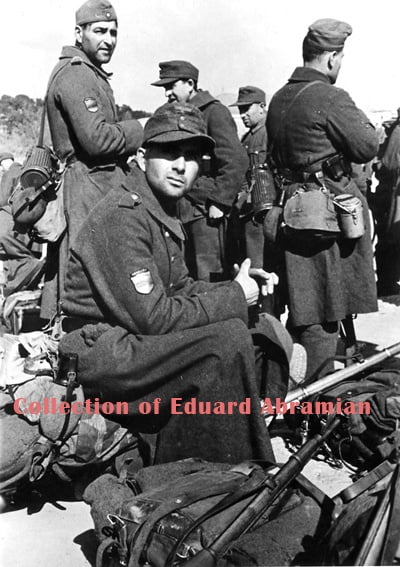
The personnel received official badges of rank and oversleeve emblems of the Armenian legion. They were compulsory to all – from the private soldier-legionary to the commander of the battalion. The personnel had additional training for the offensive and defensive operations.
Karapetyan Gevorg was appointed commander of the headquarters’ company, Sarkissian Sergey was appointed commander of the 1st infantry company, Ayvazian Hovhannes – commander of the 2nd company, Shakoyantz Michael – commander of the 3rd company, Pashinyan Alexander – commander of the 4th company. Besides Armenian commanders new German officers together with the previous ones were attached to the companies, including senior-lieutenant Bunts Wilfred, Ekkhold Karl, Witter Friz and others[20]. The battalion had its own clergymen, moreover, an Armenian Apostolic Church was built near the legion camp. One Armenian church was also opened in the town of Pulawa. According to the Armenian calendar Christian holydays were marked in the battalion, people were baptized… It’s known that local inhabitants were also baptized: the children got the second – Armenian name.
Besides German rifles, pistols and guns the battalion “Zeytun” got flame-throwers, machine-guns of different calibers, 12 mortars, anti-tank rifles and 4 anti-tank optical guns. The battalion began to receive weekly mail and Armenian newspapers “Hayastan”, (“Armenia”), “Hay Azg” (“Armenian Nation”) and “Legionakan lratu” (“Legion informant”); the legionaries had an opportunity to publish articles poems and songs about Armenia or about the service in the legion. The correspondent and photographer from the weekly newspaper “Hayastan” was always in the battalion.
In the middle of August 1943 the 809th Armenian battalion “Zeytun” was sent to the Ukraine. Its units immediately took part in the fights against partisans, though some of the units were sent to the corn fields to guard the crops.
The actions began in the east of the town of Rovno. The battalion was given 80 km territory to guard. The greater part of the legionaries had no language problems with the local population, 90% of which treated the Germans with enmity, furthermore, the inhabitance were hostile not only to the Germans but also to the legionaries of different nationalities settled in that region. The local population often spread meaningless panic news which was a part of the anti-Soviet propaganda of the Red partisans. In addition, there were unexpected attacks of the Ukrainian insurrectionists and Soviet partisans. In fact there was ardent anti-Soviet propaganda everywhere. However, according to the German reports all the scouts and agitators were liquidated with the help of legionaries and Armenian officers. Participation in the anti-partisan actions became a great trial for the battalion. Operating against partisans in the unusual conditions – in swampy and wooded locality, in the rain, the Armenian soldiers displayed courage. But they had big losses: during two months of intense actions the battalion lost 59 men killed and wounded, 25 men, owing to the continuous propaganda of the insurrectionists (UPA), transferred to the side of the Ukrainian insurrectional army. Through the fault of the great activity of the anti-Fashist forces all that time there was no telephone connection with the posts where the Armenian legionaries dislocated. The situation became especially heated when in the neighboring regions where the 805th Azerbaijani and 814th Armenian infantry battalion settled down some platoons deserted to the partisans. The latter were immediately distributed to the partisan detachments for carrying out a more effective propaganda in national languages. In this connection the 814th battalion was immediately withdrawn from the region, disarmed and sent to the legion camp in Pulawa, where after numerous arrests it was again reformed and sent to the Balkans.
Having shared the same fate, the 805th battalion was sent to Rumania. The 809th Armenian battalion remained comparatively steady and fulfilled its assignments excellently. On the 6th of October 1943 there came an order to withdraw the battalion “Zeytun” from the Ukraine and send it to the West. In the Ukraine the battalion was honored special praises and many legionaries were rewarded with crosses and medals, leaves and even money bonus.
Majority of legionaries and officers were reworded with Iron crosses of different ranks, crosses for the services in battles and medals for the Eastern people. According to the number of rewards and special thanks the battalion occupied the highest level compared with all the Eastern units of the German army.
The Armenian battalion received special thanks for heroism in the anti-partisan fight from Karl Kitzinger, general of aviation, from the Command of Wehrmacht in the Ukraine and from general-major Max Ligen, commander of the Eastern units and special formation of the special purpose 740 (s.b.V. 740) [21].
On the 16th of October 1943 the battalion arrived in Belgium for the further service on the defensive lines of the Atlantic Wall (rampart).
According to the report of captain Becker, after having arrived in Belgium, the battalion joined the complement of the 171st reserve division; the German personnel and companies separately turned to additional trainings. The aim of the trainings was directed to learning how to organize defense in the coastal regions. The soldiers learned how to use special lanterns and other light devises in the sphere of the visual communication.
According to the reminiscences of one of the German officer from the 809th Armenian battalion, moral spirit of the Armenian officers considerably lowered (dropped) because of withdrawing the battalion from the Eastern front. According to him many legionaries fought bravely and belied that in this was they were approaching the day when they would reach the borders of Armenia. After the withdrawal from the Eastern front many legionaries ceased to believe that some day they would see their Motherland. After that there were cases of disobedience: armed legionaries demanded to send them to the Eastern front to fight against Bolshevism.
Moreover, many of them didn’t understand “why Hitler had given them weapons to liberate their country from Bolsheviks and now was sending them to the West to fight against French and Anglo-Saxons. Aren’t there enough German soldiers for that? What have they done for to us? Hitler has promised us to return to new Armenia very soon, hasn’t’ he?”…
The commander of the battalion also reported about the dropping of the moral spirit of the legionaries, but in vain, as it was the High commands’ order to send the greater part of the Eastern units to the West.
According to the order the command of the battalion, the headquarters of the 2nd and 4th companies had trainings and re-forming in the training camp in the small town of Zedelgem, and the 1st and 4th companies settled down near the village of Jabbec. By that moment the battalion “Zeytun” consisted of five officers, 43 commanders of companies and platoons (19 were Germans) and 792 private legionaries[22].
From the 29th of November to the 20th of December 1943 the 809th Armenian infantry battalion “Zeytun” organized additional trainings on the training ground in Sissone after which on the 8th of January 1944 it was sent to South Beverland (The Netherlands) and it occupied the defensive line in the area of the towns of Middelurg and Goes, where the headquarters of the battalion had settled down. The stuff was situated 4 km from the town of Borselle. One company was sent to North Beverland. Beverland is a part of the Netherlands and looks like a peninsula, surrounded by bays of the North Sea.
Soon the battalion was re-informed and entered the complement of the 128th Grenadier-regiment of the 48th infantry division and became the 3rd battalion of the regiment named III (Armen.Inf.Btl. 809)/Gren.Rgt.128. Judging by documents the battalion entered the different regiments and divisions several times from February to March.
In January a part of the battalion was re-formed and participated in the construction of defensive structures of Beverland peninsula.
According to some dater the Germans included the 3rd Armenian construction company of the 148th constructional-engineer battalion into the battalion “Zeytun”. This battalion operated in the Netherlands till August 1944 when it was again re-formed into the rifle unit and sent to Normandy in the complement of the 48th infantry division.
The Armenian battalion dislocated 100 km from Paris and had restrained the British troops’ onset for three days. But some days later the offensive began on the wide front. After violent battles a considerable part of the battalion was destroyed by the Allied troops. About 100 men were taken prisoners and only a small part was able to retreat with the German army. All the legionaries from the American occupation zone were handed over by the Americans to the representatives of SMERSH and NKVD.
A small part of the battalion “Zeytun” returned home in 1945 but three years later all of them were convicted and got different terms. From some archival sources of National Security of the Republic of Armenia the survived legionaries of the 809th Armenian battalion “Zeytun” were exiled to Vorkuta camp of special regime for 20-25 years.
Only a small number could withstand cold, famine and torture and return to Armenia.
References
[1] Hoffmann J. Kaukasien 1942/43 Das deutsche Heer und die Orientvölker der Sowjetunion. Freiburg, 1991. S. 356.
[2] Drobyazko S. Krashchuk A. The Eastern legions and Cossack units in Wehrmacht, Moscow, 2001, p. 4. (in Russ.).
[3] Dallin A. German Rule in Russia 1941-1945: A Study of occupation polices, London; N.Y. 1957.
[4] The materials of the Committee of State Security of the Armenian SSR. 1966. D. 23342. P1, pp. 131.
[5] Abramian E.A. The First battalion of Armenian legion on the Caucasian front 1942-1943// The Low and Reality magazine, № 11-12, Yerevan, 2004, pp. 43-45.
* In this case the Soviet propagandists, underground activists or scouts are meant.
[6] Drobyazko S. Under the enemy’s banners. Anti-Soviet formations of German army, Moscow, 2005, p.376. (in Russ.)
[7] Abid.
[8] Hoffmann J. Kaukasien 1942/43. Das deutsche Heer und die Orientvolker der Sowjetunion. Freiburg im Breisgau. 1991. p. 334.
[9] BA-MA. Stammtafel des Armen. Inf. Btl. 809. RH 58/41.
[10] BA-MA. Oberkommando der Heeresgruppe A. RH 19 V/7. bl. 57-61; SMG. Den Haag – Armen.Inf.Btl. 809 (Anlage 179, d.d. 6.11.1943; pp.6-11).
[11] BA-MA. RH 19V/ 110.
[12] Hoffmann J. Kaukasien 1942/43. S. 431.
[13] BA-MA, RH 19V/3. H.Gr. A, KTB, S. 144, 22.11.1942.
[14] Hoffmann J. Kaukasien 1942/43. Das deutsche Heer und die Orientvolker der Sowjetunion. 1991. p. 335-336.
[15] BA-MA, RH 19V/7. Pz.AOK 1, IIa, an Arm.Inf.Btl. 809, 4. 12.1942.
[16] BA-MA, RH 19V/4, H.Gr. A, KTB, S. 50, 7.12.1942.
[17] BA-MA. Oberkommando der Heeresgruppe A. RH 19 V/7. bl. 57-61.
[18] Arm.Inf.Btl. 809, 3.4.1943 (Becker), ebd; Hoffmann J. Kaukasien 1942/43. p.345.
[19] Abramian E.A. Armenian legion of Wehrmacht (1941-1945), Yerevan, 2002.p. 14.
[20] Houterman J. N. Eastern troops in Zeeland, The Netherlands, 1943 – 1945, Hitler’s Osttruppen in the West. Middelburg – 1993. pp. 17-18.
[21] Houterman J. N. Eastern troops in Zeeland, The Netherlands, 1943 – 1945, p. 17.
[22] SMG. Den Haag – Armen.Inf.Btl. 809 (Anlage 179, d.d. 6.11.1943; 7 p.).