

Verjine Svazlian, ethnographer and folklorist, was born in 1934 in Alexandria (Egypt) in the family of the writer and public man Karnik Svazlian, himself an eye-witness survivor of Turkish tyranny.
In 1947, she has been repatriated with her parents to the Motherland, Armenia.
In 1956, she has graduated with honours from the Department of the Armenian Language and Literature of the Kh. Abovian State Pedagogical Institute.
Beginning from the nineteen fifties, she has, on her own initiative, started to write down and thereby saved from a total loss the various folklore creations communicated by the repatriates forcibly deported from Western Armenia, Cilicia and the Armenian-inhabited provinces of Anatolia, as well as the narrated memoirs of the eye-witness survivors of the Genocide.
Starting from 1958, she has worked at the M. Abeghian Institute of Literature of the Academy of Sciences of Armenia. During her post-graduate studies, she has been a M. Abeghian grant-aided student.
From 1961, she has worked at the Institute of Archaeology and Ethnography of the National Academy of Sciences of Armenia and, from 1996, also at the Museum-Institute of the Armenian Genocide of the National Academy of Sciences of the Republic of Armenia.
She has maintained her Candidate thesis in 1965 and her thesis for a Doctor’s Degree in 1995.
She has participated in republican and international conferences, discoursing upon folklore, ethnography and the Armenian Action.
She is also the author of a number of scientific papers published in the Motherland and in the Diaspora.
Publications:
Has compiled and edited: Karnik Svazlian. “For My Motherland.” “Hayastan” Publishing House. Yerevan, 1965 (in Armenian, with Cartoon Illustrations).
“Sarkis Haykouni. (Life and Work).”Armenian Ethnography and Folklore. Vol. 4, Publishing House of the AS ASSR, Yerevan, 1973 (in Armenian, with Russian Summary).
“Artsakh-Outik.”Armenian Folk Tales. Vol. 6, Publishing House of the AS ASSR, Yerevan, 1973 (in Armenian).
“Taron-Turuberan.”Armenian Folk Tales. Vol. 12, Publishing House of the AS ASSR, Yerevan, 1984 (in Armenian).
“Van-Vaspurakan.”Armenian Folk Tales. Vol. 15, “Gitutiun” Publishing House of the NAS RA, Yerevan, 1998 (in Armenian).
“Moussa Dagh.”Armenian Ethnography and Folklore. Vol. 16, Publishing House of the AS ASSR, Yerevan, 1984 (in Armenian, with English & Russian Summaries)
| [In 1985 was awarded the “Honour Certificate” of the Presidium of the Academy of Sciences of Armenia and the Gold Medal “Honorary Denizen of Moussa Dagh” granted by the Moussa Dagh Compatriotic Union]. |
“Cilicia. The Oral Tradition of the Western Armenians.” “Gitutiun” Publishing House of the NAS RA, Yerevan, 1994 (in Armenian, with English, French & Russian Summaries).
“Genocide. The Oral Evidences of the Western Armenians.” “Gitutiun” Publishing House of the NAS RA, Yerevan, 1995 (in Armenian, with English, French & Russian Summaries).
“The Genocide in the Memoirs and Turkish-Language Songs of the Western Armenians.” “Gitutiun” Publishing House of the NAS RA, Yerevan, 1997 (in Armenian, with English, French & Russian Summaries).
“The Genocide in the Memoirs and Turkish-Language Songs of the Western Armenians.” “Gitutiun” Publishing House of the NAS RA, Yerevan, 1997 (in Russian, with English, French & Armenian Summaries).
“The Armenian Genocide in the Memoirs and Turkish-Language Songs of the Eye-Witness Survivors.” “Gitutiun” Publishing House of the NAS RA, Yerevan, 1999 (in English).
“The Folklore of the Armenians of Constantinople.” “Gitutiun” Publishing House of the NAS RA, Yerevan, 2000 (in Western Armenian, with English Summary).
“The Armenian Genocide. Testimonies of the Eye-Witness Survivors.” “Gitutiun” Publishing House of the NAS RA, Yerevan, 2000 (in Armenian, with English, French & Russian Summaries).
| [On April 24, 2000, on the occasion of the 85th anniversary of the Armenian Genocide, was awarded the “Diploma of Honour” of the Presidium of the NAS RA “for the scientific investigations in the field of the historical study of the Armenian Case, the Armenian Genocide and the Armenian Diaspora, which are important contributions to Armenian historiography.” On May 2, 2002 was awarded the Diasporan literary-philological prize “Haykashen Ouzounian” of the Tekeyan Cultural Union for over 50 years of Armenological investigations and especially for the book “The Armenian Genocide. Testimonies of the Eye-Witness Survivors.”]. |
Has compiled and edited: Grikor Gyozalian. “The Ethnography of Moussa Dagh.” “Gitutiun” Publishing House of the NAS RA. Yerevan, 2001 (in Armenian, with English Introduction).
“The Armenian Genocide and Historical Memory.” “Gitutiun” Publishing House of the NAS RA, Yerevan, 2003 (in Armenian).
| [On the 24th of April, 2003, the Presidium of the National Academy of Sciences of the Republic of Armenia and the International Committee “The Veritables for the Armenians” granted her the “Fridtjof Nansen’s Memorial Medal for the scientific and public activity directed toward the condemnation of the Armenian Genocide and toward the establishment of philanthropic principles.”]. |
“The Armenian Genocide and Historical Memory.” “Gitutiun” Publishing House of the NAS RA, Yerevan, 2004 (in English, with English, French, Turkish, Russian & Armenian Summaries).
About Verjine Svazlian:
Svetlana Vardanian. “Verjine K. Svazlian.” Notable Armenian Women Scientists. Bibliographical Materials. No. 3, Yerevan, 2002 (in Armenian & English).
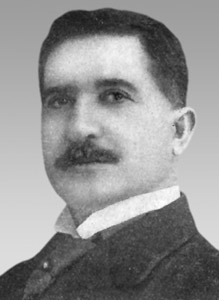
Mihran Svazlian
(1863, Izmir – 1935, Boston)
——————————–
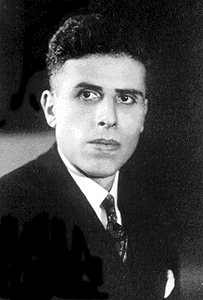
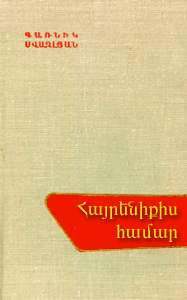
(1904, Kayseri – 1948, Yerevan)
——————————–
The Oral Tradition
of the Western Armenians.
The Armenian Genocide – 1915
Doctor of Philological Sciences, ethnographer Verjine Svazlian
writing down the tragic memoirs and songs
narrated by the Genocide survivor, Mariam Baghdishian (b. 1909, Moussa Dagh)
The oral tradition of the Western Armenians is part of the oral culture of the Armenian people. Its original peculiarities are conditioned by the public and political circumstances connected with the life of the Western Armenians.
In the course of a number of years, the following folklore collections have been written down word by word, fragment by fragment and published.
I wish to express my deep gratitude to those Western Armenian narrators, who, with their already fading dialects have communicated me and saved from a total loss the remains of the spiritual culture of this part of the Armenian people, so I offer you what is yours, Armenian people.
——————————–
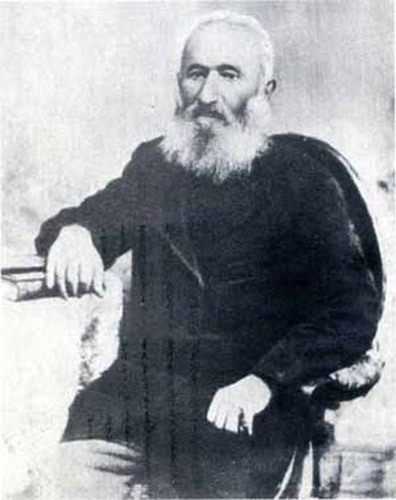
(1838 – 1908)
Sarkis Haykouni
(Life and Work)
——————————–
Armenian Folk Tales.
“Artsakh-Outik”
“Taron-Turuberan”
“Van-Vaspurakan”
——————————–
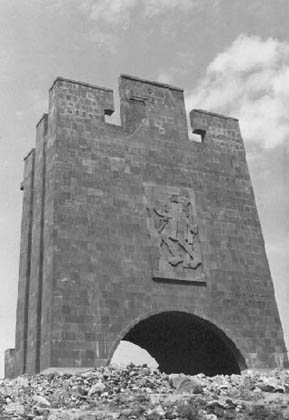
Moussa Dagh
(Summary)
Moussa Ler (Moussa Dagh) is the name of a locality on the northeastern shore of the Mediterranean, populated since of long with an ethnographic group of Armenians.
In time of the 1915 wholesale massacre of the Armenians they rose to worldwide renown for their forty-day-long heroic battle, after which they commenced a nomadic life in different countries. In 1946 the greater part of those wanderers was repatriated to Soviet Armenia.
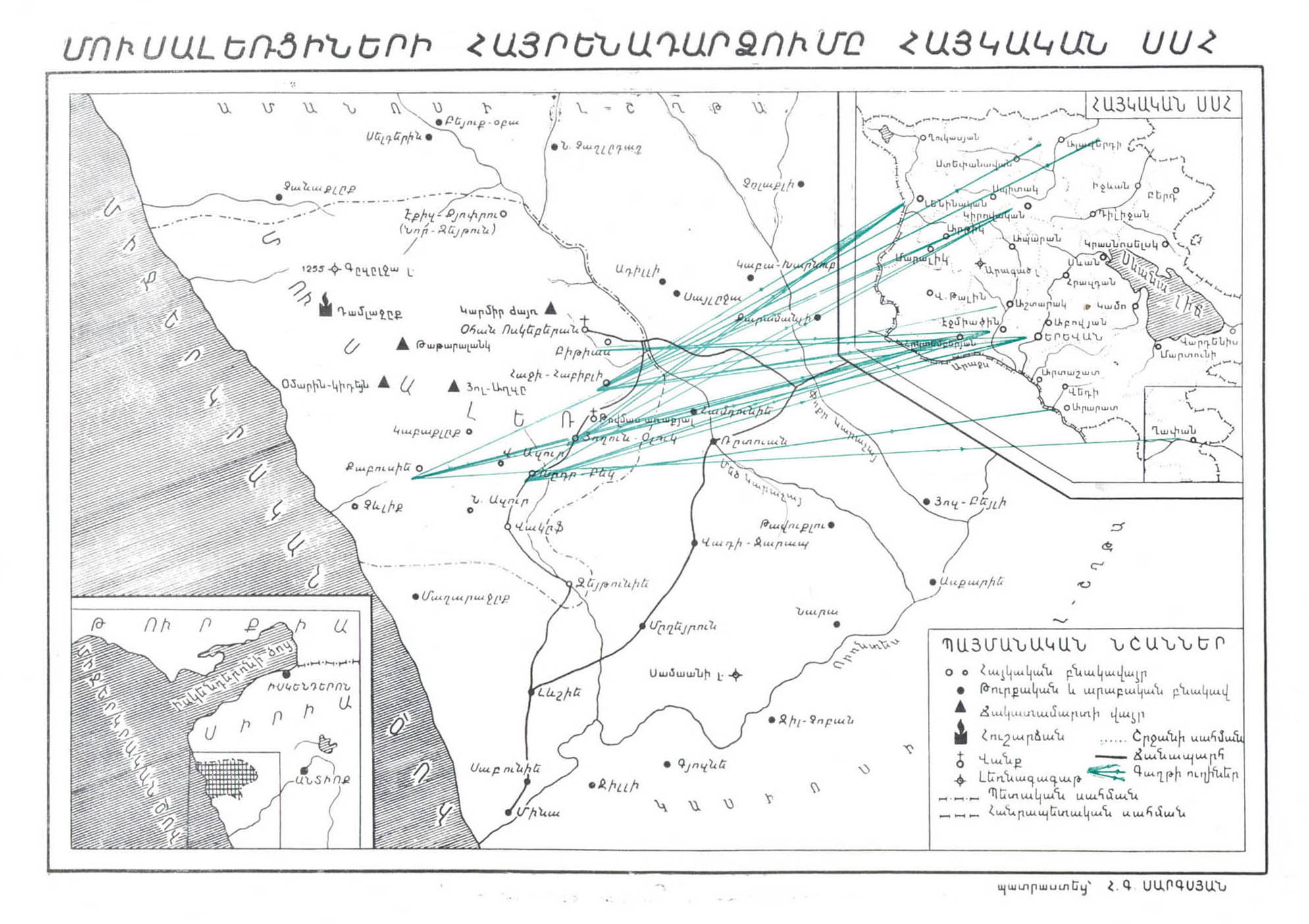
Repatriation of the Moussadaghians to the Armenian SSR
The present edition is the first attempt to sample nearly all the traditional folklore genres of the natives of Moussa Ler.
The collection comprises 1319 texts of different productions, characteristic of the repertory of Moussa Ler natives living in Armenia.
The folklore data are presented in three large sections:
- Epic Folk Art.
- Tales
- Fables
- Anecdotes
- Legends
- Lyric Folk Art.
- Ditties
- Ritual songs
- Patriotic songs
- Soldiers’ songs
- Nomadic songs
- Everyday songs
- Formulas.
- Sayings
- Proverbs
- Riddles
- Blessings
- Imprecations
- Oaths
- Idiomatic Expressions
The data were recorded with due account of their dialectological principles, each provided with parallel entries of equivalents in literary Armenian.
The edition includes a vocabulary explaining the difficult words and expressions, the biography of narrators, comments marked with archival references showing motif parallels in world tales, tables, a number of notations of songs based on their execution, as well as a map portraying the repatriation of the natives of Moussa Ler to Soviet Armenia.
The introduction enlists general information on Moussa Ler and its former inhabitants and a number of results of special studies of the folklore repertory of this group.
The folklore data were recorded in two periods: 1955-1960 and 1972-1978. A collection of statistical and analytical observations made in time of two expeditions enabled us to draw a number of synchronous and diachronous conclusions. Thus, tendencies of qualitative changes on the synchronous plane make themselves felt in the quantitative reduction of the traditional repertory, apparently due to generation shift: the departure of the senior generation of narrators brings about a gradual disappearance of oral folktales.
Making use of the Armenian system of documentation (ASL) worked out by Isidor Levin, a doctor of philological sciences, as well as the research methods he has suggested, we have succeeded in a number of cases in objectifying the changes in the folklore of the natives of Moussa Ler, accountable in terms of modified historical and geographical setting, the growth of social and cultural standard and the shaping of a new thinking and psychology.
The research method and the references drawn upon in the writing may prove of interest not only to the folklorists but also to the historians of Armenian culture, dialectologists and sociologists.
——————————–
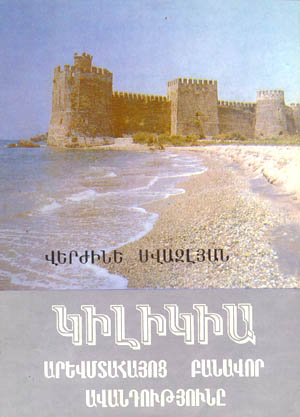
Cilicia.
The Oral Tradition of the Western Armenians
(Summary)
The medieval Armenian State Cilicia was situated on the South East of Minor Asia and North East Coast of the Mediterranean Sea.
During three centuries of its glorious sovereign state (XI-XIV centuries) the Armenian Cilicia was famous for its developed political, economic system. Here flourished the trades, educational centres of science and culture.
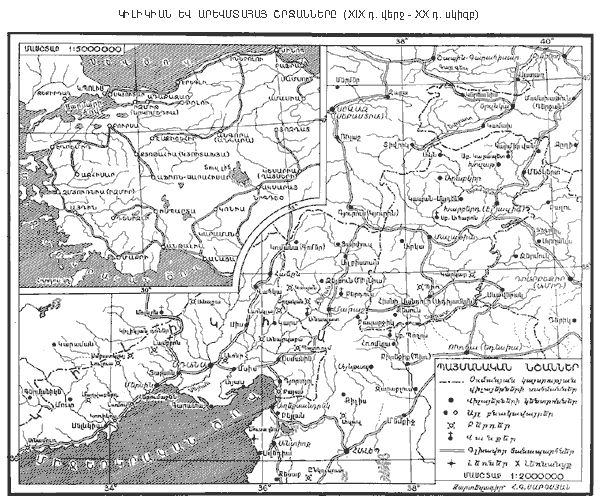
Cilicia and the Western Armenian Regions
(End of the 19th – Beginning of the 20th Century)
After the Genocide of the Armenians in 1915, the deportation from Cilicia (1921) and the disaster of Ismir (1922), considerable part of the Western Armenians was exterminated. The rest, who escaped and survived by miracle, remained homeless and unmotherland. So they were obliged to settle in different countries of the world, creating the Armenian Diaspora as a historical phenomenon.
After long wanderings, most of them repatriated to Soviet Armenia and settled in new localities, which symbolized their past cradle.
From the representatives of the eldest generation which suffered, eye-witnesses of the historical events we mentioned above, by our own initiative, since 1950s, we inscribed numerous memories, historical folk tales about historical events and features, as well as songs and epical songs of various genres, which in artistic forms reproduced the past flourished life, customs and mode of life of the Cilician Armenians, who suffered because of the forced massacre and deportation organized by the Turks, the honest and fair struggle, which the Cilician Armenians held against that violence from the beginning of the insurrection of Zeytoun 1862 until the heroic resistance of Moussa Dagh, Yedessia (1915), and also Adana, Aintab, Hadjn and other places in 1920, until the forced deportation of the Cilician Armenians and Anatolia, their wanderings and repatriation, their adaptation to the new mode of life of their Homeland, including the actual events of nowadays and the confirmation of the new Sovereign Armenian State.
That period is saturated with rapid social-historical events, and this collection includes memorized folklore materials of this period, which until now by different causes was not inscribed and studied.
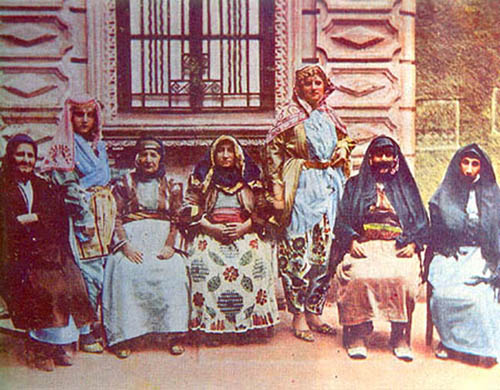
Costumes of Cilician Women
While inscribing the materials of the collection we tried to maintain the irreproachable oral speech of the narrator. The dialect materials are presented as it is accepted in the scientific transcription, having in particular the dialect of Cilicia (Zeytoun, Hadjn, Marash, Moussa-Dagh, Kessab, Beylan, Deurtyol, Sis, Tarsone, Adana, Mersine) and also the oral folklore of other Western Armenian regions (Yedessia, Tikranakert, Bitlis, Erzroum, Van, Harput, Keghy, Balou, Malatya, Kesarya, Sebastya, Shabin-Karahisar, Adabazar, Eskishehir, Boursa, Biledjik, Nicomidie, Rodosto, Tchanakgale, Smyrne, Constantinople) in Armenian and Turkish languages accompanied by our literary Armenian translations.
The materials of the collection are mainly inscribed in Armenia, partial in the USA and Greece and are grouped and systematized in four parts.
- Epical Folklore.
- Tales
- Fables and recitals
- Religious legends
- Superstitious narrations
- Toponimical legends
- Historical narrations
- Amusing narrations
- Poetic Folklore.
- Lullabies
- Children’s songs
- Songs and couplets of love
- Songs and couplets of exile
- Ritual songs
1. Marriage
2. Holiday
- Custom and amusing songs
- Historical and epic songs
1. Patriotic and heroic
2. Military muster and prisoners
3. Deportation and massacre
4. About mothers who lost their children, orphans and orphanages
5. About nostalgia for their Motherland and repatriation
- Phraseological Folklore.
- Proverb-sayings
- Edifications
- Maledictions
- Benedictions-wishes
- Prayers
- Memories About the Armenian Genocide.
The collection has a vocabulary of foreign words and dialects, footnotes, a map, songs accompanied by musical notes, historical-ethnographical photos.
The introduction of the collection includes information about the historical past of the Cilician Armenians, their political, economic, spiritual and cultural life.
In applying the least scientific modern methods of quantitative analyze in folklore science, we studied the sex-age relation of 230 narrators, comparing with their 1461 unit information in various genres materials.
The folklore materials and memories of this of this folk-historical collection, for its originality and historical value, shall be the witness for the objective illumination of the Armenian Genocide and other historical events by a simple, popular language, and so they appears as historical reliable documents.
——————————–
Genocide.
The Oral Evidences of the Western Armenians
(Summary)
Recently, the interest around the Armenian nation’s fatal Genocide increased, as far as the Turkish historiography obstinate to distort the reliable historical events. In a sense, except of the official published documents, the folk songs and memoirs, created directly under the impression of the events mentioned above, have an exceptional historico-factual importance and were not inscribed and researched in Armenia until now.
After the Genocide of the Armenians in 1915, the deportation from Cilicia (1921) and the disaster of Ismir (1922), considerable part of the Western Armenians was exterminated. The rest, which escaped and survived by miracle, remained homeless and unmotherland. So they were obliged to settle in different countries of the world, creating the Armenian Diaspora as a historical phenomenon.
After long wanderings, most of them repatriated to Soviet Armenia and settled in new localities which symbolized their past cradle.
This collection includes memoirs and folk songs of historical character (in Armenian and in Turkish languages), which, since 1950s, we have inscribed in Armenia and partly in the Diaspora, created by the Armenians deported from Western Armenia, Cilicia and the localities of Anatolia, who reproduced the eldest generation of eye-witness repatriates, salved by miracle from the Genocide.
These factual documents really reflect the military muster, the mass exile, massacre and slaughter organized by the Turks, also the heroic self-defense and the overwhelms of Van, Sasoun, Moush, Shatakh, Shapin-Garahisar, Zeytoun, Moussa Dagh, Ourfa and other places, later in 1920-1921 Marash, Ayntap, Hadjn.
In spite the movements were crushed by the Turkish autocracy, the fearless heroes, who struggled for their elementary rights and physical resistance of their nation, left a bright sign in the history of the national liberation struggle.
In the process of noting the materials we tried to be faithful to the oral speech of 230 narrators, to the specific dialogue of their languages. Some interpretations are given by special footnotes.
Besides the folk materials, the collection includes a scientific introduction, where parallel to the historical events we researched the inscribed folk materials, the original texts and notes of which are kept in the fund of the folklore archive Verjine Svazlian at the Institute of Archaeology and Ethnography of Armenia’s National Academy of Sciences.
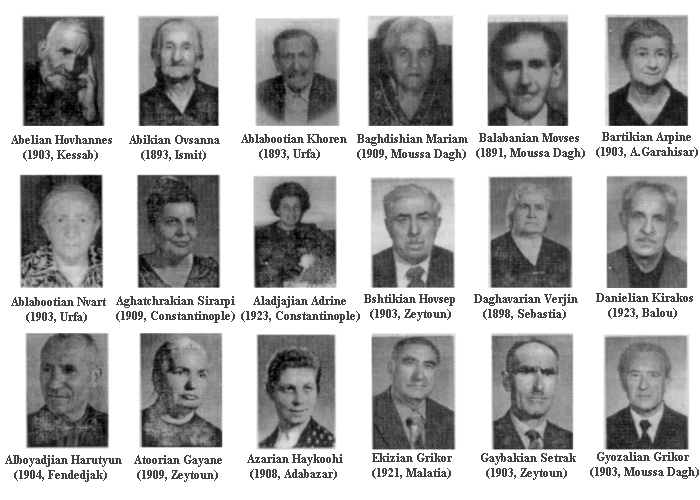
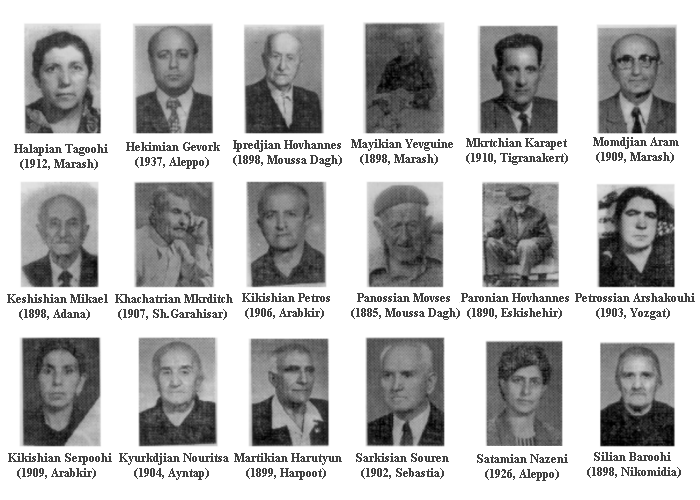
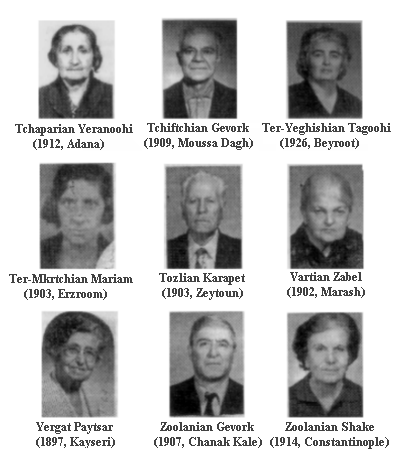
The collection has a vocabulary of foreign words and dialects, footnotes, a map, songs accompanied by musical notes, historical photos, information about the narrators and their photographs.
In the course of tens of years period word by word, fragment by fragment the inscribed and presented oral materials, because of their original and valuable historical cognition remain reliable, factological and documental evidences, reflecting by a simple folk language the events of the Armenian Genocide.
——————————–
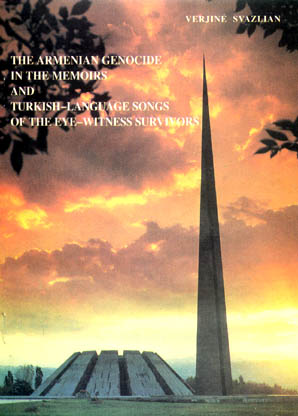
The Armenian Genocide
in the Memoirs
and
Turkish-Language Songs
of the Eye-Witness Survivors
——————————–
The Folklore of the
Armenians of Constantinople
After the fall of Constantinople in 1453, Fatih Sultan Mohamet II proclaimed it capital of the Ottoman State and renamed it Istanbul.
The monarch transferred there the families of the Armenian masters from the inner provinces of the Turkish Empire, who not only increased the number of the flourishing Armenian community, but also imparted beauty and radiance to the newly-established capital with the ability of their mind and their arm.
Under the immediate supervision of Sultan Fatih Mohamet, the Armenians found a true atmosphere of activity and, owing to the religious freedom afforded, founded in the new capital the Armenian Patriarchate of Turkey in 1461, to which the Sultan granted certain ecclesiastic and communal rights.
There were at that time about one thousand Armenian families in Istanbul. During the subsequent years the number of Armenians in Istanbul grew gradually as a result of the migration of people from the provinces in search of work. The Armenian jewellers, silk-spinners and other craftsman enjoyed a great reputation. The wealthy class was composed of money-changers, money-lenders and tradesmen, who, owing to their capital and enterprising efficiency, had gained influential positions, had established ties with the Sultan’s Court and played an active role in the economic and political life of Turkey.
The important state functions of the Sultan’s Court had been trusted to the Armenians, who conducted them devotedly and by inheritance, from generation to generation. Thus, Harutyun Amira Bezjian was the Sultan’s counsellor, the Duzians governed the jeweller’s art and the mintage, the Dadians were leaders in gunpowder manufacture, the Balians were distinguished in architecture, etc. The Armenians have had also ministers of the Post, the Telegraph, the Public Constructions, Agriculture, Foreign Affairs in the government of the Ottoman Empire and subsequently, deputies of the Ottoman Parliament as well.
The commission merchants were also among the wealthy class and greatly fostered the developing trade between Turkey and Europe.
The Armenian community in Istanbul included also famous intellectuals, artists and architects, who had an active participation not only in the Palace, but also in the public and political progress of the country.
During the 539 years of its existence, the Armenian Patriarchate of Turkey, with its various religious and cultural activities, has lead the Armenian community along the path of civilization, constantly supporting the social and ideological ascent of the country. It has also greatly contributed to the unification of the Armenian people, to the preservation of its national identity, language and culture. At present, the Armenian Patriarch in Turkey is His Beatitude Archbishop Mesrob M. Mutafian.
Now the Armenians have 42 churches and 19 schools in Istanbul and the provinces. The schools have their alumni associations, which keep alive the cultural life of the Armenian community by their various artistic enterprises and publications.
Besides the daily newspapers “Zhamanak” and “Nor Marmara,” the weekly journals “Akos” and “Lraber” (publication of the Patriarchate) are published in Armenian and Turkish languages, the yearbook “Shoghakat,” the monthly journal “Soorp Prkitch,” the reviews “Hopina” and “Poondj” are published in Armenian.
At the present time, about 60 thousand Armenians reside in Istanbul and 5 thousand live in the provinces. They are engaged in trade and handicrafts. The Armenian community has devoted clergymen, teachers, physicians, writers and artists, who have been specialized in Turkey and in foreign countries.
It is impossible to conceive the spiritual character of the Armenian community of Turkey without studying its oral tradition, which has been transmitted from generation to generation.
The various materials of the oral tradition (1516 units) we have written down from the representatives of the Armenian community of Turkey (120 narrators) have been summarized in the present collection under the following headings.I.Prose Folkore.
- Fables, tales.
- Legends.
- Religious-moral tales.
- Humorous tales.
- Parables and animal tales.
- Custom tales.
- Historical tales.
II. Verse Folklore.
- Lullabies.
- Children’s play songs.
- Children’s songs.
- Adolescent songs.
- Love songs.
- Emigration songs.
- Ritual (nuptial, festive) songs.
- Custom and humorous songs.
- Nature songs.
- Proverbs.
- Edifications.
- Maledictions.
- Benedictions.
- Idioms.
- Riddles.
- Patters.
- Verse aphorisms.
- Creeds.
- Prayers.
The volume includes also a glossary of foreign words and dialects, foot-notes, songs accompanied by musical notes, photographs of narrators and commentaries.
The present collection of oral folk tradition gives the reader an idea about the past mode of life, demeanour, customs, emotions and experiences of the Armenian community of Turkey, as well as about the present day joint, peaceful and creative life of the Armenian and Turkish peoples in the Republic of Turkey.
——————————–
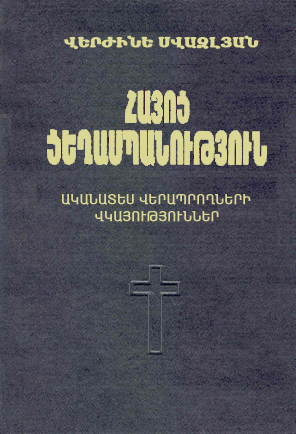
The Armenian Genocide.
Testimonies of the Eye-Witness Survivors
Dedicated
to the 85th Anniversary
of the Armenian Genocide
D E D I C A T I O N
This volume is published with the patronage of
the Catholicosate of the Eminent House of Cilicia.
We express our deep gratitude to
His Holiness
ARAM I Catholicos
of the Eminent House of Cilicia
for, publishing with his patriarchal enlightened patronage
the historical memory of the Armenian nation,
as an evidence of the past and a warning for the future,
it is presented to the world and to the impartial judgement of mankind.
V. S.
(Summary)
During the past years, interest toward the fatal events of the Armenian Genocide has grown, especially when Turkish historiographers obstinately tried to distort the true historical facts. In this respect, the popular songs and memoirs created under the immediate impression of the said events are, besides the official published documents, of an exceptional historico-cognitive value; in spite of their importance, however, they had almost not been recorded and studied until recently.
As a result of the Genocide of the Armenians in 1915, the deportation from Cilicia (1921) and the disaster of Izmir (1922), more than 1.5 million Western Armenians were exterminated, while those who were rescued and miraculously survived, remained homeless and deprived of their motherland; they were compelled to migrate and to settle in different countries of the world, creating the Armenian Diaspora as a historical reality.
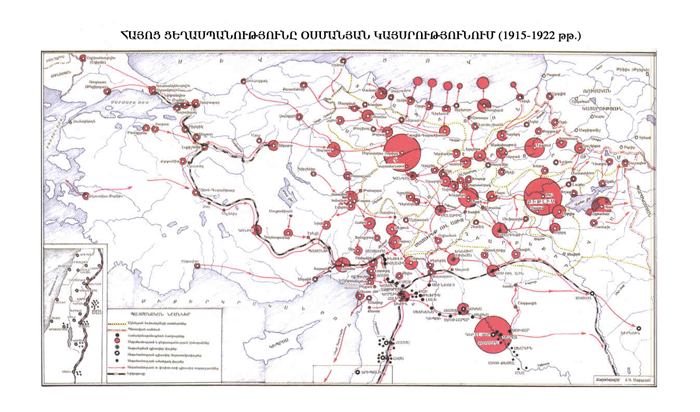
The Armenian Genocide in the Ottoman Empire (1915-1922)
After long wanderings, many of the eye-witness survivors of these tragic events have been repatriated to the Motherland from Constantinople, the Balkan countries, Greece, France, Syria, Lebanon, Iraq, Egypt and settled in newly-built localities symbolizing their former native cradles.
The present collection includes oral memoirs and folk songs of historical character (in Armenian and Turkish languages), which we have inscribed since 1956 in Armenia and partly in the Diaspora; they have been narrated and sung by Armenian repatriates, representatives of the senior generation of eye-witnesses, miraculously saved from the Genocide and deported from 70 localities of Western Armenia, Cilicia and Anatolia.
These factual documents truthfully depict the mobilization, the arm-collection, the mass exile, massacre and slaughter organized by the government of Young Turks, as well as the heroic self-defensive battles of Van, Sassoun, Moush, Shatakh, Shapin-Garahissar, Moussa Dagh, Urfa and later (1920-1921), of Ayntap and Hadjn.
Although the Turkish autocracy cruelly suppressed the heroic resistance started in various localities, nevertheless, the fearless Armenian heroes, who fought for their elementary human rights and for the physical survival of their nation, recorded brilliant pages in the history of the national-liberation struggle of the Armenian people.
In the process of recording the materials, we have tried to be faithful to the oral speech of our 550 narrators and to the specific dialect of their language. Some interpretations are given by special footnotes.
Besides the memoirs and songs, the collection includes also a historico-scientific introduction, where, along with the historical events, we have analysed the recorded oral folk materials (600 units), the original texts and notes of which are kept as a special fund (Verjine Svazlian Fund) in the archives of the Museum-Institute of the Armenian Genocide of the National Academy of Sciences of the Republic of Armenia.
The collection is provided with a glossary of foreign words and dialects, footnotes, historical map, songs accompanied by musical notes, information about the narrators and their photographs.
The present oral testimonies, which have been inscribed (written down, audio- and video-recorded) word by word, fragment by fragment in the course of 45 years, are, by reason of their originality and historical value, unique factological and documental evidences reflecting, in a simple folk language, the tragic events of the Armenian Genocide.
——————————–
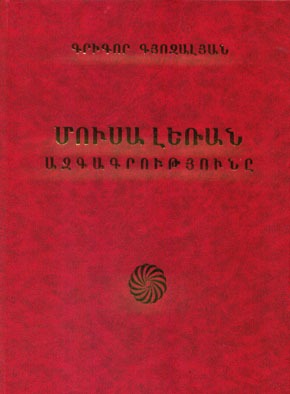
Grikor Gyozalian
The Ethnography of Moussa Dagh
From the Editor
I made the acquaintance of the repatriate intellectual Grikor Gyozalian (Geghuni), a native of Moussa Dagh, specialized in engineering in Paris, in 1976, at the time when I was preparing my folklore collection “Moussa Dagh” for publication (V. Svazlian. Moussa Dagh. “Armenian Ethnography and Folklore.” Vol. 16, Publishing House AS ASSR, Yerevan, 1984). Grikor Gyozalian became for me not only a talented narrator from whom I have written down folklore materials already doomed to oblivion, but also, with his compassionate behaviour and patriotic fervency, he assisted in the dialectal corrections of the original texts of my collection, for which I am grateful to him.
Formerly, Grikor Gyozalian had assisted also the academicians Ararat Gharibian and Gevork Jahukian in studying the difficult dialect of Moussa Dagh.
Appreciating Grikor Gyozalian’s rich experience and knowledge of his native land, I requested him to compile the ethnography of Moussa Dagh, putting at his disposal the “Ethnographic Questionnaire” of the famous ethnographer Stepan Lissitsian, in order that, using these scientific principles as a starting point, he might present the life and customs of this section of the Armenian nation, the lack of which is notable up to the present day.
Inspired with the dream of his native land and endowed with poetic style, Grikor Gyozalian realized this work with love and enthusiasm; however, it was left unpublished up till now for various reasons at the archives of the Institute of Archaeology and Ethnography of the National Academy of Sciences of the Republic of Armenia.
The present work summarizes the period extending till the heroic battle organized by the denizens of Moussa Dagh during the days of the Armenian Genocide in 1915. Based upon the general characteristic of the seven villages of Moussa Dagh, it depicts the geographical environment they have lived in, the old and new historical events, the popular rites and beliefs embracing all the spheres of the human life from birth till future life.
The section “Economic Life” includes detailed descriptions concerning land-cultivation, horticulture, vegetable-growing, cattle-breeding, sericulture, apiculture, hunting, widespread occupations in handicraft and manual skill, barter, trade, transport, etc.
The section “Material Life” describes the villages, the churches, nearly all the variants of the external aspect and internal furnishing of houses and adjacent constructions, of costumes, of adornments, of food and beverages.
Of special interest are the materials included in the section “Social Relations” of the inhabitants of Moussa Dagh dealing with the customary right and various forms of thinking of the generation, the family, the class layers, the beliefs, the holidays and the rites.
Grikor Gyozalian has succeeded, as an eye-witness survivor, in presenting what he has seen and heard in the past in a popular language and in an expressive and vivid style, imparting to the material a truthful and trustworthy character.
The work is supplied with drawings made by the author himself, which render this valuable ethnographic ancient material more obvious and more comprehensible.
Grikor Gyozalian’s present work is a colourful panorama saved from a total loss of the former life, customs and outlook of the heroic denizens of Moussa Dagh, which, we are sure, will occupy its befitting place in the century-old history of the Armenian people.
Verjine Svazlian
Doctor of Philological Sciences
——————————–
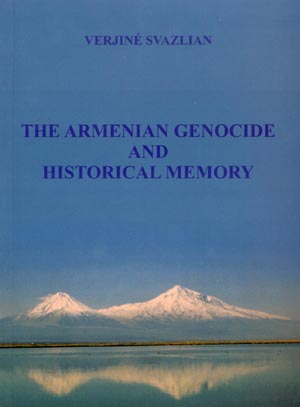
The Armenian Genocide and Historical Memory
Translated from the Armenian by
TIGRAN TSULIKIANDedicated
to the 90th Anniversary
of the Armenian Genocide
C O N T E N T S
The typological peculiarities of the testimonies of eyewitness survivors
The course of the Armenian Genocide according to the testimonies of the eyewitness survivors
Bibliography
Photographs of the eyewitness survivors of the Armenian Genocide
Photographs of the following generation of the eyewitness survivors
About the author
Map of the Armenian Genocide in the Ottoman Empire (1915-1922)