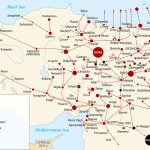
Ani (often called the “City of 1001 Churches”) was one of the most beloved and renowned capitals in Armenian history. The city was situated on a hilltop near the banks of the Akhuryan River. It was an important cultural and economic center, with evidence of habitation dating back to the Bronze and Iron Ages. Excavations have revealed classical masonry reused in the citadel walls and what is believed to be a Zoroastrian fire temple.
Symbol of the Bagratid Kingdom

Ani was first mentioned by Armenian historians in the 5th century AD as part of the Kamsarakan principality. By the end of the 8th century, Ani and its nearby estates came under the control of the Bagratid dynasty. The city started to flourish in 961 AD when King Ashot III moved the Armenian capital from Kars to Ani. Within a few decades, Ani transformed from a small fortress town into a large medieval city. King Ashot constructed the Inner (or Ashotyan) walls, and as the city continued to expand, King Smbat II built much larger outer (or Smbatyan) walls by 989 AD. The remains that stretch beyond these walls indicate that even these were not large enough to contain the rapidly growing population.



Architectural Marvels
Ani became known as a hub for merchants and traders, controlling key trade routes between Byzantium, Persia, Syria, the Caucasus, and Central Asia. By 992 AD, the Armenian Catholicosate had moved its seat to Ani, and the city had over 100,000 inhabitants by the early 11th century, with 12 bishops, 40 monks, and 500 priests.

Some of the most notable churches and structures include:
- Mother Church (Surp Asdvadzadzin): Also known as the Cathedral of Ani, this church was begun in 989 under the reign of Smbat II and completed in 1001 during the rule of King Gagik I. Designed by the renowned architect Trdat, it remains a masterpiece of medieval Armenian architecture.
- Grigor Lusavorich Church: Built in 1215 under the Zakarid dynasty, this church is the best-preserved monument at Ani. Commissioned by the wealthy Armenian merchant Tigran Honents, it features a unique series of frescoes depicting the lives of Saint Gregory the Illuminator and Christ.
- Gagkashen Church: Commissioned by King Gagik I in 1010 and designed by Trdat, this church was a masterpiece of Armenian architecture. It collapsed shortly after its construction, and later houses were built atop its ruins.
- Araqeloc Church: This church was built in 1004 and is another fine example of the architectural achievements of Ani.

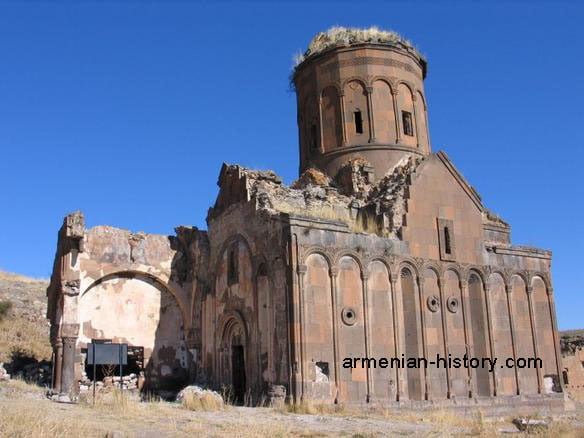
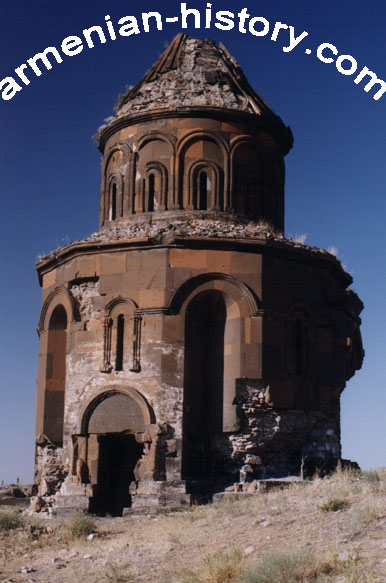

Ani also had several Georgian and Byzantine churches, as well as mosques, reflecting its diverse cultural and religious landscape.
Structure of Ani
The city of Ani was structured like many other medieval cities, with a citadel, an inner city (shahastan), and expansive suburbs. The citadel, located in the southwestern part of the city, was separated from the shahastan by special city walls. It housed the royal palace, several churches, a bathhouse, and other essential buildings.
Royal palace
The royal palace, excavated by Nikolai Marr in 1908-1909, occupied the highest part of the citadel hill and served as the residence of the Bagratid kings. The citadel also contained the ruins of three churches and other structures, showcasing the city’s strategic and administrative significance.


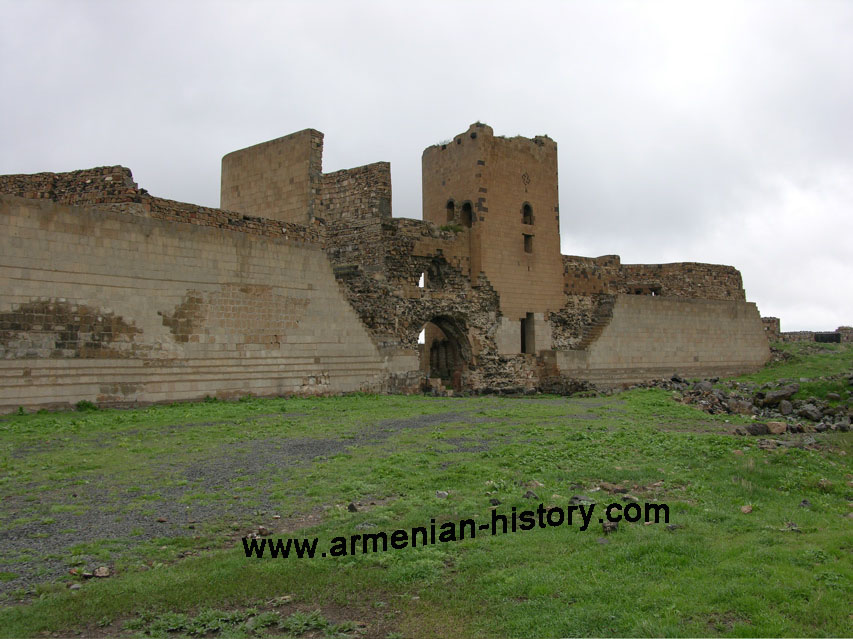

Defensive Walls and Bridges
Ani was fortified with two lines of defensive walls. The first line, known as the Ashotashen Walls, was constructed during the reign of King Ashot III (963-964). The second line, the Smbatyan Walls, built by King Smbat II (977-989), spanned 2.5 kilometers and stood 8-10 meters high. These walls included several gates, such as the Lion Gate, the Kars Gate, and the Dvin Gate. Additionally, Ani had numerous bridges, built during the 10th and 11th centuries, that connected various parts of the city.
Decline and Conquest
Ani’s decline began after the death of King Gagik I in 1020. Internal strife between his sons and external pressures from the Byzantine Empire led to instability. After King Hovhannes-Smbat’s death in 1042, the Byzantines claimed the Bagratid Kingdom. Though initially resisted, Ani eventually surrendered to the Byzantines in 1045.
In 1064, Seljuk Sultan Alp-Arslan attacked Ani, capturing and devastating the city. In 1072, the Turks sold Ani to Abul-Svar, who passed it on to the Manuchyan Emirs. The city regained some of its prosperity under the Zakarid princes in 1199, but it was later invaded by the Mongols in 1237 and occupied by the Kara Koyunlu in the 14th century.
Ani eventually became part of the Ottoman Empire in 1579, but by the early 19th century, the city was deserted, earning its moniker “The City of Ghosts.”
During the brief existence of the First Republic of Armenia (1918-1920), Ani was included within its borders. However, following the military advances of Turkish forces in 1920 and the subsequent geopolitical changes, Ani was incorporated into Turkey, where it remains today.