HOME
HISTORY
BIOGRAPHIES
ANALYTICS
MAPS
LIBRARY
LINKS
ABOUT ME


MYTHOLOGY
MILITARY HISTORY
CAPITALS
CHURCHES
COINS
DIASPORA-SPYURQ
KINGS
GALLERY
KARABAKH
JAVAKHK


Armenian Rock-Art

Can a shamanistic approach bring us closer to an understanding of the rock-art of Ukhtasar?


Reproduction in full or in part is prohibited


Author: Tina Walkling

Introduction

I believe that a shamanistic approach may prove useful as a starting point in helping to bring us closer to an understanding of the rock-art of Ukhtasar in the Syunik region of Armenia. Rock art is, of course, notoriously difficult to understand or interpret. Certain Scandinavian specialists, including Malmer, doubt "whether we today actually can extract from rock-art anything of its' original meaning, neither by intuition nor by the help of ethnographical and historical analogies" (Goldhahn, 1999). We should never expect to be able to step inside the minds of our ancestors, least of all to find prescriptive meanings, but even if we are enabled to ask better-informed questions, it is surely worth the attempt, especially when the images in question are extraordinary and fascinating. In this study, in addition to "formal methods" (examining the images themselves), I plan to use "informed methods" such as archaeological and ethnographic evidence, myth, ritual and 'religion', together with analogy, (Chippindale & Tacon, 1998; Dowson, 1998; Solomons, 1998). By weaving these strands together, I will discuss what some of the images may have meant to the people who created them, while keeping in mind that the rock-art may well bear multiple, ambiguous and complex meanings, perhaps even "riddled with contradictions" (Tilley, 1991; Bahn, 1998).

I plan to approach the rock art by studying images of the goat and the snake and show how these animals seem to play a central role in the rock carvings at Ukhtasar as agents of transformation. Both animals appear to be inextricably linked with death, rebirth, and the shamanic 3-tiered cosmos, themes that were apparently paramount in the beliefs of the people who created the images. But why employ a shamanistic approach? Is such an approach justified by the images themselves? Can a shamanistic approach tell us anything new about the people who created the art? Is such an approach adequate or can we employ additional means to enrich our understanding? A shamanistic approach to rock-art is of course far from new and some specialists (for example Bahn and Francfort, 2001) have been sharply critical of researchers, including David Lewis-Williams, who have been accused of using shamanism as a "blanket explanation" for all rock-art (Bahn, 2001). However, at Ukhtasar the carvings seem to speak for themselves in the most striking way (see fig. 1). 

The manner in which the subject matter is portrayed strongly suggests that the images were created with the memory of trance-induced hallucinations still fresh in the mind of the artist or 'shaman'. The characteristic entoptics, seen universally in the first stage of trance and the construals of the second and third stages seem to be ubiquitous in the images at Ukhtasar, where the elements include elongation, grids, nested U-shapes, zigzags, lines, spirals, dots and filigrees. Many of the same entoptics and construals were seen recently by Charmian Gradwell (personal communication, 2004) while participating in the Yukon River Quest (kayak) Race. Huge, shimmering "rainbow bridges" [classic nested U shapes] "extended far into the distance", spirals, animals, especially antelope with big horns, horses and "panther"-like predators were all around her as she slipped into deep trance, induced by extreme exhaustion, sleep and food deprivation. As Lewis-Williams and Dowson (2000) stress, hallucinations seen in the second and third stages of trance are culture specific, so it is remarkable that Gradwell's vision of "men with snakes on their heads" can be seen also in the rock carvings at Ukhtasar (fig. 3.). The fact that today western subjects in deep trance can see the same visions as those imaged by the artists at Ukhtasar, several thousand years ago (whether shamans or not) supports the theory of a neuropsychological basis for at least some prehistoric rock art (Lewis-Williams & Dowson, 2000).

The Setting

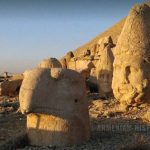
According to Lewis-Williams (2002) the 3 world cosmos, (evident in Armenian mythology, burial practices and artefacts as well as in the rock-carvings) is also a universal construct, hard-wired within the neurology of the human brain, just as the entoptics seen in altered states of consciousness. At the 'sacred' site of Ukhtasar, the 3-tiered cosmos, central to shamanism, can be easily imagined. The setting seems to lend itself to the practice of ancient worship. The black chthonic depths of the Underworld reside below massive boulders piled up by glaciation. A lake, dammed naturally by the rocks, and high pastures represent our Earth World, while the mountains, traditionally venerated as sacred in Armenia (Ananikian, 1925), reach up to the Heavenly World. Being heavily polished by glacial action, and perhaps covered in a layer of silica, the rock surfaces are both dark and highly reflective. The images, pecked into the mainly horizontal surfaces, seem to reflect into the sky like a mirror. With some imagination, one could say that the rock carvings have been deliberately positioned to reflect up to the heavens where the deities reside. Within the context of Algonkian rock-art, Arsenault (2004) describes the "almost supernatural brilliance" of a particular rock surface, remarking that "its immediate physical setting" "is another element to be considered in studying the sacred dimension attributed to certain places" (see fig. 2). A natural amphitheatre, with a dramatic mountain backdrop could have held many people for ceremonies, worship and meetings, perhaps with other groups or clans. Ukhtasar, meaning Pilgrimage Mountain, is still regarded as a sacred place by many, including the artist, Ashot Avagyan of nearby Sisian. Every August Avagyan leads a group of artists, poets, musicians and friends up the mountain to celebrate the ancient Armenian New Year with contemporary rites and rituals including painting fertility symbols on the breasts of young women. The participants are cleansed and reborn by immersion in the icy water of the lake. The site would no doubt "do it" for John Berger in a Floodsky way (Berger, 2002; Floodsky, 2002). 

Altered states of consciousness

The journey to Ukhtasar, at an altitude of over 3,300 meters (=10800 feet), could almost lead in itself to an altered state of consciousness, due to lack of oxygen, physical exertion and possible sleep and food deprivation. An altered state of consciousness can be induced in many ways of course, including rhythmic drumming, dancing or whirling in order to assist the shaman or 'priest' to enter into a state of trance. The rhythmic action of pecking the rock at Ukhtasar might have helped to induce a state of deep trance. In "The Color of Pomegranates" (1969), by the Armenian filmmaker, Parajanov, a short sequence shows a monk clearly entering into trance as his fellow monks rhythmically peck crosses into the wall of their monastery. It is possible that hallucinogens were used at Ukhtasar; certain local plants are known to be hallucinogenic. Entering into a state of trance can be a painful and terrifying experience (as reported by Narby, 1998; Parry, 2005). It is not surprising that at Ukhtasar, as elsewhere, there are many images which seem to show 'death', whether real or metaphorical (fig. 3). 


Sources


I have used extensively Karakhanian and Safian's "The Rock-carvings of Syunik" (1970), the main visual reference work. Although invaluable, this resource has drawbacks. Firstly, the illustrations (whether based on tracings, drawings or photographs is not clear) do not show the naturally occurring fissures, depressions and crevices on the rock surface. Bradley (1997) would describe the images as "detached from the surfaces on which they were created and reproduced on the printed page in exactly the same manner as portable artefacts". Secondly, it is not clear whether each of the groups of images appear on the same rock surface as each other or on separate rocks. Thirdly the orientation of the panels is unclear (which in itself could make interpretation difficult, through misreading an image upside down or sideways, for example); and fourthly the authors' choice of images is of course, subjective. Despite the drawbacks, I have had to rely on this source, as, although I was lucky enough to visit this remarkable site, time was too short for a thorough examination of the many thousands of petroglyphs. I have included a few of my own photographs to show the setting of the rock-art.

The snake

I have chosen to look at the snake first because, as well as being an entoptic commonly seen in trance as a zigzag or "filigree" shape (Lewis-Williams & Dowson, 2000), snakes, serpents, dragons, reptiles and monsters seem to be one of the most universally observed hallucinations of deep trance (Narby, 1998; Thompson, 1971; Parry, 2005). Many sources agree that "the cult of the snake is a widespread phenomenon" (Gelling, 1969; also Eliade, 1987, Narby, 1998) and this is true in Armenia as anywhere else in the world (Ananikian, 1925). Snakes are depicted frequently on the rocks at Ukhtasar, often closely associated with other animals and humans. Karakhanian & Safian (1970) interpreted the snakes as "lassoes", stating that previously images of 'snakes' or 'serpents' were indeed thought to be 'snakes' or 'serpents. Possibly, some of the 'snakes' were meant to depict ropes used in the domestication of animals. However, another (perhaps more likely) interpretation is that the 'ropes' formed the means of communication between the underworld and our earthly world and maybe onwards up into the heavens. The snake, in myth, legend and in shamanism usually resided in the underworld or in water, acting as a mediator between the three worlds of the cosmos. Perhaps in some of the images, the 'snake' simply represents water, a stream perhaps, either mythical or real, above or below ground. Possibly the 'snake' is sometimes actually blood; a number of images (e.g. fig. 4) depict what might be animals (or shamans in the shape of animals) bleeding from the nose, as seen in many San paintings, depicting shamans in deep trance (Lewis-Williams & Dowson, 2000). Frequently at Ukhtasar, snakes seem to be agents for transformation, helping one animal or human to transform into another. More likely, perhaps, such images show the transformation of the shaman during the third stage of trance while actually "becoming" an animal or a bird for example. Fig. 5 shows a serpent with the horns of a bull - it looks almost as if he has denuded a nearby Bezoar of his horns in order to make this transformation. In fig. 6 a human figure may be transforming into a serpent in the deepest stage of trance in the same way that Western subjects have reported becoming an animal, for example a fox in the third stage of trance (Clottes & Lewis-Williams, 1998). Other interpretations might include the descent to the chthonic depths or the ascent to the heavens of the man (or shaman), with the aid of a spirit helper in the form of a serpent. Whatever the meaning, it seems very likely that this dramatically strong image, with its bold emphasis on the entoptic or construal of the zigzag and S shapes, was strongly influenced by an altered state of consciousness.

Fig. 7 may show a shaman between the upper and lower worlds, particularly with the placing of the 'celestial' dot near the top of the snake. It is tempting, however, to interpret this image as snake-worship; the human figure, arms raised, is dwarfed by the snake, which appears to be rising up into the heavens. Ananikian (1925) states that whether or not "serpent worship precedes and underlies all other religion and mythology, we have cumulative evidence, both ancient and modern, of a world-wide belief that the serpent stands in the closest relation to the ghost" [probably 'spirit']. Furthermore, "the ancestral spirits usually appear in the form of a serpent". Both spirits and serpent "possess superior wisdom" and "healing power" as well as protecting the "fecundity of the family and the fertility of the fields" (Ananikian, 1925).


Fig. 8 shows a snake attached to the horn of a bull. Possibly this image shows the transformation of the shaman into a snake which leads the oxen to the underworld to which the 'celestial' cart, representing the sun, "crosses the vast sea to reach the east". This interpretation seems plausible, given that one of the duties of the shaman was to act as "psychopomp (escort of the souls of the dead to the other world). According to Armenian myth, "at sun-set the sun is the portion of the dead. It enters the sea and, passing under the earth, emerges in the morning at the other side" (Ananikian, 1925). It seems that the snake plays an important part in Armenian beliefs about death and rebirth, beliefs central to shamanism also.
Archaeological evidence seems to confirm the important role of the snake and other animals, including the Bezoar goat, in burial rituals. Snakes appear on grave goods, including ceramics (see fig. 9), jewellery, belts and weapons. Small bronze statuettes, originally attached to a complete wooden cart, like the goat in fig. 10 symbolize various animals "spirit helpers", which accompanied the 'sun-chariot' on its journey to the other world. These rich grave goods (dated c1500 B.C.) from burials at Lchashen on the shores of Lake Sevan, seem to reflect similar beliefs about death and resurrection to those seen in the rock-art (which is currently thought to date from c. 5th - 2nd millennium B.C.). 

In the History Museum of Armenia, written information (on the walls, but unfortunately unpublished) tell the visitor that "the ancestors" were believed to act as "mediators between the gods and the living". Further text, in English, concerns the symbolism of images painted or engraved on large ceramic vessels, found in graves, and filled with "ripe things" for the journey of the soul to the after-life. Wavy lines and zigzag patterns symbolize water and the underworld; birds etc. represent the heavenly world, while animals (including goats, bulls and deer) represent our middle world. While care should be taken in making parallels - the people who made the ceramics and the bronzes, perhaps from a more sedentary community, might well be very different from those, maybe nomadic or semi-nomadic hunter-gatherers, who created the rock art, it does seem that the same basic beliefs applied.
The snake has always had a paradoxical or dual nature; it is chthonic but also benign; feminine and masculine, accursed and worshipped. Although they often inhabit dark stony places or water, some snakes can climb right up into the upper canopy of the rain forest, reaching up to the sky. Only in the mid -1st Millennium, with the advent of the monotheistic religions did the serpent come to be regarded as evil (Narby, 1998). Recently an Armenian specialist of myth interpreted certain images at Ukhtasar as the "crushing of the evil serpent" by the great and noble Bezoar goat (personal communication, 2004). Even today, however, the paradoxical personality of the snake is apparent. Though feared, it is still admired for its "superior knowledge" and its association with healing (as we see in the symbol for medicine). In some parts of the World (as previously in Armenia), the snake traditionally 'protects' the home and is fed with milk, while "various Slavic peoples believe that the souls of deceased ancestors dwell in snakes" (Eliade, 1987). 

The Bezoar Goat

The goat, Capra aegagrus is probably the most common motif at Ukhtasar; in fact, Karakhanian & Safian state that rock-carvings in Armenia are commonly known as "goat-letters". The most important distinguishing feature of the wild goat is its massive horns, which have an extremely sharp inside cutting edge, so it is not surprising that this attribute is emphasized in the rock-art. Like many other figurative images at Ukhtasar, the goat is often portrayed in a way that suggests a variety of trance-induced culture-specific construals. Fig. 11, for example, shows how the horns often become nested U-shapes, sometimes continuing all the way along the animals back until he takes on the appearance of a "rain animal". This aspect seems to be informed by myth, the Bezoar goat being regarded as the god of rain, storm, thunder and lightning (personal communication, 2004) and thus fertility of the earth. The goat is imbued with "extraordinary virility and fecundity" (Eliade ed., 1987) and certainly this attribute is seen frequently in the rock art in the shape of exaggerated phalluses, sometimes reaching the ground, although the appearance of a fifth 'leg' might simply form a group of entoptic lines. The horns themselves are potent symbols of virility and the close association between Bezoar and ithyphallic man or shaman seems to imply that he gained fertility or potency from the goat.

As the god of storms, thunder, rain and lightening (lightening was thought to emanate from the sun), the Bezoar goat is firmly associated with the sun and the weather. Current ethnographic evidence reveals practices, still taking place, which seem to derive from worship of the rain god and the sun. Ananikian (1925) reports the "survival of an indubitable fire festival", "originally aimed at influencing the activity of the rain-god". On February 13 (Candlemas and the day of the Purification of the Virgin in the Armenian Church, as elsewhere), an annual bonfire is kindled. People leap over the flames (particularly newlyweds; pers. com) and dance in a circle around the fire. Traditionally, Armenians slept, prayed and were buried towards the rising sun.
In one of the most striking images (there are a number of similar examples at Ukhtasar) (fig. 12) the Bezoar is not only extremely elongated, but its horns form a grid-like ladder, a construal often seen in trance-induced hallucinations. Eliade (quoted by Narby, 1998) states that the symbolism of "the ladder, necessarily implies communication between sky and earth. It is by means of a rope or ladder"... "that the gods descend to earth and men go up to sky." "According to Eliade, the shamanic ladder is the earliest version of an axis of the world, which connects the different levels of the cosmos, and is found in numerous creation myths in the form of a tree" (Narby, 1998). It seems that the Bezoar goat played a central role in the beliefs of the people who carved images of the animal at Ukhtasar, although it would seem that 'snakes' frequently played a similar part, as did stags. Other examples of construals seen in goats include grids, formed by adding a horizontal line under the animal's legs (fig. 13), lines in the form of extra legs, and extra horns, three or even four (fig. 14). Fig. 15 shows two goats whose horns are arranged to make a spiral shape - a man stands on one of the horns (on the outer edge of the "spiral". Whether this represents the vortex into which the shaman enters in order to achieve the third stage of trance, is difficult to tell, but this interpretation seems likely. This image strongly suggests that, while the goat's horns often provide a ladder to the upper world and the snake traditionally helps the shaman in his journey to the underworld, the roles of the two animals may be interchangeable. Another possible interpretation is that the different 'spirit helpers', or shamans in the shape of animals, represent shamans from different clans. Many different groups presumably used the site of Ukhtasar during the three thousand years or so that the rock art was created (bearing in mind that dates for the carvings are speculative).

Goats are very often shown in the company of leopards or wolves, described by Karakhanian & Safian as predators endangering herds of domesticated animals. While this interpretation might well be relevant to some of the rock-art, the predators may represent the (culturally specific) equivalent of the rodent-type creatures, which seem to prowl around, often with bloody mouths, in the third, most hallucinatory stage of trance (Narby, 1998; Parry, 2005; Thompson, 1971). Also, as Dunnigan relates (Eliade, 1987) the symbolism of certain predators such as the wolf, like that of the snake, has a dual aspect, both good and evil, and, "as a hunter, man identified himself with the wolf, the exemplary predator".

Whitley, in his research on the rock-art of North America, concludes that "in the Great Basin rock art and elsewhere"; "there is a 'shamanistic symbolic repertoire' that includes hallucinations of death/killing, aggression/fighting, drowning/going underwater, flight, sexual arousal/intercourse and bodily transformation" (Lewis-Williams, 2002; Whitley, 2000). Most of these elements seem to be applicable just as well at Ukhtasar. If Whitley is correct, then it may be difficult to sustain a literal or narrative interpretation for any of the images at Ukhtasar. Although Whitley's interpretation may be too far-reaching in the case of Armenian rock carvings, it could be agreed that, as in the Great Basin, at Ukhtasar also, without the "neuropsychological model", '"features of the art (such as the common association and juxtaposition of geometric and representational motifs) would remain enigmatic'". (Whitley, quoted by Lewis-Williams, 2002). Whitley's model certainly seems more plausible than the somewhat literal interpretation of the original researchers of Ukhtasar, Karakhanian & Safian, (1970). However, they also seem close to recognizing a shamanic element in certain images which are "difficult to say anything about", including the "mysterious positions of hands", "strange masks and headgear" and "men with deer antlers". These may be "magic persons", [presumably shamans], who are connected with rituals carried out as a preparation for "good luck in hunting". 

Conclusion

The more one looks at the strange world of the rock-art of Ukhtasar, the more difficult it is to accept an interpretation that excludes altered states of consciousness and shamanism. I hope that this short study, while provoking more questions than answers, has helped to shed some light on the rich and varied rock carvings and what they might have meant to the people who created them. Much research is needed, including modern archaeological investigation, before we can begin to answer why people might have needed to create the images, given that prehistoric rock-art is considered by many specialists to be the visual expression of the deepest concerns and preoccupations, spirituality and beliefs of our ancestors. Above all, we should bear in mind that "Rock art research must contribute directly to archaeology if it is to achieve anything of value. It is not a separate discipline..." (Bradley, 1997). 

Bibliography
 

bullet

Akkermans, P. & Nieuwenhuyse, 0. 2001 [?]. Warlords from the Mountains: Archaeological Treasures from Armenia. Minerva 9-12.

bullet

Ananikian, M.H. 1925. Armenian Mythology in Vol. VII of The Mythology of all Races ed. MacCulloch, J.A. London: George G. Harrap & Co.

bullet

Arsenault, D. 2004. Spiritual Places in the Algonkian Sacred Landscape [pp 304-6] in Chippindale, C. & Nash, G. The Figured Landscapes of Rock-Art. Cambridge, Cambridge University Press.

bullet

Bahn, P.G. 1998. The Cambridge Illustrated History of Prehistoric Art. Cambridge: Cambridge University Press.

bullet

Bahn, P.G. 2001. ? in eds. Francfort, H.P. & Hamayon, R.N. with Bahn, P.G. The Concept of Shamanism: Uses and Abuses. International Society for Shamanistic Research. Budapest: Akademia Kiado. pp 76-93.

bullet

Berger, J. 2002. Past Present. Article (dated 12.10.02) in the Guardian Newspaper.

bullet

Bradley, R. 1997. Rock Art and the Prehistory of Atlantic Europe: Signing the Land. London: Routledge.

bullet

Chippindale, C. & Tacon, P. 1998. The Archaeology of Rock Art. Cambridge, Cambridge University Press.

bullet

Clottes, J. & Lewis-Williams, D. 1998. The Shamans of Prehistory. New York: Harry N. Abrams.

bullet

Dowson, T.A. 1998. Rain in Bushman belief, politics and history: the rock-art of rain-making in the south-eastern mountains, southern Africa, in Chippindale, C. & Tacon, P. (Eds.). The Archaeology of Rock Art. Cambridge, Cambridge University Press.

bullet

Eliade, M. (Ed. in chief) 1987. The Encyclopaedia of Religion. London: Collier Macmillan.

bullet

Floodsky, R.P. 2002. Art: What's It All About Then? in Art: What is it good for? Institute of Ideas. London: Hodder & Stoughton.

bullet

Francfort, H.P. 2001. Art, Archaeology and the Prehistories of Shamanism in Inner Asia, in eds. Francfort, H.P. & Hamayon, R.N. with Bahn, P.G. The Concept of Shamanism: Uses and Abuses. International Society for Shamanistic Research. Budapest: Akademia Kiado.

bullet

Gelling, P & Davidson, H.E. 1969. The Chariot of the Sun and other Rites and Symbols of the Northern Bronze Age. London: Dent

bullet

Goetz, P.W. (ed. in chief). 1987. The New Encyclopaedia Britannica, Vol. 10, p.693, 1a.

bullet

Goldhahn, J. 1999. Rock art and the materialisation of a cosmology - the case of the Sagaholm barrow, in ed. Goldhahn, J. Rock Art as Social Representation. BAR International Series, 794. pp 77-100

bullet

Karakhanian, G.H. & Safian, P.G. 1970. The Rock-Carvings of Syunik, Volume 4, The Archaeological Monuments and Specimens of Armenia. Yerevan.

bullet

Lewis-Williams, D. & Dowson, T. 2000. (Second edition). Images of Power: Understanding Bushman Rock Art. Johannesburg: Southern

bullet

Lewis-Williams, D. 2002. The Mind in the Cave: Consciousness and the Origins of Art. London: Thames & Hudson

bullet

Mohen, J.P. & Eluere, C. 1999 (transl. Baker, D & D. 2000) The Bronze Age in Europe. Discoveries, New York: Harry N. Abrams

bullet

Narby, J. 1998. The Cosmic Serpent, DNA and the Origins of Knowledge London: Victor Gollancz.

bullet

Parajanov, S. (Parajanian, S.). 1969. The Color of Pomegranates (Sayat Nova) film, USSR: Gruziafilm.

bullet

Petrosyan, A.Y. 2002. The Indo European and Near Eastern Sources of the Armenian Epic, Myth and History.

bullet

Piggott, S. 1983. The Earliest Wheeled Transport from the Atlantic Coast to the Caspian Sea. London: Thames & Hudson.

bullet

Renfrew, C, 1998. All the King's Horses in Creativity in Human Evolution and Prehistory, pp 260-284, ed. Mithen, S. London: Routledge.

bullet

Russell, J.R. 1987. Zoroastrianism in Armenia, Volume 5, Harvard Iranian Series, ed. Frye, R.N. Cambridge, Mass: Harvard University Press.

bullet

Shahnazarian, A. & Mkrtchian, I. Catalogue of the State History Museum of Armenia. Yerevan, Alma, The State History Museum of Armenia.

bullet

Sher, J. & Garyaeva, O. 1996. The Rock Art of Northern Eurasia, in Rock Art Studies: News of the World 1. Eds. Bahn, P.G. & Fossati, A. Oxbow Monograph 72, pp. 107-125.

bullet

Solomon, A. 1998. Ethnography and method in southern African rock-art research. In Chippindale, C. & Tacon, P. (Eds.). The Archaeology of Rock Art. Cambridge, Cambridge University Press.

bullet

Tacon, P.S.C. & Chippindale. 1998. An Archaeology of rock-art through informed methods and formal methods, in Chippindale, C. & Tacon, P.S.C. (Eds.). The Archaeology of Rock Art. Cambridge, Cambridge University Press.

bullet

Thompson, H.S. 1971. Fear and Loathing in Las Vegas. London: Flamingo, Harper Collins.

bullet

Eliade M. 1964. Shamanism: Archaic Techniques of Ecstasy. London: Routledge and Kegan Paul.

Visits to sites and museums

bullet

Visit to the site of Ukhtasar rock-carvings, September 4-5, 2004, in the company of Karen Tokhatyan, rock-art specialist and astrophysicist.

bullet

The State History Museum of Armenia, Yerevan, December 2004: 3 visits.

bullet

Visit to Sisian (town nearest to Ukhtasar), December 18, 2004, including: Sisian Museum, with the Museum curator, Tsovinaryan.

bullet

Sisian Tourist Office with a showing of the film, "Rebirth" by Ashot Avagyan, showing part of the celebration of the (ancient) New Year, which took place on 11th August, 2004.

bullet

Natural History Museum of Armenia, Yerevan, December 15, 2004.

bullet

The site and Museum of Shengavit, 2000.


SOURCES

rockart.am


BACK HOME UP NEXT


Reproduction in full or in part is prohibited
 

Copyright©2003-2008, Yerevan, Armenia

All rights reserved 

Smbat Minasyan : E-mail

Armenian Top Web Sites Statistics & Rating